
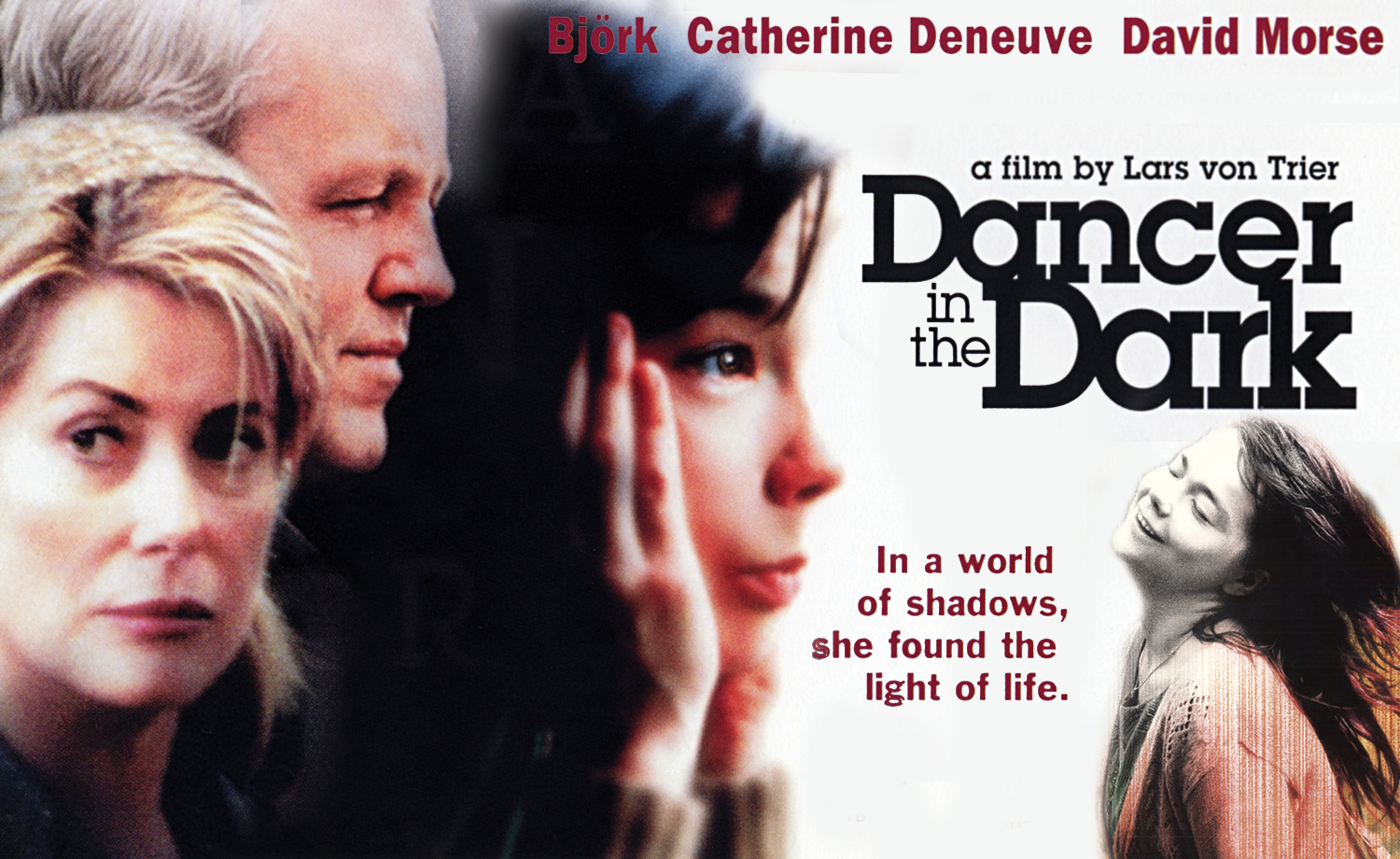
Dancer in the Dark" is a Danish film released in 2000. It was directed by Lars von Trier. The film became a topic of conversation because of its starring role by the world-renowned singer and composer Björk. The film's endlessly inescapable storyline, combined with its shocking ending, continues to reign as a representative of "depressing films with a bad aftertaste," even more than 10 years after its release. Bjork also wrote the music for the film, including "I've Seen It All," which was nominated for both a Golden Globe Award and an Academy Award, and received high acclaim.
In the Musicals
It is played during Selma's arrest and the courtroom scene. In each of these scenes, the viewer is frustrated by Selma's naivete as she repeats her fantastic fantasies in spite of the fact that she is in a desperate situation. The gap between fantasy and reality becomes more and more serious, and the situation is not improved by Selma's fantasies, and before you know it, the verdict is tilted toward the maximum punishment.
107 Steps
As she spent her days in prison, Selma seemed to realize that her time of death was getting closer by the day. Finally, on the day of her execution, a prison guard takes her by the hand and leads her to the gallows, but she is so terrified that she loses her footing. The kindness of the female prison guard tells her that "107 steps will take you to the gallows," and Selma quickly reaches the gallows, singing and dancing to this song in her imagination.
The song is appropriate for the tragic climax of the film, from which there is no escape. The viewer is struck with a sense of urgency and despair.
Second to last song
Music starts at 3:20
There seemed to be no help for the absurdity that assailed Selma until the very end. Cathy rushes to Selma, who is screaming in terror at the prospect of death with a rope tied around her neck. She tells him that the operation was a success. Selma realized at the last moment that her son was safe. This was the only relief that came to Selma at the end of her life. After regaining her composure, Selma sang this song, not fantasizing, for the first time. She was a musical actress as she sang it in front of the people watching her under the gallows. For the first time, her fantasy became reality. But it was too late. The musical ends with the prison guards, the onlookers, and even the audience, all of whom are left with a sense of regret as they watch Selma's sentence mercilessly expire mid-song.
Bjork, the lead actress and composer of the musical, was originally scheduled to participate only in the music. However, as she worked on the music, she decided that she should play the role of Selma. Although she is a singer and artist in her own right, her performance in the execution scene is truly ghoulish.
New World
This is the closing song of the film. The song "The Second Song from the End" can be considered to be based on this song. The song reaches the ears of the viewers who are at their wits' end after being forced to watch a terrible ending, but with the title "New World," it also sounds somewhat hopeful. This is a hope for the only salvation of his son Gene's successful surgery, and it is not an absolute bad ending.
Famous quotes, lines/scenes and scenes from Dancer in the Dark
Why did he have a child if he knew his son would go blind too?
The scene where Jeff comes to visit Selma after her arrest. Even after Selma is sentenced to death, Jeff still speaks warmly to her until the very end. A typical scene is when he asks her, "Why did you have a child if you knew your son would also go blind?" Why did you give birth to a child when you knew that your son would also go blind? Selma knew that by giving birth to her son, the eye disease would be passed on to him. In other words, when her son Gene was born, he, like his mother, was destined to go blind in the future. In response to this question, Selma said, "I wanted to hold the baby. I wanted to hold my baby in my hands. Jeff, either out of frustration or pity for Selma, whispered a final "I love you" to her. Jeff's own birth, and his own embracing of his irreplaceable treasure. This is the greatest joy a parent can have, and Selma wanted to fulfill this wish.
Kindness shown by female prison guard
Jeff and Kathy were not the only ones who showed mercy to Selma. Brenda, a female prison guard who appears toward the end of the story, is one such person. Despite her position as a prison guard, she always showed kindness to Selma, perhaps because she is also a woman and because of the tragic circumstances that Selma herself had suffered. She taught Selma, who loved musicals, that she could hear music through the vents, and encouraged her on the day of her execution, when her legs would slow to a crawl. Just before the execution, the inmates were blindfolded, as was the custom, but Selma was so frightened and frenzied that she begged them to take off the blindfold, saying, "She is blind. Thanks to her arrangement, Selma was freed from the blindfold, and when Kathy told her that the operation was a success, she regained her composure and Selma was able to meet her final days in relief for the first time. When Selma's sentence was carried out, Brenda was unable to look directly at her and could only bury her face in tears, but thanks to Brenda and others' efforts, Selma, who had been so unlucky until then, finally found some relief.
Although he appears only toward the end of the film, he is one of the few people who show understanding toward Selma despite his position as a prison guard, and is a character that leaves a strong impression on us.
Backstories, trivia, subplots/episodes, and anecdotes from "Dancer in the Dark".
A discussion of the last scene and another ending
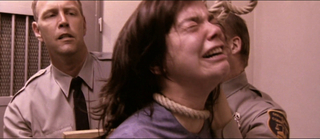
The only redeeming feature of the film, which is to all intents and purposes inescapable, is the success of the surgery on the son, Gene. However, it is questionable whether it was really a success or not. At the execution site, Cathy tells Selma that Gene's surgery was successful, but since Gene is not there, it is possible that Cathy lied in good faith to reassure her. This point is probably left to the viewer's imagination. The surgery may be seen as a success and Selma's final salvation, or it may be seen as a failure, or the surgery may not have taken place at all.
The climax of the film was actually different from what was originally planned. Director Lars von Trier had originally envisioned that just before the execution, Gene's surgical failure would be discovered and Selma would die in a frenzy, knocked to the edge of despair. This is the kind of climax that director Lars von Trier might have come up with, but Bjork apparently found it distasteful, and the film ends, at least on the surface, with the surgery being a success.
It is up to the viewer to decide which he or she wants.
The reality is horrifying in every way, and the songs are beautiful.
As mentioned above, this film caused a great deal of trauma to viewers when it was first released, and it received mixed reviews. Although it is categorized as a "musical film," it is by no means the fantastical musical that is generally imagined. The musical is merely the fantasy of the main character, and the further the musical progresses, the worse the situation becomes.
However, there is a sense of beauty in the inescapable content, and it is the presence of the songs in the play that attracts many viewers.
The magnificent and gloomy songs sampling the sounds of trains, machines, and radio noises were created by Bjork, an artist who continues to pursue innovative music, and it is inevitable that they were nominated for Golden Globe and Academy Award in the song category.
By listening to the music as well as to the story, one is struck by the contrast between Selma's absurd reality and her fantasy, and one is left in despair.
The songs from the film are included on the soundtrack, and although there are some differences from the film, such as the male singer of I've Seen It All being replaced by Thom Yorke of Radiohead, the viewer can still fully enjoy the world of the film.
Amazon Selma Songs - Music from Dancer in the Dark
www.amazon.co.jp

Related Articles
![Album] The Ultimate Human Beat Box! Bjork's "Medalla" - A New Look at the Appeal of Bjork's "Medalla](https://renote.net/files/blobs/proxy/eyJfcmFpbHMiOnsiZGF0YSI6ODcyNTE1OCwicHVyIjoiYmxvYl9pZCJ9fQ==--93738053380c127f316e2f43fb6599cfb812b175/800x_image.jpg)
Album] The Ultimate Human Beat Box! Bjork's "Medalla" - A New Look at the Appeal of Bjork's "Medalla
Bjork is a diva from Reykjavik, Iceland. Her unique worldview has captivated many top artists, who profess to have been influenced by Björk. Today, we take a look back at the charms of her 5th album "Medalla," released in 2004!
Read Article
The Green Mile (The Green Mile) Spoiler Commentary and Discussion Summary
The Green Mile" is a film directed by Frank Darabont, based on a fantasy novel by horror novelist Stephen King, and released in the United States in 1999. It is a moving masterpiece with a star-studded cast including Tom Hanks, and was nominated for four Academy Awards in 2000. The story takes place in 1935 in the death row of a prison, where the protagonist is Paul, the chief guard. It is a fantasy human drama about the interaction between John, a large black man with mysterious powers who is sent there to be executed, the other guards, the condemned prisoners, and Mr. Jingles, a rat.
Read Article

The Lost World/Jurassic Park (film) Spoilers and Discussion Summary
The Lost World of Jurassic Park" is a 1997 American film, a sequel to the 1993 film "Jurassic Park. Four years after the incident on Isla Nublar, the existence of dinosaurs was confirmed at a different site called Site B from that island. Hammond's nephew, Ludlow, the new president of the company, is planning to capture the dinosaurs at Site B and build a new "Jurassic Park" in San Diego. Malcolm and his team try to stop the plan, but the capture is successful and the dinosaurs are transported to San Diego, where tragedy strikes again.
Read Article
Truth (Film) Spoiler Commentary and Discussion Summary
Truth is a 2019 Japanese-French co-production human drama film directed by Hirokazu Kore-eda, winner of the Palme d'Or at the 2018 Cannes Film Festival. His best-known works include "Shoplifting Family" and "Nobody Knows". The film attracted international attention as it is the director's first international co-production film with Catherine Douwe, one of France's greatest actresses, in the lead role, and was shot entirely in France. The publication of "The Truth" reveals the truth behind the hearts of veteran actress Fabienne and her daughter Lumir, and the thoughts of the people around them.
Read Article
Fargo (film) Spoiler Summary and Discussion Summary
Fargo" is an American-British crime suspense film by Joel Coen. It is set in a snowy city, Minneapolis, Minnesota. Jerome "Jerry" Lundigard, a car salesman with a large debt, hatches a plan to ransom his wealthy father-in-law by kidnapping his wife under false pretenses. Jerry hires two hoodlums to kidnap his wife, but then unexpected events occur. The film depicts how Jerry's kidnapping plan takes a turn for the worse as one by one the victims are born. The film is full of unique characters.
Read Article
10 Bad-endings movies with a bad aftertaste [Dancer in the Dark and others].
There are films of all genres in the world, and some of them are so depressing that they send the viewer's mood into the depths of melancholy. Here, we have selected 10 movies that have bad endings or leave a bad aftertaste. Films rated simply as "boring" and horror films are excluded.
Read Article
Before and after images of Hollywood and international actresses
International actresses attract fans with their beauty and acting ability. But they all age equally. Here, we have alternately arranged images of them in their youth and in their old age. Please enjoy the charms of both their girlhood and veteran years!
Read Article
Bjork's music videos by Michelle Gondry 5 Bjork music videos created by Michel Gondry
The music videos of Bjork, a female singer from Reykjavik, Iceland, have a cult following along with her music. In particular, the films directed by filmmaker Michel Gondry are very popular and have received international acclaim. Today we present to you a selection of Bjork & Michel Gondry's music videos in the form of five!
Read Article
A compilation of filmmakers who are geniuses of bad taste, madness, and malice! Lars von Trier, etc.
Here we have compiled a list of filmmakers who make viewers feel the worst by putting bad taste, madness, and malice in their works. Michael Haneke, who created the chest-thumping masterpiece "Funny Games," and Lars von Trier, who has torn viewers' mentality to pieces with "Dancer in the Dark" and "Dogville," are among the directors featured.
Read Article
Contents
- Overview of "Dancer in the Dark
- Synopsis and story of "Dancer in the Dark"
- Working daily to save money for her son's surgery.
- Fired from the factory where he worked. And an accelerating absurdity.
- Surgery is assured. But an even more unbelievable reality awaits.
- The only salvation at the end. A fantasy musical becomes reality for the first time, but mercilessly executed.
- Characters and characters from Dancer in the Dark
- Selma (played by Bjork)
- Cathy (played by Catherine Deneuve)
- Bill (played by David Morse)
- Linda (played by Carla Seymour)
- Jeff (played by Peter Stormare)
- Aldrich Novi (played by Joel Grey)
- Brenda (played by Siobhan Fallon)
- Theme and insert songs for Dancer in the Dark
- Overture
- Cvalda
- I've Seen It All
- Scatterheart
- In the Musicals
- 107 Steps
- Second to last song
- New World
- Famous quotes, lines/scenes and scenes from Dancer in the Dark
- Why did he have a child if he knew his son would go blind too?
- Kindness shown by female prison guard
- Backstories, trivia, subplots/episodes, and anecdotes from "Dancer in the Dark".
- A discussion of the last scene and another ending
- The reality is horrifying in every way, and the songs are beautiful.