
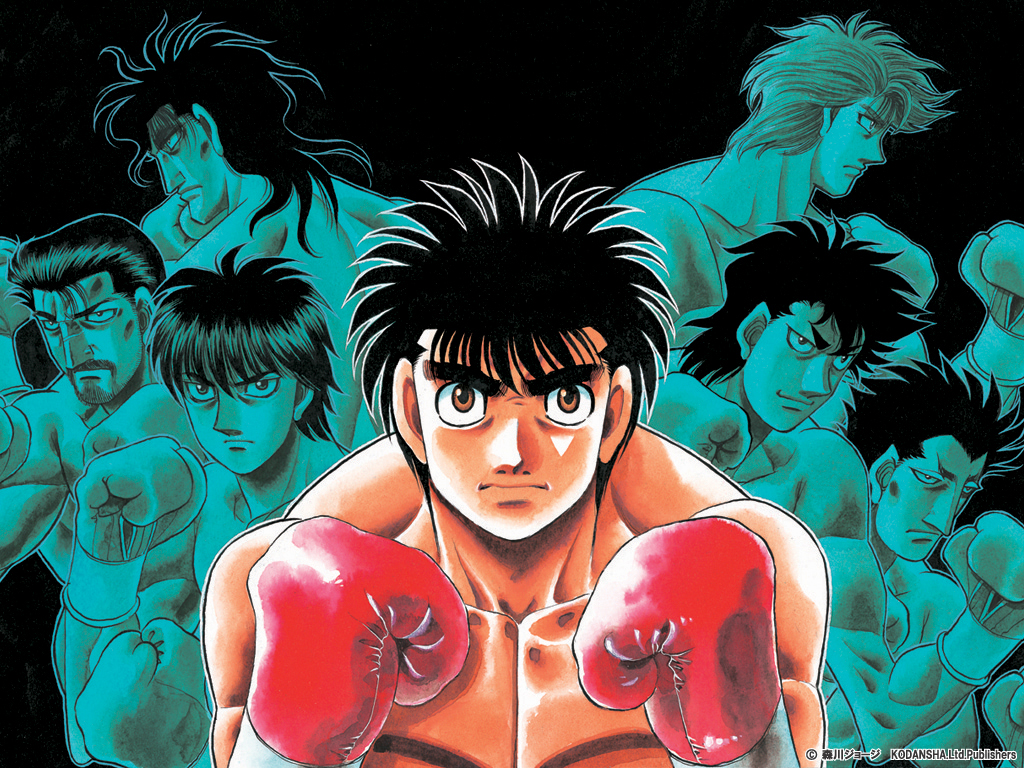
Hajime no Ippo" is a boxing-themed manga by George Morikawa, serialized in "Weekly Shonen Magazine" since 1989. Many of the characters in the manga are based on actual fighters. As the author says, "All the characters are main characters," the stories of supporting characters and rivals are also depicted in detail. The author himself is the owner of a boxing gym and is friends with many famous professional boxers, and has given interviews and supportive comments in the magazine and in the comics. The manga is a long-running series that has been published in over 120 comics volumes.
When I get out of this ring, I'm the champion!
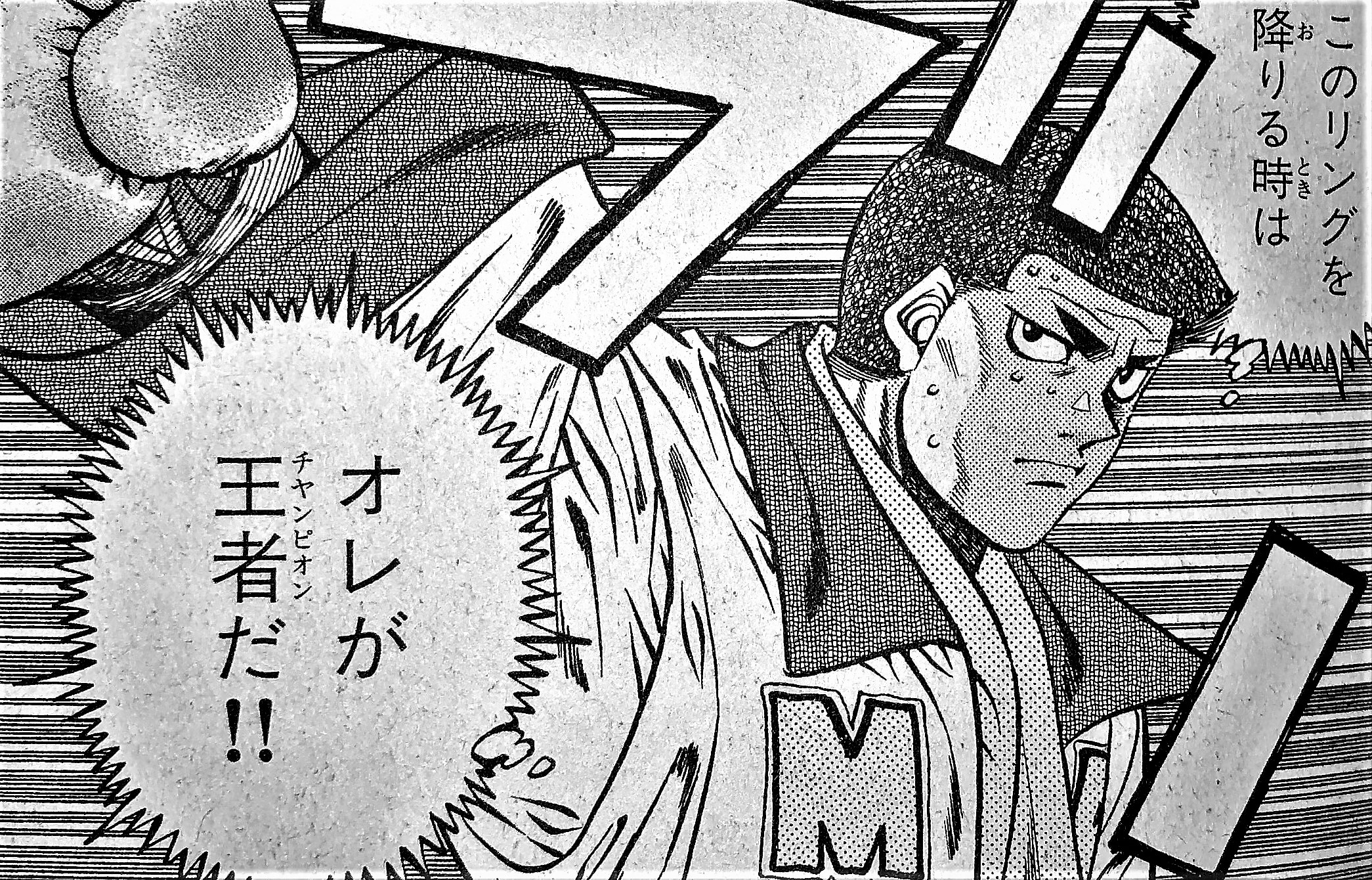
The spotlight is so bright, and the cheering is so different from usual! I've always wanted to be in the ring for a title match! Don't worry, Tomiko. I'm gonna do it.
Aoki, who was challenging for the lightweight title for the first time, entered the ring at the Champion Carnival. Aoki's "firm determination" overflowed in his famous line, "I'm going to fight for the lightweight title, and I'm going to fight for the lightweight title.
I'm going to take the big gamble! I wish, Tomiko! Give me the courage!
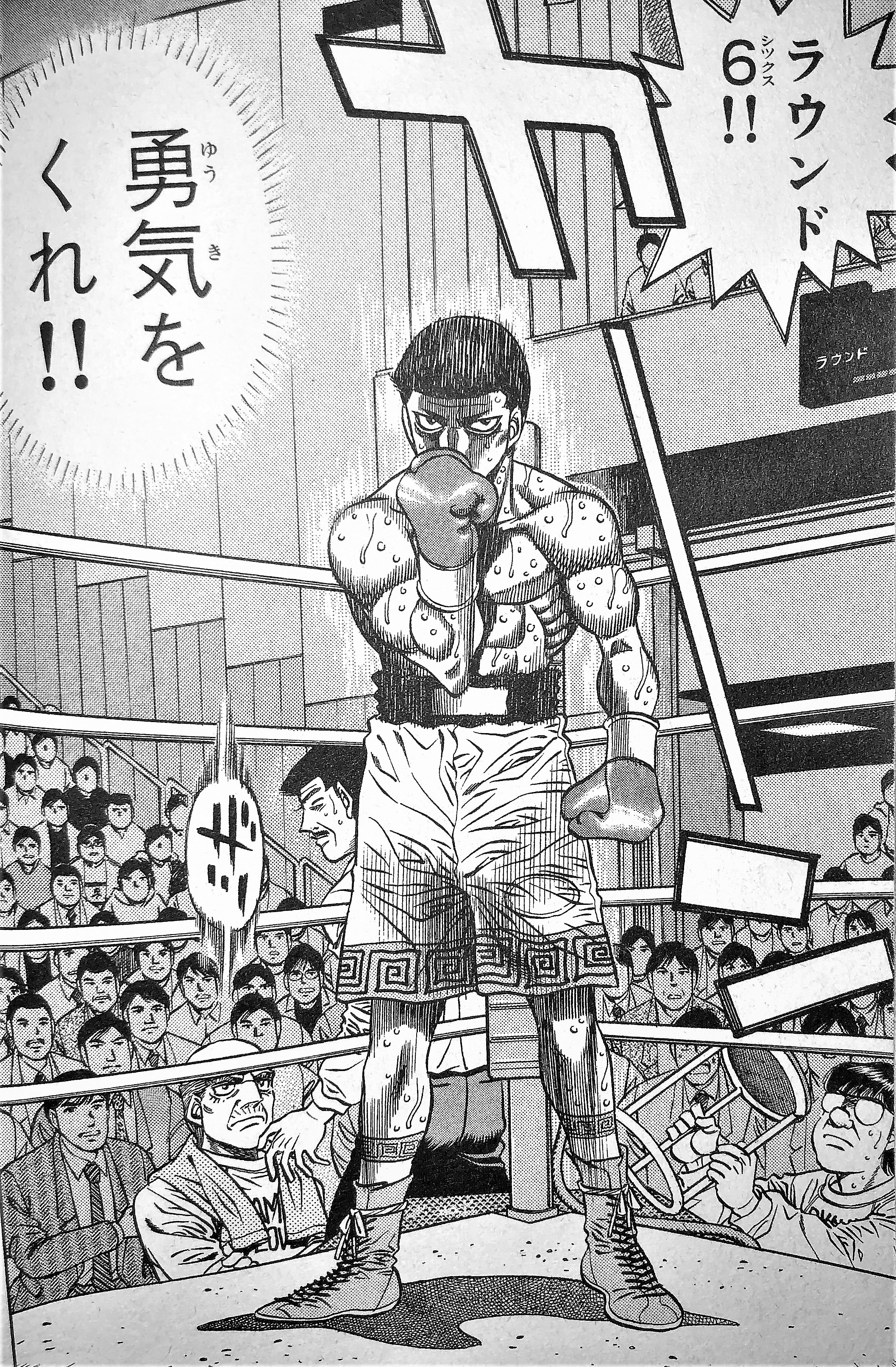
Aoki is taking on lightweight champion Imae in his first title match.
In the first round, Aoki tried to take control, but Imae showed no openings. Aoki throws his signature "frog punch," but it is avoided. Aoki then tried to play around with Aoki's typical moves, but was unable to control the pace. Aoki threw his second "frog punch" but was countered and taken down.
Aoki then switched to a strategy of "playing dead" until the fifth round to take away Imae's stamina and disrupt the pace of the fight.
Aoki, despite the point deduction, waited patiently for Imae to tire out by "playing dead.
In the sixth round, Aoki decides to use his "new weapon" and heads into the decisive round.
The belt is right in front of you!
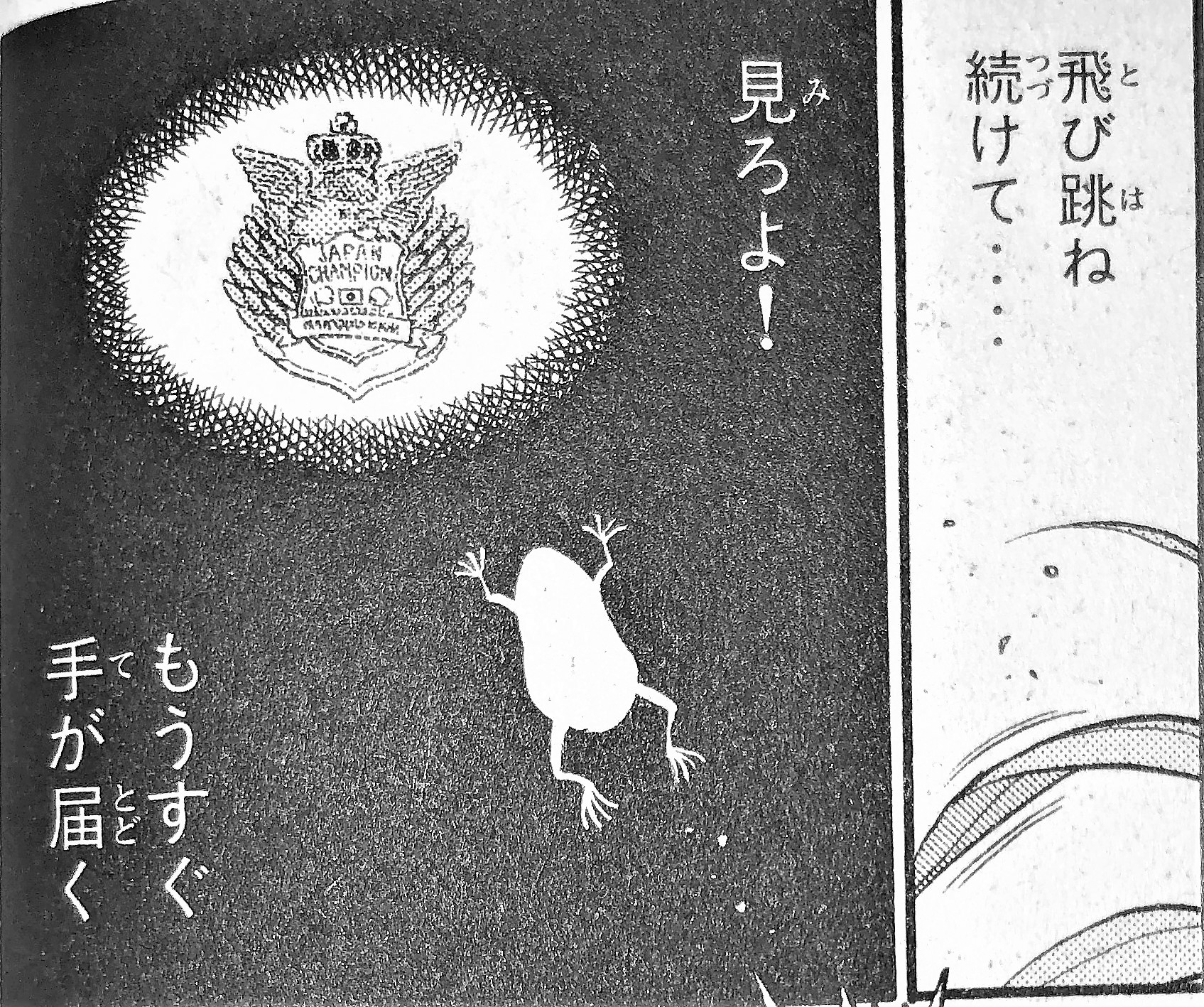
The culmination of six years of survival wisdom is this "new weapon"! You can't fly like a bird... but you struggle and you struggle and you keep hopping and you keep hopping... and look, it's almost here."
Aoki's first title match.
After being knocked down by a "frog punch," Aoki tried to take control from Imae by "pretending to be dead," a strategy that deprived Imae of his stamina. In exchange for a point deduction, Aoki continued to force Imae to throw punches until the fifth round.
In the sixth round, determined to use his new weapon, Aoki used his new weapon: "looking away"!
Imae was successfully caught by the "looking away" technique. A second "Isozomi" explodes, but by accident Imae's gloves get caught in the way and the damage is mitigated.
Don't say thank you... you should've just knocked me out... and I could've given up.
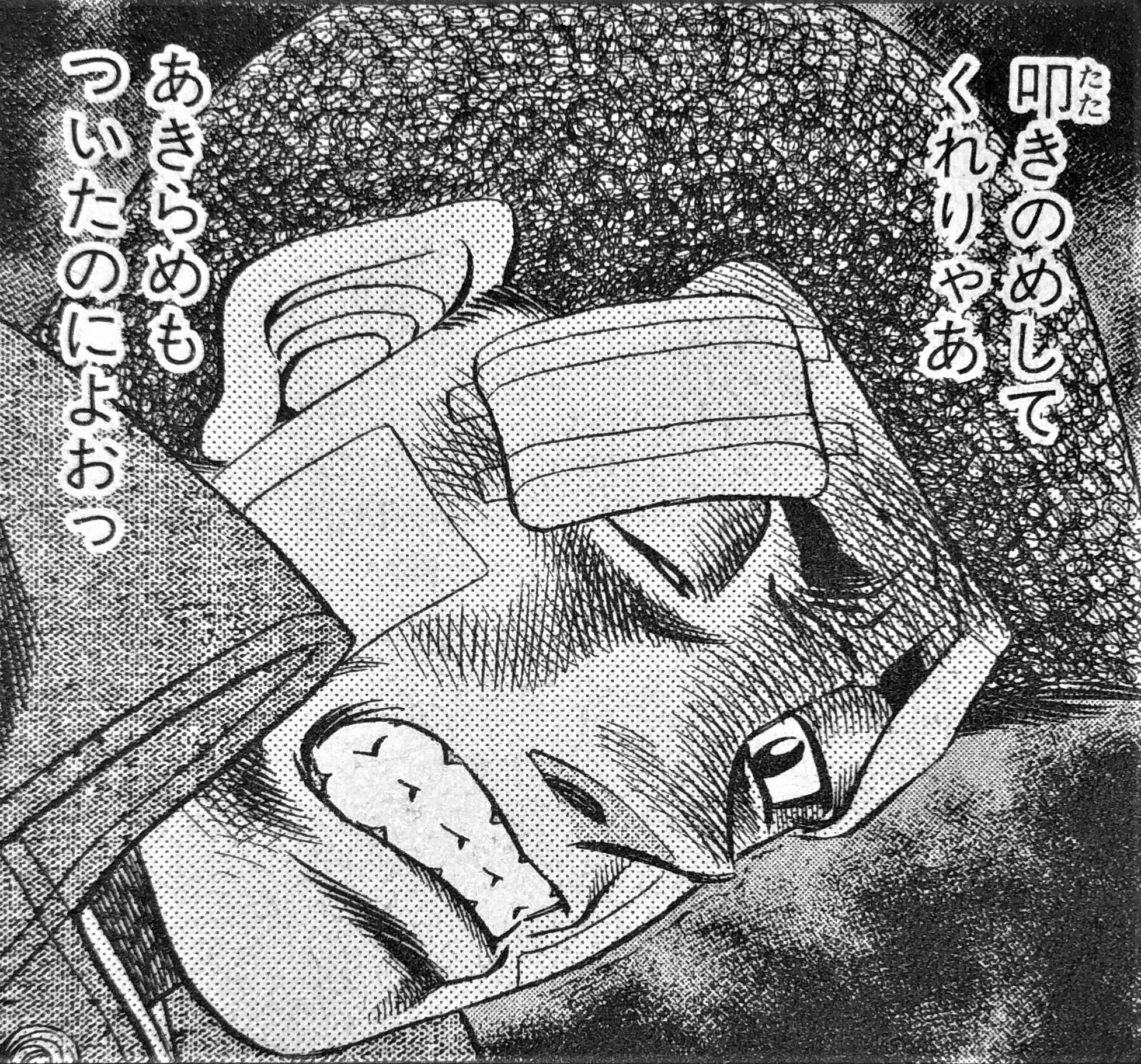
Aoki unveiled his new weapon, the "Yonomi," in his first lightweight title match, but the bout dragged on until the final round.
With both fighters running out of stamina and the sound of uninspiring blows echoing, the decision was left to the judges. The result was a draw, and the champion, Imae, defended his title.
As Aoki left the venue, he saw Imae coming out of the venue as well, and beside her was the "Goddess of Victory.
Aoki saw her and thought, "I'm convinced of your effort from the middle of the tournament. Imae found Aoki and said, "Thank you very much! and bowed with Sachiko, the "Goddess of Victory.
As Takamura said to Aoki, "It was not a black-and-white match," so he did not really feel that the match was over.
It's because you put everything you've got into a single moment that it shines so artistically.
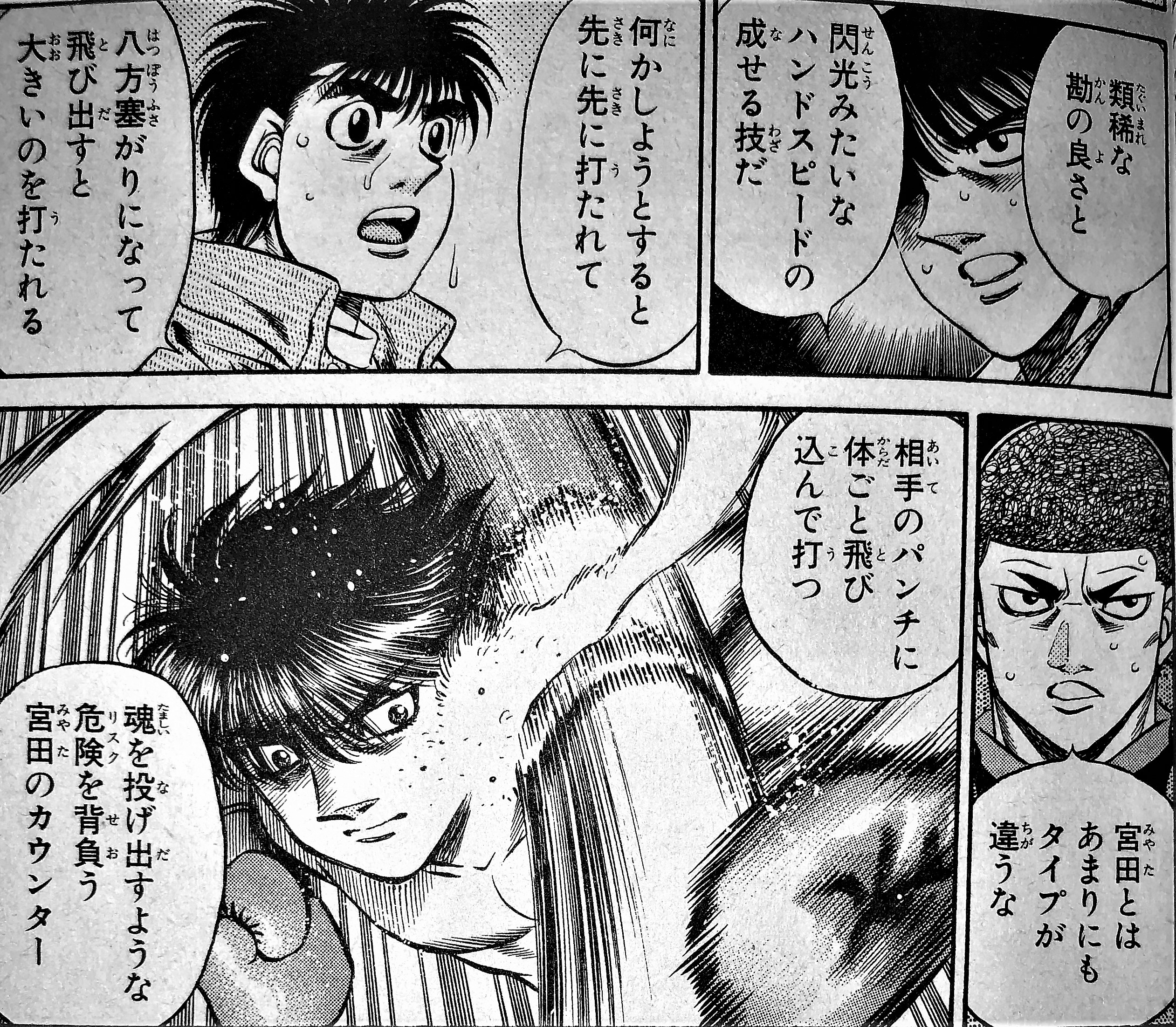
The opponent for Kazuho's fifth featherweight title defense was chosen by Kazuho himself, Ryuhei Sawamura, the "Owari no Ryu" (Ryu of Owari).
His gym mates were called to Takamura's room to watch the video. Sawamura had more countering ability than Miyata, but he was also a problematic boxer who sometimes "played" during fights.
The Kazuho and the others also compare Sawamura to Miyata, who they are familiar with as a counter, but Aoki's comment about Miyata, while describing Sawamura as "black as dirt," becomes a famous line.
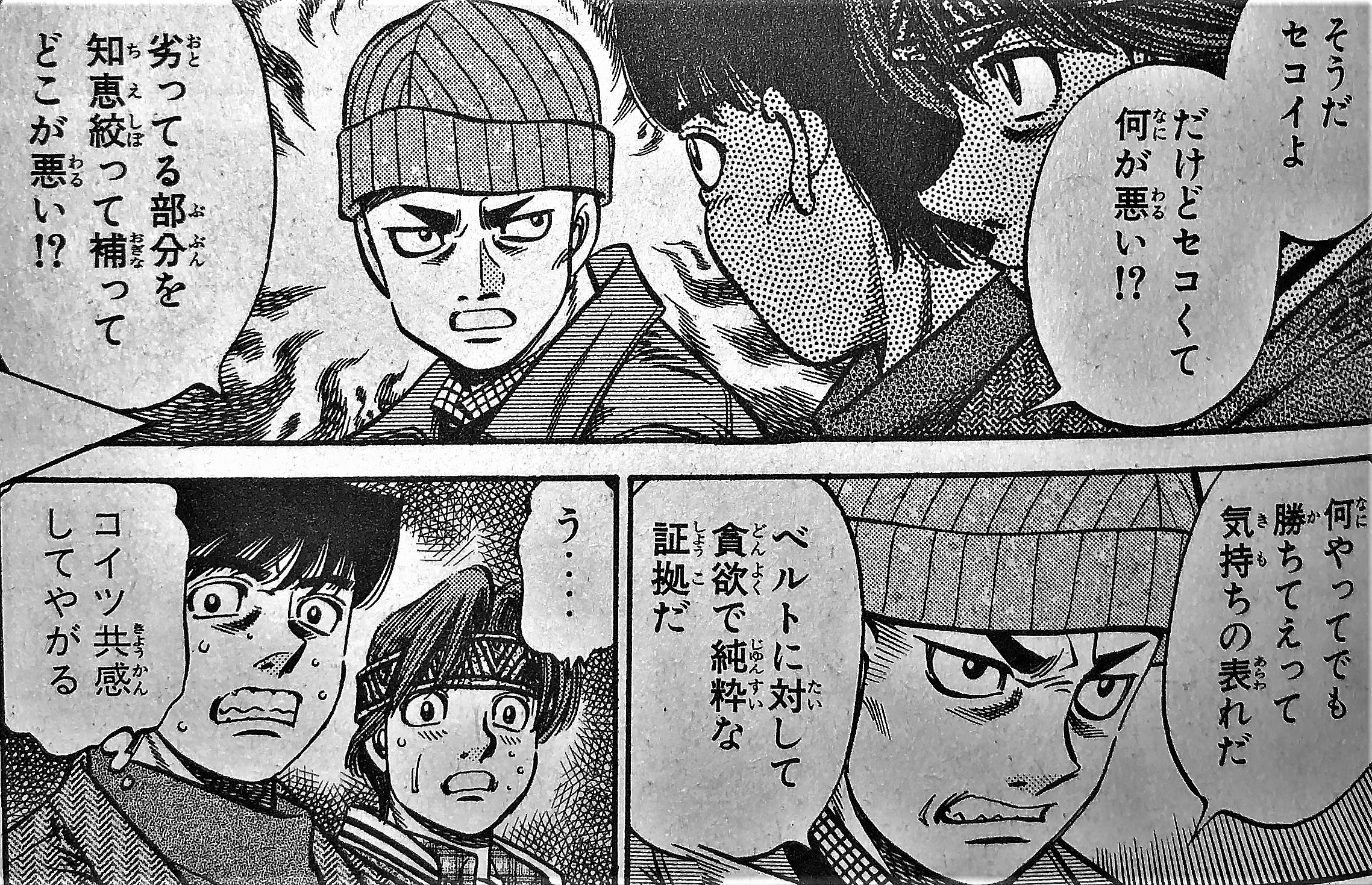
What's wrong with using your wits to compensate for what you lack?
After watching Itagaki's East Japan Rookie of the Year final, Ippo remembers the promise he once made to Miyata. He asked Chairman Kamogawa to let him give up the belt, and Kamogawa agreed. Later, Miyata and Ippo reach an agreement, and a match between Ippo and Miyata is arranged.
The two fighters' schedules were adjusted so that they would have one fight between each other, and Kazuho was able to defend his featherweight belt for the seventh time. After going to see the All Japan Rookie of the Year competition, Kazuho and Itagaki visit Date, who is the president of the gym. There, Date tells Kazuho about Takeiichi, who will be his opponent for his last defense.
Itagaki reflected on the fact that he had been distracted by the match with Miyata and shadowed Miyata, and he changed his mind and started practicing hard.
On the day of the match, Takeshi, a veteran fighter, makes the most of his "experience" to beat Kazuho.
Itagaki sees this and calls him "Sekoi," to which Aoki responds with a famous line.
I'm gritting my teeth--I'm gathering all the courage I can!
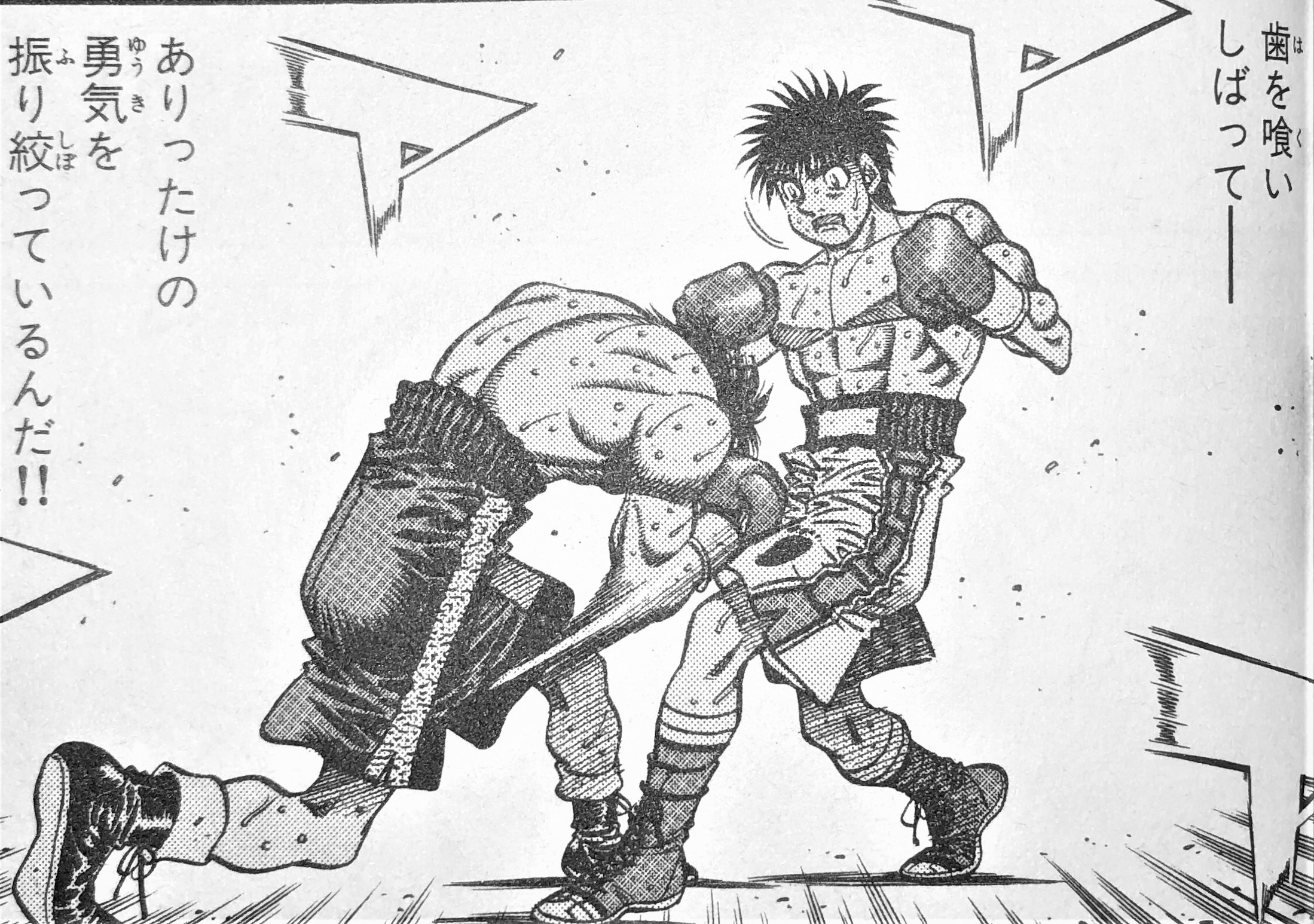
Aoki says, "I know it's not wisdom that's coming down on me," and the words that follow become a famous line.
Kazuho's last defense was against Keiichi Take. Itagaki, a veteran fighter, is using his "experience" to challenge Ippo.
When Itagaki called him a "sekoi," Aoki replied, "What's wrong with making up for it with your wits? In the meantime, Takeshi succeeds in killing Ippo's destructive power.
Even Chairman Kamogawa did not notice it immediately, but by "blocking Ippo's rotation," he killed one of Ippo's strong points, his destructive power. The only way to get into Kazuhiro's pocket and avoid his destructive punching power was to get into his pocket and avoid his destructive punching power.
Aoki said, "Can you do it? Can you do that thing? Do you have the confidence to fight? Kimura and Itagaki were speechless.
We're still trying, even though we're still bitter. We don't want to run away, because it's the path we chose.
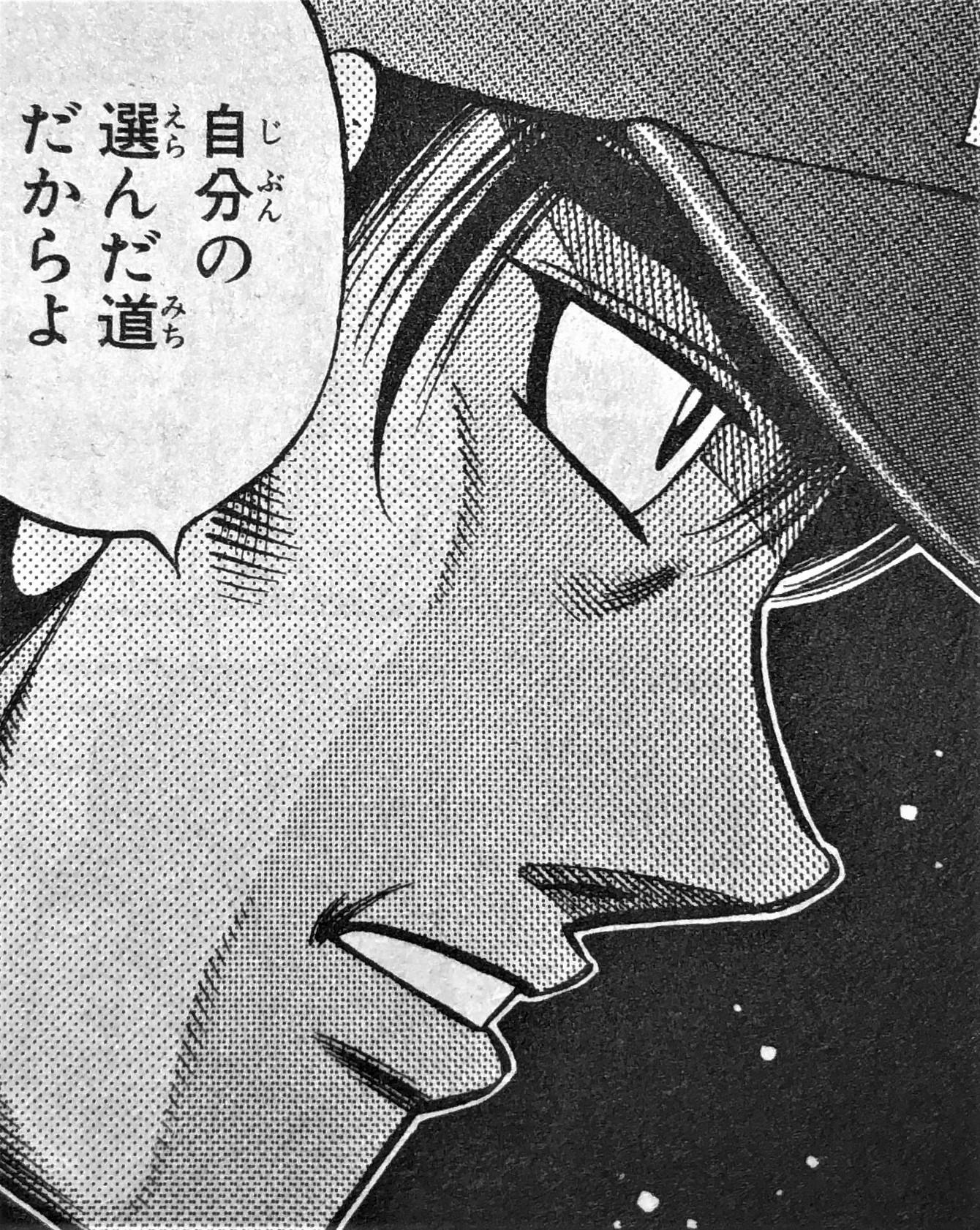
There is a grass baseball game in the shopping arcade, but there are three players missing. So, Kazuho, Takamura, and Itagaki are called in. Kimura and Kazuho are in a bad mood and it is a chance for them to make up, but their opponents have five players with Koshien experience.
Itagaki was doubtful, "Did they win in a brawl?" Kimura says, "If it weren't for Aoki, I would have been the ace in boys' baseball. Aoki says, "If it weren't for Kimura, I would be number four. Aokimura was amazing!
After the first inning, the two were shunned, but Kimura asked, "Do you still hold a grudge against me for throwing away the Koshien dirt?" Kimura replies, "That's not all. Why did you abandon baseball?
Kimura explains how he quit baseball and became a delinquent, saying, "Because I could get what I wanted. Kimura then asks, "Didn't you try out for the pros?" Kimura asks.
He replies, "The dream of becoming a professional baseball player is not so easy, and it's not a world where you can do whatever you want.

Related Articles
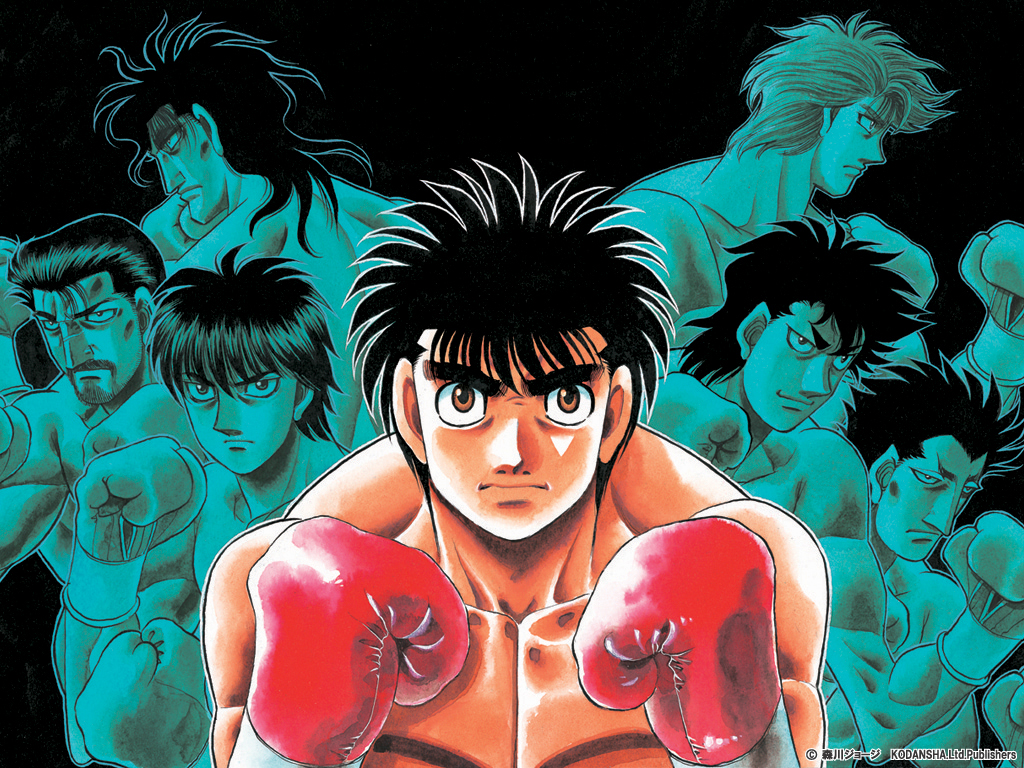
Spoiler commentary and discussion of Hajime no Ippo (manga and anime)
Hajime no Ippo" is a manga and anime work serialized in Weekly Shonen Magazine by George Morikawa since 1989. The story is about a bullied child, Ippo Makunouchi, who encounters boxing, trains hard to find the answer to the question, "What does it mean to be strong? The story depicts how Ippo Makunouchi, who was bullied by his peers, grows up through rigorous training and battles with rivals in search of the answer to the question, "What does it mean to be strong?
Read Article
Summary of the magazine's past heroines
Shonen Magazine" is one of the longest running weekly shonen manga magazines in Japan. Over its long history, the magazine has produced numerous masterpieces and supported Japanese manga culture. Because of the "shōnen manga" (boys' manga) concept, most of the main characters are boys, but the heroines who support them are also an integral part of the story, and are depicted in an attractive manner. The heroines are childhood friends, students, outsiders, and people from other worlds, and their relationships range from lovers to friends to rivals. Here we introduce some of the heroines who have graced the pages of the magazine.
Read Article
Best 100 most powerful ranking of The First Steps, a manga to read in one sitting during the year-end and New Year holidays!
The boxing manga "Hajime no Ippo" features many strong characters, including the main character, Makunouchi Ippo, as well as Mamoru Takamura and Brian Hawk. Here is a ranking of the strength of the characters in "Hajime no Ippo. The ranks are not taken into account.
Read Article
Tags
Contents
- Overview of "The First Steps
- Famous quotes and lines by Ippo Makunouchi
- What does strong look like...
- I'm going to be born again--!
- No matter how many beatings I get, I can always get back up to do my best.
- I could have done it if I tried hard enough!
- I want to go head-to-head with them.
- It's a waste of time and I can't sleep!
- I still have one more thing to do.
- I will never move out of the featherweight division!
- I want to be a professional boxer because I love boxing!
- I've never been in an atmosphere like this... with friends, having fun.
- This is the one thing I can never do halfway...
- I'm not going to let it end like this!
- What would happen if...I fight this guy!
- He's clumsy, so he has to be stubborn, even if it's not cool.
- All alone... and only alone...
- That boat is the one my dad left me, isn't it?
- Good luck. Good luck.
- He said there is no escape if you are in a cage, you have to step forward!
- You're amazing... You know everything...
- I'm a challenger.
- It's a match against the strongest man in Japan!
- --I wanted to win...
- The determination to compete--! That's where the big difference was.
- It's... it's those determined eyes.
- I'll beat you in the next R!
- Let's do it! Mr. Sendo!
- We are not the ones who can win by being on the run!
- I hope you feel good about your birthday!
- It's not like we're fighting over a belt or anything.
- I've been practicing to win.
- Now I finally realized that I am facing that Mr. Sendo!
- You're getting results! Have confidence!
- I trained hard after losing to Mr. Date. I'm not the same as I was then! I'm not the same!
- You'll get the answer you've been chasing all along!
- We're going to try until the very end!
- Please make me move!
- How far I can go now - seriously!
- I didn't teach him how to win the belt!
- I'll give it my all! That's my answer!
- There are things you don't know yet!
- --You don't know how to lose yet!
- We should be much stronger than we are today.
- I've always loved you, Kumi!
- I'll give myself a pat on the back tonight.
- It's your fault!
- Absolutely! Please be the world champion!
- He definitely lives up to expectations!
- What are we chasing?
- I don't know... no answer...
- Let me fight, please!
- I don't want to admit that guy!
- I won't back down -- I won't!
- Thanks to all of you for your strength! I will do my best!
- I wanted to be strong.
- You told me not to give up and to come back alive, didn't you!
- You kept your promise, Dad... and now you're back.
- If you don't get there, there's no point--!
- He said we're best friends!
- You already look like a fine... fine... professional!
- It's how much you believe in yourself!
- Miyata-kun is waiting for me!
- Let's meet in the ring this time!
- Passing the baton.
- I will do my best too!
- We're going to go forward and we're going to strike, that's it!
- The promised match with Miyata-kun!
- Let's remember, this is the time...
- To take over this store that my father built and my mother kept.
- Only Chairman Kamogawa can aim for the world!
- For me, it was the heaviest thing ever!
- I know...I'm excited!
- I'll get it done right away.
- I betrayed my practice.
- We'll be together forever!
- I'm almost ready to show the world that the boxing I've been doing with the Chairman is world-class!
- I don't want to lose anymore...!
- This will be my last attempt. If I lose again, then I will retire gracefully.
- Start over from scratch! Start over!
- We are being taught by the same master!
- I knew that there was another me!
- We wanted to face each other head-on in the ring!
- I feel like I'm boxing.
- I'm going to beat them in the next R!
- It's a new model given to me by the chairman!
- It's over...
- I'm home!
- Thank you so much!
- Famous quotes and lines by Mamoru Takamura
- I don't like it when people say they're going pro because it's a simple idea.
- The professional ring ain't so sweet!
- I didn't have the strength to make a fist, but now the world recognizes my fist...
- I'll show you what a professional fight is all about!
- I have only one ultimate goal - to become a world champion!
- I owe you a small favor.
- Attack the weak points to win! It's the ironclad rule of victory!
- Strong one step!
- In the ring, there are winners and losers, light and shadow.
- It's only polite to stand up to the strongest challenger as the strongest champion.
- He's a champion, and he's the head of the gym, and he knows it.
- I'll show you the power of the king!
- I have to remain a target!
- A champion's fist is special, not the same!
- All their thoughts are stuck in my fist.
- I'm not going to die!
- It's become a familiar line.
- I'm feeling a little toothless.
- It makes sense for you to go.
- I just see a sad face.
- Evidence of an intense time.
- We are the stars above it! We're the stars above it, and we're going to keep shining!
- I'm sorry your life expectancy has been shortened!
- I'm going to win the world my way.
- I am - Mamoru Takamura-sama!
- If you don't have a belt, you have no use for it.
- There's only one place for me.
- To protect the place where we live -- we fight!
- Proof of the best!
- I'll take your sweat with me to the world!
- I don't want to lie... not to boxing.
- I'll be the first to deliver you the World Champion belt!
- You don't have to be patient anymore! In the ring!
- Let it happen!
- You think I'm going to break my word?
- I'm glad I did it, boxing--!
- Let's get out of here!
- The Chairman's (Grandpa) boxing is world class!
- For what--! For this!
- Before I could think about what to do, my body moved. It's a punch I've repeated thousands of times, tens of thousands of times!
- He said the chairman's (grandpa) boxing is world-class!
- From here on out, it's a fight, you idiot!
- It's finally empty. I'm empty...
- The thing that's holding me up!
- --Even if my heart stops beating, I will fight with my soul. Even if my soul disappears, I will rise from the coffin and defeat you!
- Anta... the best seconds, man!
- Go home a king!
- That delicious moment... I can't wait to taste it again.
- This isn't the bottom of the ocean, it's inside the ring!
- The game's not over yet. It's too early to run.
- Your obsession with winning can make the difference between winning and losing.
- --For example, let's say there is a "road"...
- I won't take a single punch! I'll take a one-sided punch and that's it!
- If you're going to whine about how painful or hard it is, just retire at that point.
- I will reforge Kisama's namakura sword!
- The world is not so sweet that you can survive by taking a chance.
- If it's something interesting, I want to see it with my own eyes as soon as possible.
- --I'm just like you! He looks just like you!
- We're fighting for the belt. We're fighting for our lives.
- I want to settle this with my fists.
- All you have to do is hit it at the chairman's (grandpa's) mitt!
- The little guy can always hit and smash!
- I ain't show you, I ain't tell you!
- I guess that means you're getting closer to your girlfriend.
- You want to see it! You want to see the king!
- The courage to go forward without the slightest doubt, believing that there is hope, the trust to go forward knowing that it will always open up--
- In the end, it's all about him, the path he chose!
- You're gonna have to take it all on your shoulders and get in the ring. Remember, you're not the only one who's lost.
- For the first time in my life... I went to a fight!
- They've taken control of the space.
- If you go off the road a little bit, it's just violence.
- We just have to do it...win the sixth weight class!
- If you're going to stand up again, a man's got to have an excuse.
- From there on, it's a place where only non-humans dwell, so don't come in as a human.
- But it's a strange thing, it makes you feel like you can do anything!
- If you can be a little stronger with a goal, that's not a bad thing.
- Don't expect me to be one step ahead of you.
- --Can you carry all that on your back?
- One step-- you're broken, man.
- This is where I wanted to be. Don't call it loneliness. Call it isolation.
- To do or not to do, that's all!
- I won't betray you.
- All you have to do is look at me.
- Famous quotes and lines by Genji Kamogawa
- You can't just twist technique by force!
- It is the cutman's job to stop the blood, but it is the boxer's job not to let the wound hit and spread further!
- You've got nothing left but an upset KO, but you've got to open the door.
- Each of the people who put you back in the ring have a punch that they're satisfied with-- just one!
- It's not the first time I've lost, but that doesn't mean I'm going to forget how pathetic it feels, and it doesn't mean I'm going to get used to the frustration.
- Laugh if you laugh! It will always show you how great it is!
- I meant a hundred things by that one word!
- It's a weapon called courage!
- The answer is in the height of your eyes!
- Hitting before being hit!
- What is the soul of a fist (punch)! Destructive power! No, it's the "killing power"!
- That is the only weapon that can overcome fear! And Ippo Makunouchi, the strongest weapon of all! Courage!
- You... did your best.
- Maybe he chose a harder path than getting any belt.
- Come back here! Come back to me!
- In many ways... it will be a battle of content!
- As the champion, face them head on! And then, use your "power" to defeat them!
- Do the job you're given, meet the client's demands, and one more thing: be competitive!
- Hammer Nao is slick. And the kid is sweet!
- There are no words in this world that a winner can say to a loser.
- Kisama is my treasure...
- You have been taunting my boxers for a long time!
- Not all who work hard are rewarded! All successful people work hard!
- It's the instructor's fault! It's my fault that there are things I'm not teaching!
- I... I taught you to the left!
- We must know that Kisama's "power" can be used worldwide!
- I love the way you fight! I still want to watch. I won't stop with my own hands!
- ...brilliant!
- Slowly but surely, the recovery process is picking up steam.
- Nothing's changed. I didn't ask you anything. I don't know anything.
- I can't overlook my best friend who is about to jump into a deadly situation!
- There are still fists in Japan to beat you! My fist is still there!
- I will clear your regret!
- One blow! You've got to make a one-hit-kill fist!
- Stay by my side the whole time... and take care of Nekota.
- I heard it, Nekota! I've never felt such pain from a fist!
- It's a life-threatening order. If I don't comply, I'm not a man!
- I don't think I can do it, because I don't think I've ever won anything on my own.
- I take it you've been made the president of a gym with a world champion, not the president of a gym that trained a world champion.
- The positions were reversed... and the gap widened! Incredibly large!
- I'm going to slap the gauntlet down on modern boxing!
- We must become like the racehorses that have thickened that ground for generations, pure-blooded infighters!
- And the blow that came out of it was... the ultimate punch for the little boy!
- You're a challenger!
- Know that steady effort is the greatest shortcut!
- Fists hot! Head is cool! The basics.
- So much determination and sense of responsibility you had going into this match!
- I bet on it!
- Let this towel be the thing that wipes the sweat off your kisama's victory!
- If there is no partner in Japan, there is no other choice but to go above and beyond.
- I wonder how much more of this old man's black eyes I'll be able to enjoy.
- The tip of his foot is an unknown territory that the Japanese (us) no longer know.
- It could expose our only weakness!
- I can't wait that long. I'm getting old.
- --The most filial son in the world!
- If you're not careful, you're the one who gets eaten.
- Realization of a fantastic match...?
- It's a path he carved out with his courage! Itagaki is determined to go that way!
- If you can't do this, you can't win!
- Look up and look ahead! Look up!
- It's steep, but climb it. Aim for the far-off, hazy summit! Aim for the world!
- I don't need anything in my coffin, I already have enough souvenirs from the underworld, more than I can hold...
- Don't think I'm blind!
- I'm on it!
- I know the magic punch!
- This match isn't over yet. I'm going to give you the light.
- Now that you've grown up, I feel that I can go up with you!
- It is the daily accumulation that makes you stronger, and vice versa!
- Tonight's boy is a challenger to the bone!
- Go beat it!
- I want you to go forward with your boxing!
- Its fist is to open up a crisis (pinch)! Its feet are for going straight ahead!
- Don't make it the player's loss! Make it our seconds' loss!
- Let's go, to the world!
- If you win, it's the world!
- Go ahead and strike a blow that will reach the world!
- What are you doing, you idiot! Is that what you are?
- The day when a path will open up is near.
- Bloom the flowers, bear the fruit, and -- harvest!
- I'll be reduced to ashes in a coffin with a small fist in my hand.
- The old should not be dragging the young down!
- It's as if you are sharing your soul with this old man.
- It's over.
- Are you glad you boxed?
- The last boxer I worked on, kid... gave me nightmares.
- Famous quotes and lines by Masaru Aoki & Tatsuya Kimura
- Those who put in the effort while others are playing get the last laugh.
- Play when you play! Practice is practice! Let's be professional and get it over with!
- I have something to protect!
- Until then, I'll play dozens and dozens and hundreds of times.
- I've never seen anything like this before, and it's not a rattle, but it's kind of... exciting, isn't it?
- We can't stop now, can we? We're addicted to the hard stuff. We can't stop now, can we?
- You hit us hard. You hit us hard.
- I won't stop boxing until then!
- From tomorrow on, I'm going to be out in front of the crowd.
- I don't care if it's crude or not, don't touch it, or I'll kill you.
- I really hope you're a champion.
- If I lose, I "retire."
- I can't see him! My eyes have been glued to his waist for a while now!
- After all, we've been trying for five years!
- I can't lose because I have willpower, right?
- Will I be dragged down for the rest of my life for the sake of a mere three centimeters?
- Maybe I'm unknowingly taking Mr. Date's place before he knows it.
- My encounter with Mr. Takamura--it was an encounter with boxing!
- Takamura-san... is our idol!
- Always going up and down... You have no idea what it's like to be on the edge like that, do you, Aoki?
- I'll make you proud!
- When the sun goes down and night falls my destiny rings!
- You... you let go of the Goddess of Victory! Today I will show you the strength of a man who is being watched over.
- When I get out of this ring, I'm the champion!
- I'm going to take the big gamble! I wish, Tomiko! Give me the courage!
- The belt is right in front of you!
- Don't say thank you... you should've just knocked me out... and I could've given up.
- It's because you put everything you've got into a single moment that it shines so artistically.
- What's wrong with using your wits to compensate for what you lack?
- I'm gritting my teeth--I'm gathering all the courage I can!
- We're still trying, even though we're still bitter. We don't want to run away, because it's the path we chose.
- I had a lot of fun. I'm glad I chose this path. I'm glad I chose Kamogawa Gym.
- For Ippo, Ichiro Miyata may be both his starting point and his end point...
- I know, right? That's the kind of game we're talking about.
- I'm not a loser!
- From here on out, it's all hands on deck for the Kamogawa clan!
- Small things, little by little! The important thing is to accumulate!
- What's left if those with no talent give up?
- The efforts of those who are born with it are limited only by how they make the most of it.
- We can't lose this fight! I won't let you stop, Kimura!
- --I'll go all the way with you... because we have a history... and I'll be there for you... until the end.
- You mustn't get in the way of people who are looking straight ahead.
- Manabu Itagaki Quotes and Famous Lines
- It's a good opportunity... to get serious... right?
- I'm here. I'll stop you this time!
- I'll never lose sight of that back! --I will never lose sight of your back!
- I have to take responsibility, don't I?
- Straight up--a weed with its roots firmly planted and growing straight up toward the sun!
- Because I want to be more and more powerful--!
- If only I had more power... my fists look so small...
- Courage and determination!
- The more you pinch me... did I mention I had a hand in it...
- In front of that person... I can't just show him that I'm going to throw away the match in the middle of the game!
- What I have seen since joining Kamogawa Gym is what a real professional looks like!
- You're looking at the wrong thing! I've seen different things!
- If you can defeat them, show them how you can knock down this pride!
- This is... my secret challenge!
- I haven't forgotten what you entrusted me with that day and that time!
- Ichiro Miyata Quotes and Sayings
- If you come with power, I'll take you head on. I'll beat you from the first round!
- I just love that last minute tension.
- Let's get this settled in a professional ring!
- I'm going to hit him with every shotgun I can get my hands on! ...with a counter.
- The East Japan Rookie of the Year final is the place for you and me to settle our scores!
- I have to go... he's waiting for me.
- I'm sorry."
- The East Japan Rookie of the Year... you've come a long way in a short time... until that gap... is filled!
- I'm not going to run away! I am a challenger...!
- If he admits that he betrayed me, I won't be able to fight anymore...
- The counter over the counter!
- There are funny moments that only a boxer can experience...
- Remember, the trick to countering is timing and heart!
- Or else... we'll miss all the fun.
- If it's a piece of shit, I'm gonna give it back to you right away, and you're gonna leave me your belt.
- We've come a long way, but let's go bury it for now!
- I'll prove to you that I can be a leader not only in the Orient, but also in the world!
- You've been restless right from the start, Champion.
- I feel like my pride has been uprooted. I can't lose like this!
- This time, I'm going to make it happen. I'm going to fulfill the promise I made to my father, the promise I couldn't fulfill...!
- The power of one shot left in the back of my body! I haven't hit yet!
- Now you can fight with your chest out! Come anytime, MAKUNOUCHI Ippo!
- It's a big world out there.
- You don't like the Oriental title? You say there is still a gap between you and us!
- --Yes! What I really wanted to see was you like this!
- I'd be thrilled.
- How far will he go? - What is he fighting for?
- I wish I could show you that I'm not stuck in the same place.
- The only thing I can think about is winning!
- From now on -- no matter who you are dealing with!
- Somewhere... you must be watching me... waiting for me... right?
- Guess it wasn't meant to be.
- The only thing left to do is slash and drop--only!
- I'm willing to accept this fate!
- We came this far in a straight line, didn't we?
- I'll never forget it!
- It's the path I've chosen for myself!
- I appreciate that, Dad but it's a fight between kids from here on out, not a parent's place!
- Don't think you're the only one ... who's delusional.
- Famous quotes and sayings by Takeshi Sendo
- I love those moments.
- I'll be waiting for you in Osaka!
- What can I do...!
- Wait for me. I'm almost there...
- Rocky... you still call me that? I've had that fight...
- We have to repay our debt to Makunouchi directly or we will never get out of this mess!
- We're going head-to-head! We can't betray this support twice!
- All I did was practice to beat MAKUNOUCHI Ippo!
- You and I will never see each other in the ring again, so I'll just say it now... this is how it is!
- It's been a year and nine months since the All-Japan Rookie of the Year (that one) -- the moment will finally come. I'll let you win!
- All that's left is for me to go prove that I'm the best in Japan!
- This is... the best fist in Japan!
- The answer is right in front of you! If we defeat this man, we will have the answer!
- The face of the man who beat me!
- See you again, Makunouchi! See you in the ring... always!
- I'll have to start all over again, but I'll make it! I promise!
- I was born with the gift of beating people up!
- You're making me hot!
- That thing--Katsunin no Kenshi!
- I'm going to eat a lot of fresh steaks with you...
- I won't stop until I get to the top!
- Don't ever forget... that's how professional boxer Ryuhei Sawamura, the Owari dragon, ended his life.
- I'm sure you and Ichiro Miyata won't be fighting anytime soon.
- You can't pretend not to see when you see someone in trouble, and you can't pretend not to hear when someone asks you for help.
- A broken fist is nothing!
- You can rewrite it yourself. You create your own scenario for your life.
- Sensei, why don't you come to my place?
- Famous quotes and sayings by Volg Zangief
- Mother... my mother in the faraway lands... I'm stronger now...
- I like boxing.
- "Mother, I'm... doing my best."
- I love boxing! I realized that I could fight anywhere with that!
- I want to fight him one more time, one more time... one more time with MAKUNOUCHI Ippo--!
- Makunouchi... good-bye.
- I'm going back to the ring.
- Finally... we meet!
- Then... I will bury him! I believe in resurrection!
- I'm going to go to Mas!
- Удачи теъе, Сынок (Удачи теъе, Сынок) (I wish you success, my son) Спосиъо, МатЬ (Thank you, mother)
- You too, come quickly -- to the world (here)!
- I fought against the strongest shield and spear in Japan.
- I'm not alone. I'm not alone. You're fighting with me.
- Yamato Damashii
- Eiji Date Quotes and Famous Lines
- Those trying to catch up, those trying to overtake, Makunouchi showed them the difference.
- I ain't giving you... you can't give me the belt. That's mine.
- Your fists are too light. You can't beat me with them.
- If I lose, I'm retired. I'm ready for that. I'm going to beat you to the punch!
- Let's re-score. In the blue corner, we have, without a doubt, the strongest challenger.
- They'll laugh at you--what's the world if you can't beat this guy!
- I will win! For me to be me!
- Next time, hurry up, I'll be waiting for you at the top of the world.
- Now all that's left is... to surpass the World Champion!
- That's what makes me who I am!
- If it's bones... I'll give you as many bones as you want! --In exchange, you give me your soul!
- I'll pass the baton to you... and you'll pass the baton to me.
- Soon the bell will ring, and the time will come when all the answers will come.
- It's not bad to look up, but do you have your eyes on the ground?
- This isn't just a copy, it's not a knockoff, it's a first-class product!
- Famous quotes and lines from our rivals
- I want to win at all costs!
- This could be my last ring. I won't end up being called gutless!
- No matter who you play against, you can't lose, you can't lose!
- I'll do my best, I'll do my best...
- Because it's only meaningful if you fight in the opponent's ring and show them the difference in rank!
- How's that? I have this shotgun, and it's my best weapon and my best defense.
- Mr. Date, I... couldn't... be... Mr. Date.
- You're telling me you were cooler than me in that pinch? I'm scared shitless. - Hey, buddy...
- I feel like something has changed in me, and that's my treasure!
- Don't look away! This is the liver blow of the first pie!
- In order to inspire others, I must become stronger as a human being.
- I want to overcome the fear of your destructive power, and I want to be sure that I have become stronger, because that's what this challenge is all about!
- I'm going to respectfully beat Miyata with everything I've got, and you can just sit back and watch.
- Good-bye Champ!
- He said he was a samurai who met in a country named Japan (Japan)! Good-bye age-date!
- And don't you think... Because you know... you can take advantage of the situation.
- Please tell Ippo Makunouchi that I'm serious about the belt.
- This is the world title match for me!
- Thank you very much.
- You want to see it? A fist fight that will give you power!
- I'd love to hear what you have to say. After the game--
- Candles before they burn out! We don't have much time, so while it's still lit... let's play before it burns out!
- Walk the straight and narrow path! The way of the fighter!
- Kamogawa's fist now is truly an iron hammer... an iron fist born of an iron will--!
- I'll take myself to the bottom of the sea, where I've never experienced it before in my upcoming matches!
- We are proud of our sea people (Uminchu)!
- That was strong! Ippo Makunouchi!
- The game is not exciting either!
- You're praying for me! It was always you, always you-- you were watching over me!
- I can do my best because there is someone who watches over me! I really felt it. This man taught me that!
- It reminded me, and taught me, that I am strong because I have support! Now I already -- I respect you!
- Unworthy techniques will be scattered in an awkward manner.
- I'm only interested in his strength in the ring that day!
- I repeat, I will do my best (best)! That is all, sir.
- It's a cliché, but... history repeats itself.
- I'll show you that you can do anything.
- We endure being trampled over and over again. Each time we are trampled, we become stronger.
- I admit that there are some things that are inferior, but I won't lose here for sure!
- They see things differently, and that difference goes directly to the game!
- --He's a pro! This guy is totally a professional boxer!
- Words can pierce a man's heart and soul and hurt more than a blow.
- Watch, Eibo, Dad...you know, I'm going to fight that strong champion in a great fight!
- Watch and wait, Hideyuki! Father's back!
- This meeting was fate. Ichiro Miyata!
- Don't... come to the next game... don't come to the next game.
- You pointed that weapon at my sister.
- We've lost the battle! I'll fight again!
- No, it's not! This guy's fist... it's heavy!
- I've found a talent.
- Be mindful of your own pride!
- I'm not giving up on anything!
- If you admit that you can't reach the top of Japan in both power and speed, then there is no place for you in this time and this world.
- The old model has the old-- way of fighting!
- I won't let them take away the value of my existence!
- I've never seen him go into a match in such great form, or show so much guts!
- I'm going to train you hard starting tomorrow! You're the challenger this time.
- You can train and master something up to a certain point, but only those who have been given a gift can go beyond that.
- I guess I'm always at war with myself. Geniuses...
- You work, you practice, you play games, you hurt more, and one day you'll get tired of it...
- ... when you get well again... we'll do our best.
- If we're too scared, we can't even talk about it.
- You were still responding even after all this time, weren't you?
- One step. Congratulations.
- We don't have dreams or hopes, so we're looking forward to cheering for you!
- I just laughed.
- I'll make you read it first when it's done. I'll make sure you'll say it's interesting!
- If you don't kill, you will be killed. If you break the iron rule, you will only be defeated...
- When you are in pain, your opponent is in pain too! Hang in there, Volg!
- You went to Mexico three years ago and never came back.
- When I see expressions like "I'm so disappointed in losing" and "I'm so pathetic," it makes me think he's a man.
- Don't lose, duck army!
- He who controls the left... controls the world!
- What have you been doing here since training camp, Makunouchi? Let me see how you've grown up!
- Watch closely, chicks, because here's a mix-up!
- It was the result of the training camp and the attack that brought out the best of my experience and everything I had to offer!
- Your boy... came back a whole lot stronger.
- Like travelers who meet by chance on a mountainside, But there is only one summit to reach. Kick down and my boxers will go up!
- It's a suicide attack! Boya, who has underestimated the landmines, is not even thinking about returning to the corner!
- Hopefully, when he looks back, he'll see that he didn't trip on a small rock, but that he hit a tremendous mountain.
- That kind of living fist that never gives up until the very end is what makes miracles happen!
- Your appearance to the end--!
- A place where for the first time you accepted yourself and where you could only express yourself. Such a fun group of people. You finally found a place where you belong!
- I get tears in my eyes when I see that proud figure of Takamura!
- All or Nothing! That's the rule of the ring.
- When you pick up one thing, you have to throw away one thing... your Japanese pride.
- It grows straight toward the sun and blooms big flowers... It's kind of "energetic", isn't it?
- So at least while I'm doing this I can let you rest in peace and quiet.
- Aoki is doing the best he can with what he's got.
- No matter what the outcome, it's still the coolest thing in the world!
- It's not over... Masaru's fight is not over until he hears the verdict!
- Don't give up. We'll get out of here alive.
- Let's live -- together!
- I'm going to get in the ring myself!
- People who are about to enter a new world should not look down, always look up, look forward, and do your best!
- You have a dream, big or small, and you chase it... and you bet on how far you can go... and that's more boyish.
- He has the sun, too. I'm sure he'll recover... steadily... straight...
- Go gut, gut, gut!
- I will make this the place where my humble apprentice will surpass his master.
- You want to be strong like your father, a man who will not let anyone get away with anything, teach me how to box!
- Is this fighting style... or is it really... your style?
- Whatever the method of teaching, it was definitely passed down to me from you.
- The thing that resides in that raised right fist no longer exceeds the father (watashi).
- That last counter was not a lucky punch, that was your best punch...!
- If he appreciates being scolded, return the favor.
- Even if you are no longer a boxer, even if something goes wrong with your body, I will still be there for you in the future.