
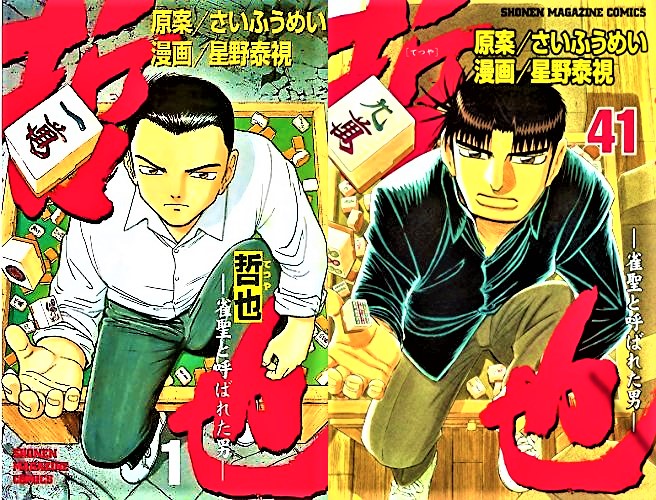
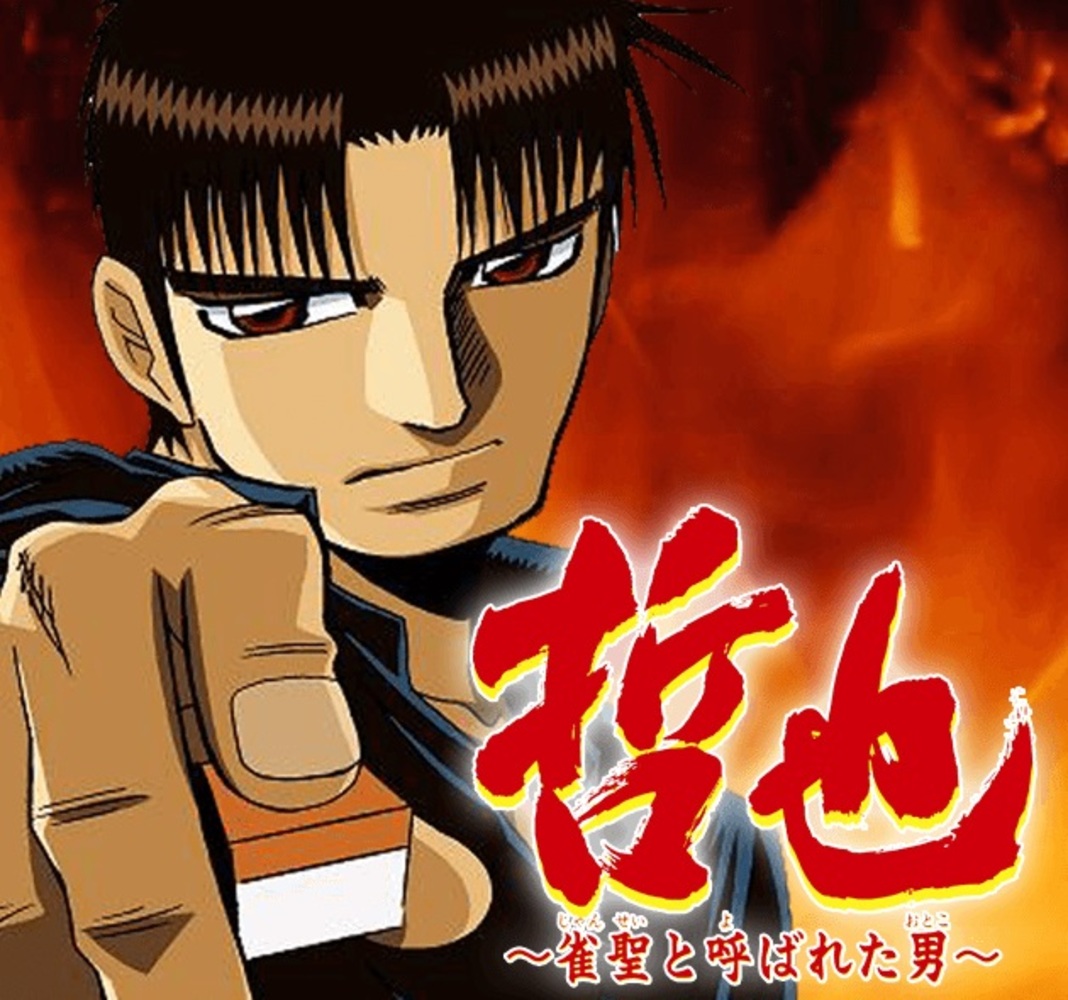
Tetsuya: The Man Called Jakusei" is a mahjong manga by Yasumasa Hoshino (original story: Saifu Mei, manga: Yasumasa Hoshino), serialized in "Weekly Shonen Magazine" from 1997 to 2004. There were a total of 339 episodes, and 41 comics volumes and 22 paperback editions were published. The manga depicts Tetsuya's growth as a professional mahjong player during the postwar reconstruction period in Japan, and his life as a professional mahjong player, including his mahjong matches with many other professionals. The quotes and lines in this work are widely appreciated not only by gamblers but also by people of all ages who cannot gamble.
Outline of "Tetsuya: The Man Called Jakusei
Tetsuya: The Man Called Jakusei" is a mahjong manga by Yasumichi Hoshino (original story: Saifu Mei, manga: Yasumichi Hoshino) that was serialized in "Weekly Shonen Magazine" from 1997 to 2004. It is a mahjong manga set in the postwar reconstruction period, but flower cards (oichokabu) and chinchillorin occasionally appear in the manga. Tetsuya: The Man Called Jansei" is very popular, and its popularity is evidenced by the many media mix works that have been created, including anime, video games, and pachinko games. Original idea: According to Saifu Mei, "In the world of the work, academic background and mahjong ability are inversely related.
Winner of the 24th Kodansha Manga Award for Juvenile Division in 2000.
This work depicts the protagonist's growth as a gentei (a guru) and his life as a gambler (a gambler), including his hand-to-hand mahjong matches with the gentei.
There are people who can only live in the world of the game. This is the story of a legendary gambler in the world of mahjong. The narration at the beginning of the anime is famous.
The main character is modeled on the real-life writer Tetsuya Asada, and the story is based on his books "Mahjong Ramblings" and "Dosa Ken Bakuchi Jigoku" and other works, and includes episodes from other works as well as the names of people who appeared in the novels.
Tetsuya Asada" is, of course, his pen name, but his real name is Takehiro Irokawa, and he has written many books under other pen names. Under the name Tetsuya Asada, he has published gambling novels and essays on gambling, especially mahjong. Tetsuya Asada's style is characterized by picaresque novels.
Tetsuya Asada is best known for his mahjong, but he is also an expert on all kinds of gambling, including chinchillorin, boat races, and casinos. Horse racing was not his favorite. He was also the biggest contributor to the Showa period's mahjong boom, and was the person who popularized mahjong from gambling to a form of culture.
Mahjong Nomadoki," which was the motif for this work, was published in four series: Seishun Hen, Fuun Hen, Gekitou Hen, and Kanban Hen, and established the genre of mahjong novels.
He formed the mahjong entertainment group "Mahjong Shin-Sen-Gumi" with Takeo Kojima and Kaiaki Furukawa, and appeared in the mahjong corner of the legendary late-night TV show "11PM.
Asada was in charge of the "Weekly Post" magazine, which started a mahjong competition between celebrities and Asada was in charge of the game report, and he wrote energetically for a series of mahjong magazines published after the first Japanese magazine dedicated to mahjong, "Monthly Modern Mahjong".
As a result of these activities, Tetsuya Asada was deified as a "mahjong saint" and became a big name in the mahjong world and a don of the mahjong world. In fact, Tetsuya Asada is enshrined as the "Great God of Mahjong" at Fushimi Inari Shrine in Kyoto.
When "Mahjong Ramblings" became a hit, some readers dreamed of "living as a genin! Asada heard that some of his readers dreamed of "living as a Genin" when "Mahjong Ramblings" became a hit, and that they lost their lives, which he regretted.
Many readers became interested in mahjong from "Tetsuya: The Man Called Jansei," and some of them started gambling from there. There are gamblers who imitate the quotes and lines of this work, and the quotes and lines of this work have been adopted as golden words and sayings not only in the mahjong world but also in the "gambling world," and they are highly appreciated not only by gamblers but also by readers who could not gamble at the time of serialization in Shonen Magazine. It is highly rated not only by gamblers, but also by readers and young adults who were unable to gamble at the time of its serialization in Shonen Magazine.
Tetsuya: The Man Called Jakusei - Spoiler Commentary and Discussion Summary - RENOTE [RENOTE]
renote.net
Tetsuya: The Man Called Jansei" is a manga written by Saifu Mei and drawn by Yasushi Hoshino. It depicts the world of betting mahjong in Japan in the immediate postwar period, and the genin who live in it. It is modeled on the novelist Takehiro Irokawa, who practiced and covered mahjong under the same name as the main character.
Tetsuya Asada, who learned to play the game during the war and was without a job after the war, is fascinated by the world of the genin who make their living betting on mahjong, and dives into it. Tetsuya's natural luck and his ability to read the currents of the game eventually lead him to be feared among the experts as "Jakusei," or "the Sparrow Sage.
Famous quotes, lines, scenes, and scenes from "Tetsuya: The Man Called Jakusei
Ken Dosaken: "Once you meet the world, it's eat or be eaten, and after a moment's mingling, there's only one person left in the world..."
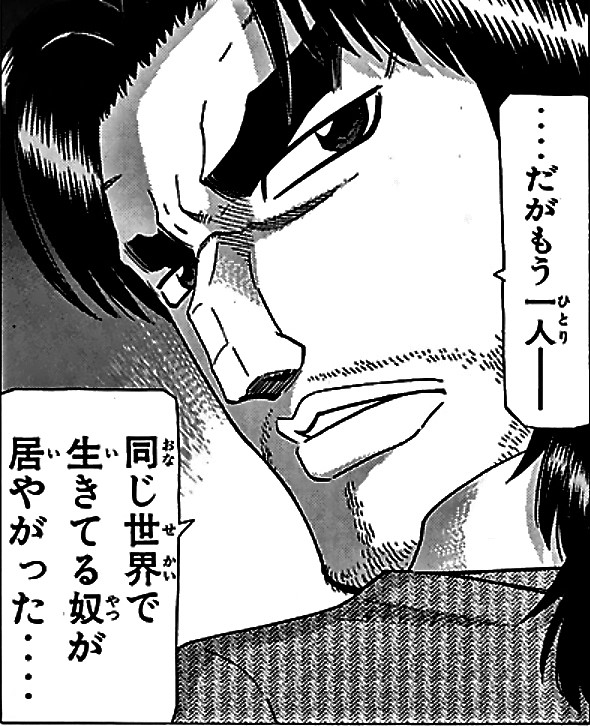
Tetsuya, the representative of Shinjuku's gentry, and Dosaken, the representative of Ueno's gentry, are in a serious battle for territory. 90,000 points behind, Tetsuya is outnumbered, and he says, "If I don't take more risks, I won't win! Tetsuya, who is down by 90,000 points, aims to turn the tables by playing W-Yaku-Man. Dosa Ken plays a "middle poker" and says, "Are you trying to get away with 1,000 points? Yu and Danchi, the experts in Shinjuku, surround the table.
With two rounds to go, Tetsuya makes a "Manko no Kuren Houtou", but Dosa Ken's winning tile is also a Manko.
Dosa Ken's last hand is a 10,000,000. If Dosaken's last hand is Saman Tsumo-kiri, he will be waiting for Shabo with San-Seventy Mans, and if Dosaken's last hand is San-Man-Kiri, he will be waiting for Kan-Chang. Dosa Ken cut Saman. Tetsuya's winning tile is 10,000,000, but Tetsuya also draws a ten thousands with his last hand.
The serious game between Shinjuku and Ueno, each betting on their territory and their pride as experts and winners, was over.
Dosa Ken visits Mayumi, his former girlfriend, at her restaurant and tells her, "Once you meet, it's a 'world' where you either eat or be eaten. The "world of the gambler," as he told Mayumi, is a famous line that expresses the severity of the professional world, not limited to gambling.
Tetsuya's last hand is Niman, which is Dosaken's winning tile.
Dosa Ken wins the serious battle for territory. Dosa Ken was able to get away with a "chu-naru-ki", but his winning hand was a big three of a kind.
This is a famous scene in which Shinjuku and Ueno, the experts and the experts, Han and Han, showed their pride in each other as winners.
Tetsuya: "Gambling players lie..."
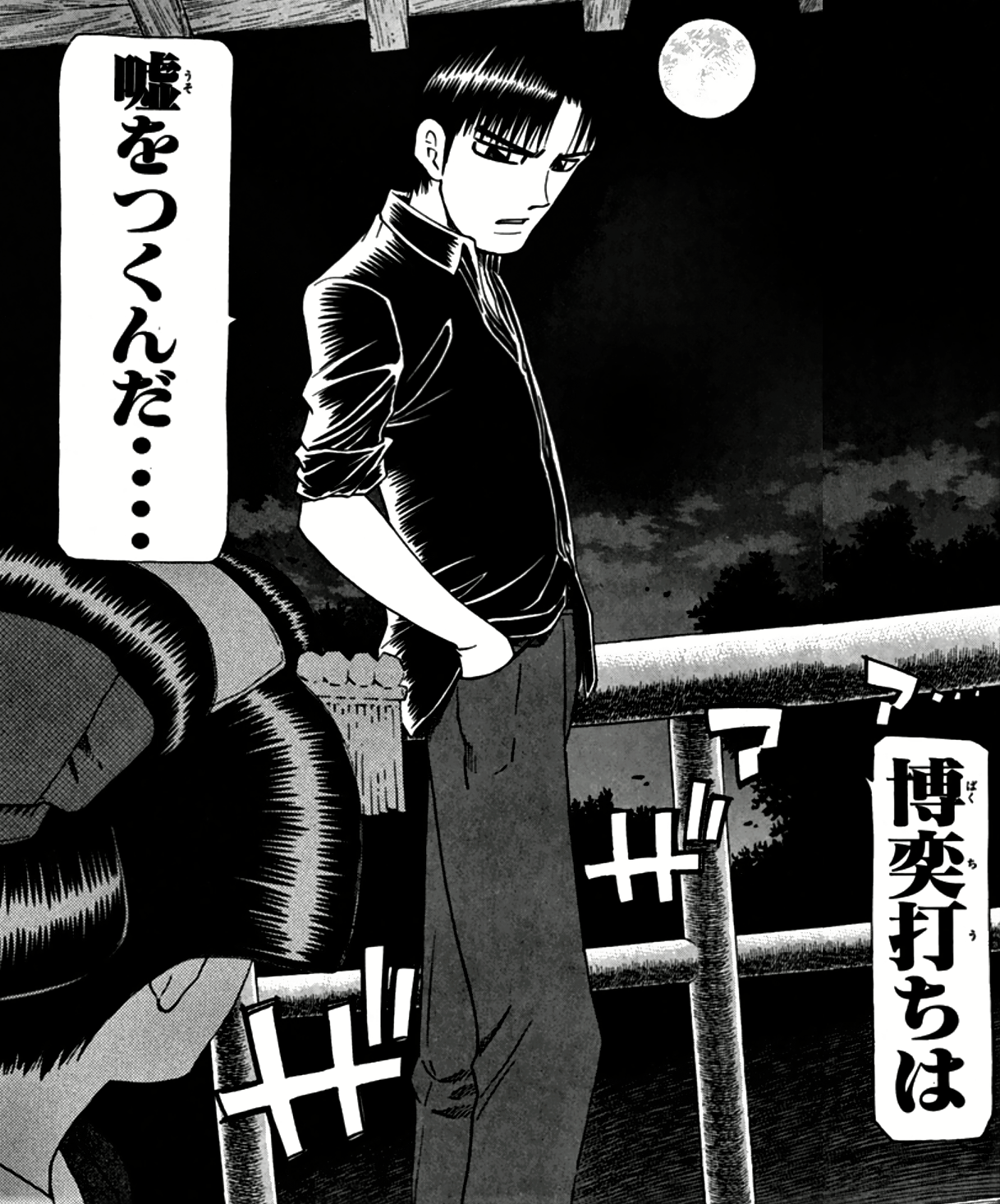
The serious game of Shinjuku vs. Ueno is over, and Shinjuku has returned to its former lively atmosphere, but Tetsuya, defeated by Dosa Ken, goes on a trip alone.
Tetsuya is saved from a fareless ride by Chiaki, a geisha in Hakone, who asks Tetsuya, "Do you... play... gambling? Tetsuya lies and says "...no, I don't..." and ends up working as a live-in at the inn where Chiaki works.
Chiaki is a half-breed geisha, but she is the favorite of Gomi, a member of the prefectural assembly, who is pressuring her to become his mistress. When Chiaki continues to refuse, Gomi proposes a geisha mahjong "special" to her, but she can't stand it and flees the scene.
The proprietress tells Tetsuya that the "specials" are a specialty in which the customers put up money and the geisha put up their bodies.
Another day, Chiaki tells Tetsuya about her dream of becoming a full-fledged geisha, and at the same time, she tells him, "Tonight's geisha show is a special program....
Gomi was carrying a deed to a woodworking shop owned by Chiaki's father so that Chiaki could not escape. The rights to the shop were at stake in the special, and a geisha who was good at specials joined in to help, but Gomi had even prepared a stand-in called "Akaike". The geisha are unable to stand up to Akaike, who is famous in the Hakone area as an "undefeated poker player.
Chiaki says, "I'm going to hit the wind," and tries to commit suicide, but Tetsuya rescues her and offers to play in her place. Tetsuya then offers to play for her, saying, "I'll play for you..." When Chiaki asks, "But you play the game...," Tetsuya says, "That's a lie," expressing the essence of a gambler.
Tetsuya "If you want to win... don't trust people easily..."
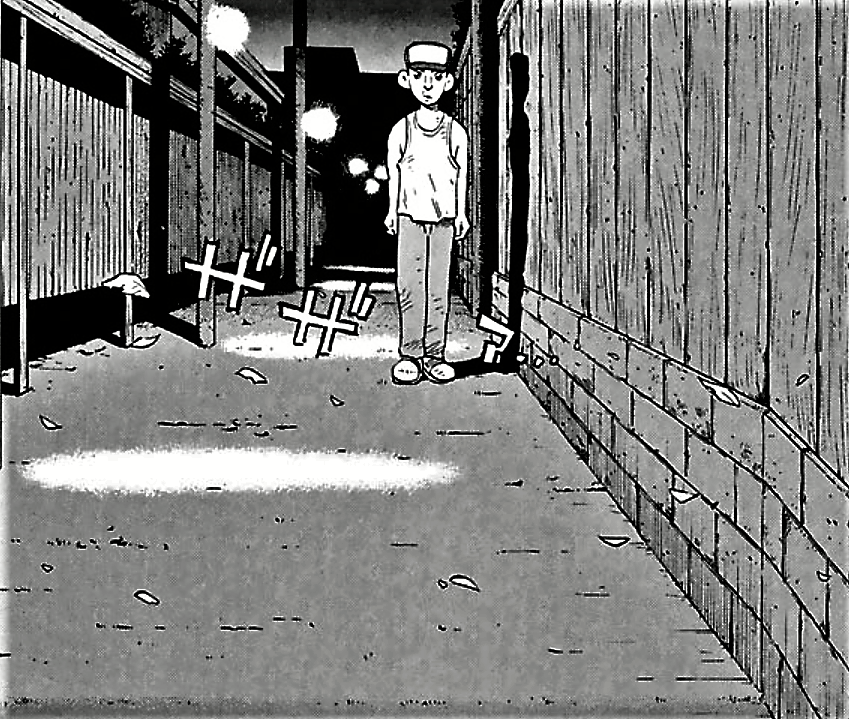
A certain steel mill in Kyushu. It is payday, but there is a young man named Kohei with a gloomy face.
On his payday, a professional named "Mantetsu" is waiting for him and says he will take all his wages in a game of mahjong. His colleague, Daizen, advises him to tell him not to play gambling, but Kohei shows his manly spirit by saying, "I don't want to show my back to my enemies.
Believing a rumor that Daizen used to be a professional mahjong player in Tokyo, Kohei asks him to teach him mahjong.
Daizen tells him about "Ni-ni-ni-no-Tenwa" (a kind of combination cheating. Kohei asks, "This must be cheating, right? Daizen says, "It's not cheating if the enemy doesn't find out. Daizen taught him "stacking" (a cheating technique used in hand stacking, where the player spontaneously selects tiles to be stacked in his own pile).
Next, he taught Kohei how to roll the dice, saying that it was pointless unless he could roll a "two", but no matter how many times he tried, Kohei could not roll a "two".
Daizen, unable to see Kohei's frustration, said, "I know what you lack now. Two years ago, I was the same as you are now.
When Daizen was a fledgling professional in Shinjuku, he had been losing a lot due to a lack of luck. Then he saw a man who was winning a lot and asked him to teach him how to play mahjong, and that was how he met Tetsu Boya. Daizen, who at the time was also having trouble getting a "2", received a "Gura Sai" from Tetsu.
The "glass die" has lead in it so that it can only produce a certain number of numbers.
Daizen and Tetsu go to the gambling hall to play a real game. At the game, Daizen played "Ni-ni-ni-no-Tenwa". He seems to have succeeded, but then, suspecting that he has been wrongly accused, he is grabbed by the hand and told, "Let me check the dice.
Daizen gives up and says, "I want to finish...," but there is nothing on the dice.
What Daizen wanted to tell Kohei was to believe in himself. Daizen wanted to tell Kohei that he had to believe in himself. Daizen also told Kohei that he had learned this from Tetsu.
Kohei challenges Mantetsu, who is waiting in ambush, to a game, and sets up "Ni-ni-ni-no-Tenwa" from the beginning and succeeds. Mantetsu becomes suspicious and inspects the "mountain," but finds no evidence.
Kohei continued to win steadily, but then Mantetsu asked him if he would increase the rate by five times for the settlement of one game. As expected, Kohei flinched, but Daizen urged him, "Either you run away and lose, or you take the game and win.
Then, one of the players left the table and called out to his brother, who had been earning money during the day.
The players were ready, and Kohei tried again to play "Ni-ni-ni-no-Tenwa," but the dice read "3. Kohei thinks, "I screwed up the dice roll," but he is confident, "I'm going to wait for the dummy! He was full of confidence.
Kohei, Daizen, and Mitsutetsu were surprised to hear their brother's voice, "Tsumo shikyoku monki. Daizen tried to give his brother an earful, but he was poked in the opposite direction, saying, "You two are playing together, aren't you?
Kohei says, "They know I'm working with Daizen! But the older brother, who recognized the combination of Daizen and Mitsutetsu, told Kohei that it was a common method of sucking up to amateurs.
Daizen, cornered, explains to Kohei that he really learned mahjong from Tetsu. But Daizen's older brother, who had won the "four concealed pungs" game, said, "I don't remember teaching you anything at all.
This older brother was Tetsuya Asada, whose nickname was "Boy Tetsu.
Kohei followed him and asked him to teach him how to win at mahjong, but Tetsuya ignored him. Tetsuya's famous line to Kohei, who still persists, is, "If you want to win... don't trust people easily....
Danchi: "It's the polishing sand that polishes a man."
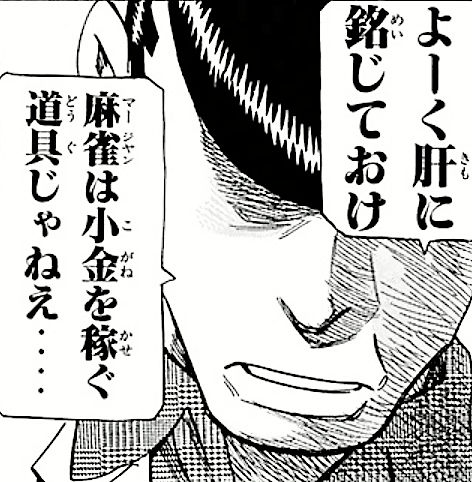
Tetsuya, who lost the game with Dosa Ken and went on a trip by himself, returns to Shinjuku.
He heard a message from Mayumi's mother and headed for the sparring parlor Ikeda-ya. There, he sees the Shinsengumi members who are eliminating the bad jankoro.
There, he met Ohiki Danchi, who had left a message for him. During a nostalgic exchange with Danchi, it is revealed that they are the "Danchi Shinsengumi" and that Danchi is the bureau chief.
One of the bureau members "sama de amateur kappai" ("sama de amateur kappai" means "to use sama to squeeze amateurs"), and his immediate superior tries to give him an iron fist sanction, but Danchi stops him, saying, "Everyone makes mistakes.
) "Keep in mind, mahjong is not a tool to make a little money... it is sand to polish a man."
This is a rare and famous line from Danchi, who usually plays the role of a goofball.
But when he continues, "That's what Tetsu-san said," it becomes an uncontrollable line.
Boshu: "Whether you're past the top (peak) or not, whether you're the last or the first, there's only one thing a guru does... no? Boy."
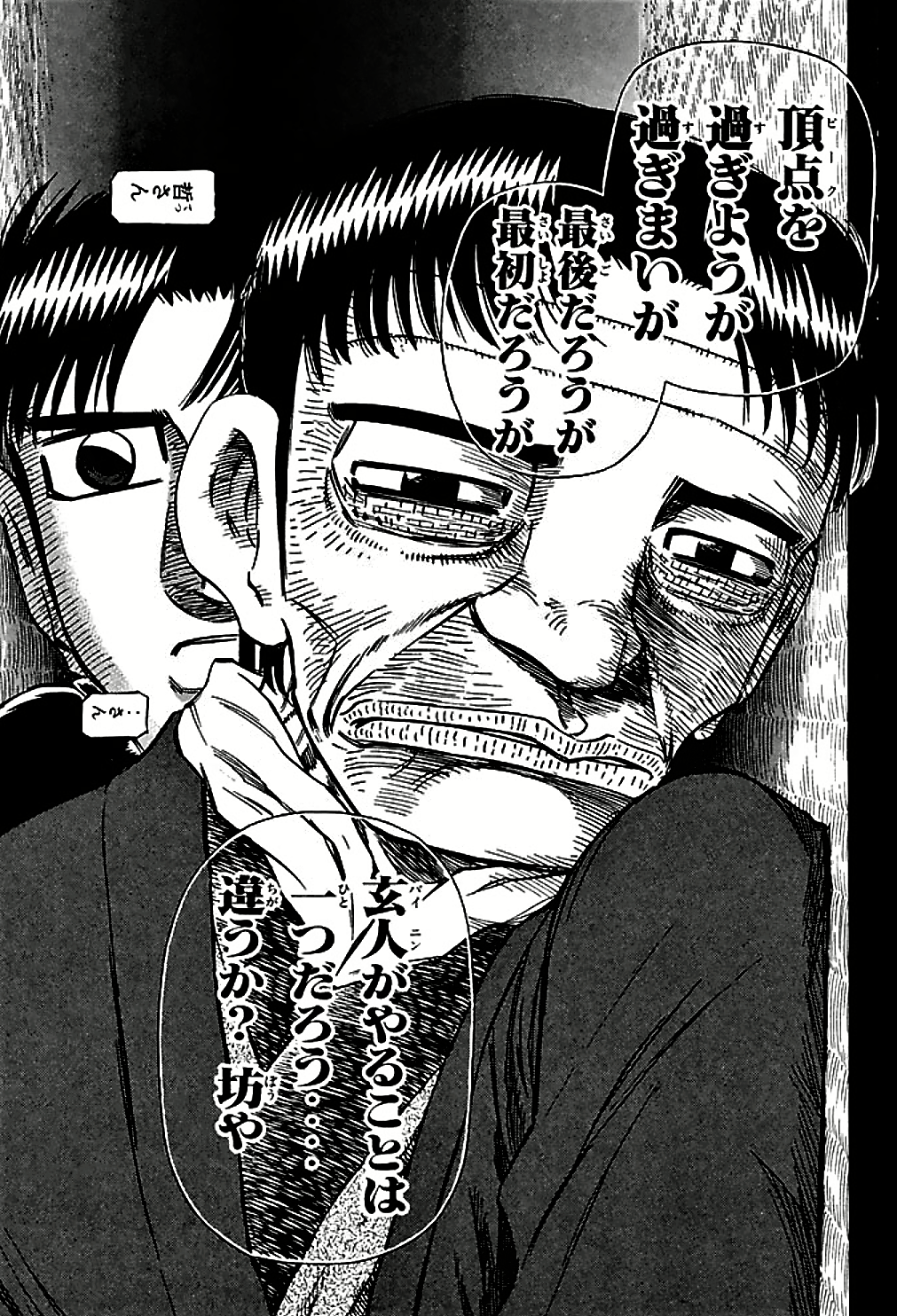
Tetsuya's narcolepsy is aided by the words of his mentor, Boshu.
Tetsuya was diagnosed with narcolepsy.
Narcolepsy was not even known as a disease at the time of the war, and no treatment had been established.
Tetsuya, who is thinking of "going out of business as a professional player," decides to play against an amateur player by "just going up fast. Tetsuya is offered a five-fold rate at the next table, but in the last game of the tournament, he is encouraged and says, "I'll show you," and decides to play 9-Ren Hodo Tenpai. He is waiting for 1, 4, and 70,000. Danchi, who was watching the game, thought, "Tetsuya would have drawn a high 10,000 or a 9-round hand..." He returned the money to Danchi. Tetsuya returns the money he bought at that time to Danchi, and goes to Mayumi's store.
Tetsuya is about to leave when he sees a couple of customers talking about how luck is also a part of one's ability, but Mayumi asks him to pay for the first time, saying, "When you have a warm pocket, you can leave your money behind. Tetsuya is puzzled, but pays the bill, and when the two customers also ask for the bill, Mayumi says, "I don't need it. When the two customers asked for the bill to leave the restaurant, Mayumi said, "...I don't want it.
Tetsuya then realized, "I've already... passed my peak... Fusyu-san....
Tetsuya was looking at the ticket gate in the rain without an umbrella, and Danchi seemed to sense that "I don't want to go alone like the last time.
Tetsuya and Danchi set off on their journey. On the train, they overheard a passenger say that he had a conversation with Fusyu, the master who was supposed to be dead. The train was suspended due to a typhoon, and when Tetsuya got off the train at the platform, he found Fosyu in front of him.
However, it was not Fosyu, but his son, Ataru (あたる). The day of their reunion was also the anniversary of Foshu's death. Tetsuya's son Ataru wanted to play mahjong with Tetsuya on the anniversary of his father's death, and challenged Tetsuya to a game, but Tetsuya thought that he had "passed the top" and tried to escape. Tetsuya, who thinks he is "past his prime," tries to run away, but Naka agitates him by saying, "My father didn't run away from a game with you even when he was dying.
Tetsuya is at the mercy of Naka's mahjong, which is different from that of Boshu. Naka declares, "I have lived ten times longer than others.
Tetsuya realizes that he will lose the game when he sees Naka's mahjong, in which he always gets an "open riichi ichi-tsumo" (one shot winning).
Tetsuya sees through Naka's loading, which is different from Boshu's, but the game is prolonged because he sees through and blocks Naka's techniques, and ironically, this is when he begins to have narcopleptic seizures.
Finally, Tetsuya fell asleep. Was he dreaming? Then the deceased Fusyu comes out and says, "Whether you are past the peak or not, whether you are the last or the first, there is only one thing a genshi-jin does... Am I wrong? Isn't that right, boy? This is a famous line in which he tells Tetsuya what a genin is.
Tetsuya tries to win the Nine Renga Hodo, but he wins cheaply. Tetsuya thinks that he has won, but then he notices that Tetsuya's eyes are not dead.
Tetsuya should have won the game with a cheap hand, but he wins the game with Uradora and wins the game back with Counting Yaku-Man.
Dosa Ken: "It's impossible to know who will win the game. That's why gambling is so interesting.
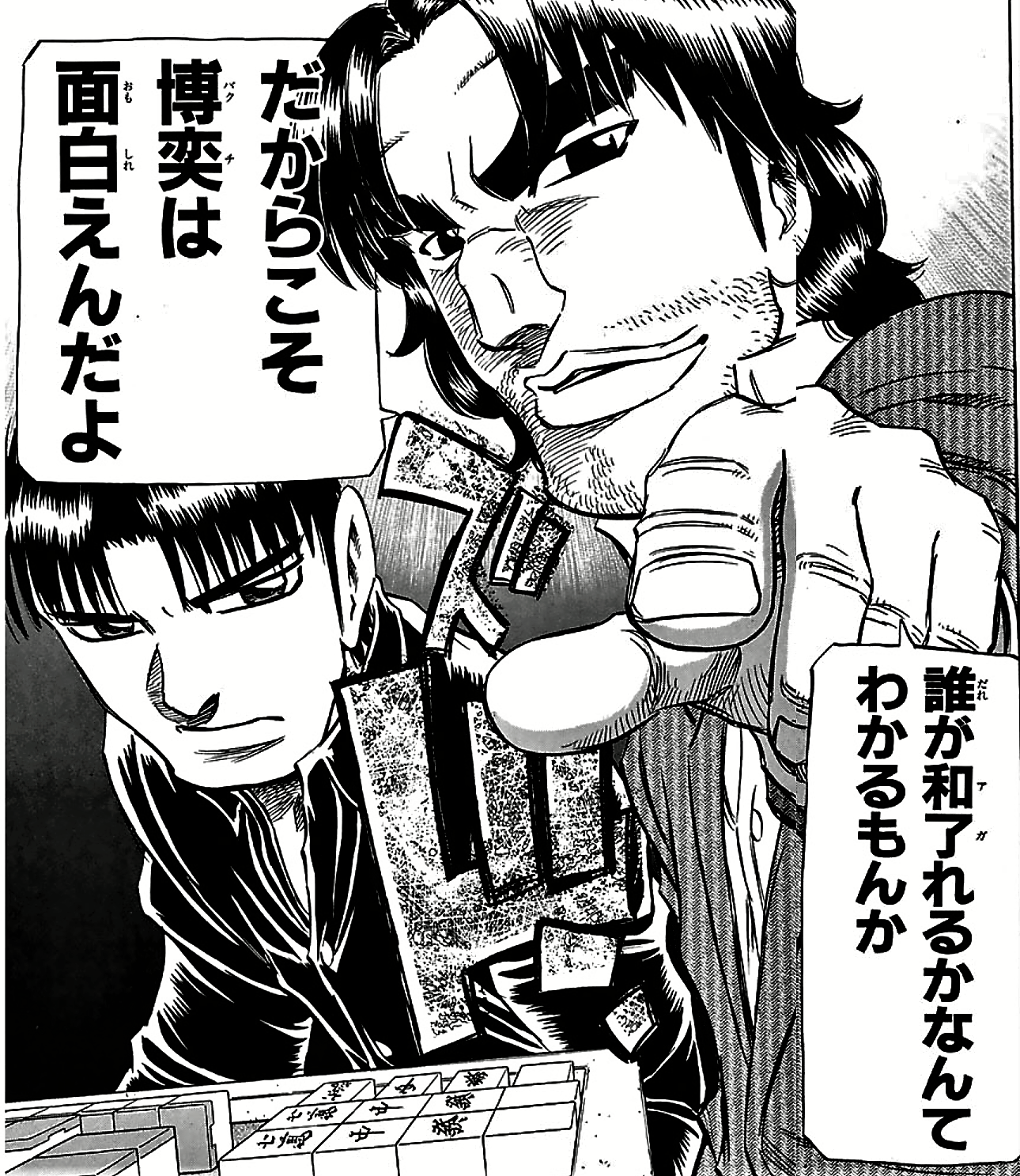
Tetsuya and Ken Dosa perform a brilliant duo performance without a meeting or rehearsal.
Father Jimbo, a Genin and Dosa Ken's mentor, has passed away. The public jumped on the new entertainment "pachinko" and the Genin also enjoyed playing pachinko, but Tetsuya suggested a "Genin's way of mourning". Tetsuya's idea was to play "memorial mahjong.
Many of the Genin who have appeared in the past have participated in the memorial mahjong. Tetsuya had been playing for a week. Danchi realized that he was waiting for Dosa Ken, saying, "Tetsu-san is waiting for him.
After the memorial mah-jongg, two men came to visit him while he was cleaning up the hall. When Tetsuya wakes up, he hears Danchi's screams. The two men were detectives from the Tokyo Metropolitan Police Department, and Danchi was seriously injured on his right hand by them.
He underwent surgery, but it was uncertain whether he would be able to move his fingers, let alone play mahjong. Tetsuya went for revenge, but these two had analyzed Tetsuya's mahjong game through profiling.
Tetsuya is in a pinch, and Dosa Ken appears in front of him. The two detectives are undaunted by Dosa Ken's words, "Raise the rate tenfold," and accept the game.
The detectives are upset, saying, "That's impossible," when Dosa Ken shows them four dora from the start, but with Tetsuya's assistance, Dosa Ken confirms the big three of a kind.
Tetsuya and Dosa Ken, who are sworn enemies but have become a perfect pair, are upset and astonished by the unbelievable mahjong, but Tetsuya says, "...unbelievable things happen in that unbelievable place.
Following this, Dosa Ken says, "There's no way to tell who will win the game. That's why gambling is so interesting," a quote that expresses the real thrill of gambling.
Dosaken: "I'm going to eat your luck, your power, and all your money!
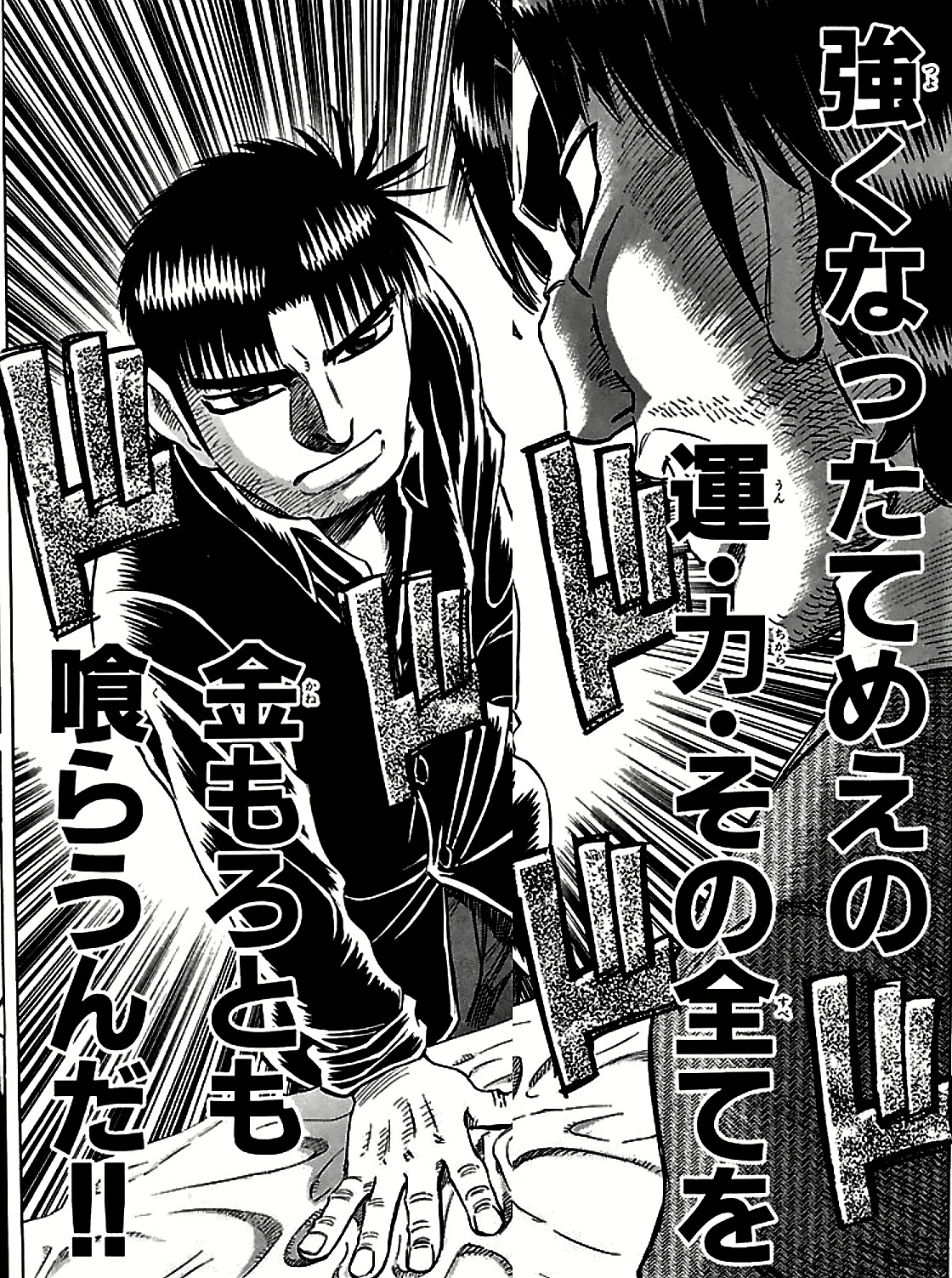

Tags
Contents
- Outline of "Tetsuya: The Man Called Jakusei
- Famous quotes, lines, scenes, and scenes from "Tetsuya: The Man Called Jakusei
- Ken Dosaken: "Once you meet the world, it's eat or be eaten, and after a moment's mingling, there's only one person left in the world..."
- Tetsuya: "Gambling players lie..."
- Tetsuya "If you want to win... don't trust people easily..."
- Danchi: "It's the polishing sand that polishes a man."
- Boshu: "Whether you're past the top (peak) or not, whether you're the last or the first, there's only one thing a guru does... no? Boy."
- Dosa Ken: "It's impossible to know who will win the game. That's why gambling is so interesting.
- Dosaken: "I'm going to eat your luck, your power, and all your money!
- Tetsuya: "So there's no more from here. My gambling is over..."
- Tetsuya: "I'm certainly alive right now..."