

The manga "Position Dystopiary" is a manga by Fumitaka Senga that was serialized in Young Gangan from issue #16 in 2014 to issue #18 in 2016. Originally, it was a web manga "Kantoku Dystopiary" published on the author's website, but due to its popularity, the plot was remade and a new artist was added to the series, and it was serialized in Young Gan Gan. After the serialization ended, it was renamed "Kantoku Monogatari" and serialized again on the original author's website. The concept is "a dark fantasy without dreams or hopes.
In a society perfectly controlled by position and level, Toruza, a "defeatist," takes on the challenge of defeating the "Demon King.
Arlesiano

The "Battoushi" Demon King Leitz.
The position of "Battoukaishi" is the ability to make orbital calculations and then cut anything in that orbit.
The orbital calculations become more complex with each level, and a high-level "Battoushi" can cut down a building with a single paper knife.
Arlugano's ability was enhanced when he became the Demon King Lights, and he is now able to cut off not only objects in orbit, but also space itself.
His real name is Al, but he changed it to "Arlugiano" when he was reborn as the Demon King Raiz.
Famous quotes, lines/scenes, and scenes from "Positional Distopari" and "Positional Tales"
The strongest and the worst of the brave."
A term often used throughout the work to refer to "defeaters."
The term is also used to refer to the "worst" because the "hero's correction" requires killing one's companions. He is also the only one who can defeat the Demon King with the "hero's correction," and he is the "hero" because "in fairy tales and other stories, it is the role of the hero to defeat the Demon King.
Although it is the only position that can defeat the Demon King, the reason why the position of "defeaters" is not called "heroic" is because "defeaters" are not heroic (i.e., they must dare to kill their comrades).
Characters such as Torza, Idokawa, and the mayor of the "news city" who are familiar with the abilities of the "defeaters" sarcastically refer to them as "the strongest and the worst kind of heroes.
The phrase is also used as a catchphrase for "Position Distopari" and "Position Monogatari," as it appears at the beginning of the first episode of "Position Distopari.
It would end up just like in the storybooks."
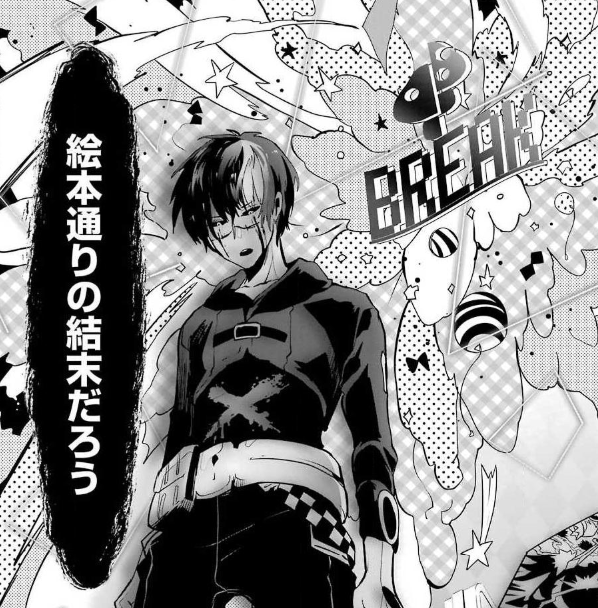
This is the line that Torza said when he put an end to Almi, who had become the Demon King Lights.
When Almi appears in "Press City" as the Demon Lord Raiz, he quotes a fairy tale and transforms into a giant mushroom, foreshadowing the development of the story.
The "storybook ending" refers both to the fairy tale's development of the evil being defeated by the heroes and to Idokawa's plan that one of the Demon King's Lights must be defeated here as part of the scenario for defeating the Demon King.
This line is spoken famously to readers as a symbolic statement that "this world is an ideal dystopia designed by the Central Tuning Bureau as if it were a game, and every event is a plot devised by the Central Tuning Bureau.
I'm the only one who can save that town.
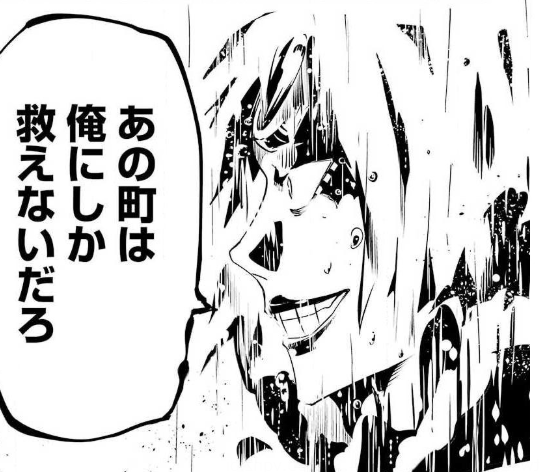
The city of Water Fix was destined to be destroyed and its inhabitants killed by the Central Bureau of Arbitration in order to create a bad aftertaste and a sense of disgust toward the Demon Lord by staging an attack on a city that had been home to "defeaters" until just before the attack. In order to stage this event, Azot was led to the "city of fetters" and instructed to leave in advance by Rakyat, who was informed of the Demon Lord's attack.
Azot ignores this and says this line in front of the "city of fetters," which is being destroyed.
Azot is thoroughly opposed to the system of this world, using the skills of an "alchemist" (homunculus manufacturing) instead of his assigned position as a "defeatist," and using the "observers" dispatched from the observation station as a means of defeating the Demon Lord, an act not recommended for a "defeatist. Azot is a character who is thoroughly opposed to the structure of this world.
Azot returned to the "city of fetters" against the orders of the observatory, which had set a scenario for his downfall, and followed a policy that was contrary to the structure of this world.
The headline line is a line that symbolizes Azot's way of life.
In "The Story of Positions," this line was simply passed over, but when the story was remade as "Positional Dystopia," it was drawn with great care, with large sesame seeds, and was depicted as a line that symbolizes Azot.
Hence, it has become a popular line among readers.
Backstories, trivia, subplots/episodes, and anecdotes from "Position Distoparii" and "Position Stories"
Yellow Warthog.
The word is used in several stories in the work. The original source is from an extra manga attached to the end of volume 3 of "Positional Distopari.
The content of the cartoon is about the time when Toruza defeated a monster called Blue Phoenix, and the interviewer accurately made a comment on Toruza's lines, "Although it is called Blue Phoenix, its body color is yellow," and "Although its name is Phoenix, its appearance was like a warthog, not a bird. The interviewer accurately made a quip to Torza's lines.
Perhaps because the story "Blue Phoenix (Yellow Warthog)" was popular with the original author, the existence of "Blue Phoenix (Yellow Warthog)" appeared (mainly in an extra manga at the end of the book) in subsequent volumes.
This kind of mismatch between appearance and name is a common story in the work, and "Blue Phoenix (Yellow Warthog)" is a typical example.
Other examples include the "Blue Dragon," which has the appearance of a slime, and the "Blue Dragon," which is a golden sphere.
Differences in death descriptions
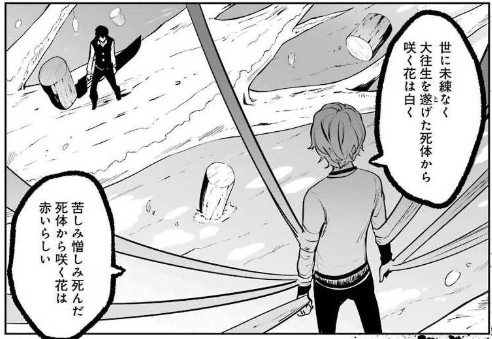
In "Tale of Positions," instead of a flower, the deceased says "poop" in place of the word "decisive.
This "poop" is referred to as a marker word in the work, and saying "poop" confirms that the person has died.
However, the word "feces" is considered too vulgar, so in "Role Dystopia," the dead are given a flower like a lily (marker topiary).
The color of the marker topiary changes according to the emotion at the time of death: white if the person accepts his or her death, and red if the person dies with lingering regrets.
Marker topiaries are also distributed as ornamental flowers, and although some people do not like the idea of flowers blooming on a corpse, saying that it is unlucky, they seem to be widely accepted by the public.

Contents
- Overview of "Position Dystopia" and "The Story of Position
- Worldview and terminology in "Positional Dystopia" and "Positional Tales"
- layer
- Position and Level
- Central Tuning Bureau
- observatory
- observer
- devil king
- The 23rd Demon King, The Demon King of the Circus
- logger
- Synopsis and story of "Position Distopari"
- The Fate of the Defeatist
- The concept of the Demon King
- Press and Wild Rose Princess
- Azot, the "Defeater".
- Conclusion to "Position Dystopia."
- Synopsis and story of "The Story of Positions
- Difference from "Position Distopriori."
- Chapter 5: Putting Love into Faith
- Characters and characters from "Positional Dystopia" and "The Story of Positional
- torsa
- shizu (Perilla frutescens var. crispa)
- landia
- aluminum (Al)
- Ido Kaw
- azot
- here (place physically close to the speaker, place pointed by the speaker while explaining)
- raccia
- Fyodor
- Tatiana
- Kaoru.
- Pisa
- calvado
- chairman
- myriavina
- Gear Gruno
- zepetino
- de pucino
- Arlesiano
- Famous quotes, lines/scenes, and scenes from "Positional Distopari" and "Positional Tales"
- The strongest and the worst of the brave."
- It would end up just like in the storybooks."
- I'm the only one who can save that town.
- Backstories, trivia, subplots/episodes, and anecdotes from "Position Distoparii" and "Position Stories"
- Yellow Warthog.
- Differences in death descriptions