
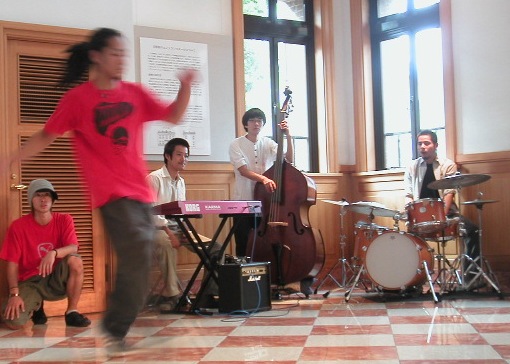
Relational art and community art are explained. In other words, these two are like activities where you do something collaboratively. We're talking about when you're working with somebody, it could be community art or relational art.
What is Relational Art?
The art of relationships. Art that transforms artistic expression from the production of fixed works of art to the experience of human connections, movement, and distribution through events, collaborations, and encounters, and to a new sense of community and camaraderie that emerges from these experiences.
Source: kotobank.jp
It's the opposite of art, which tends to be preceded by solitude and making things that are dour and dreary.

It's more like arts and crafts than art, though.

He says this is part of art. I feel like I put the word "art" on everything.
Relational art," theorized by French art critic Nicolas Briault, "places the theoretical horizon of art not on claims of uniqueness or personal symbolic space, but on human interactions and their social context.
Source: www.art-it.asia
The art critic proposed (?) The art critic proposed (?) this.
The basic concept of "relational aesthetics" was often used as a theoretical backing for the proliferation of new types of artwork, such as installations and community art, which proliferated from the 1990s to the 2000s, with the aim of promoting local communities.
Source: artscape.jp
Even if at first glance it looks like arts and crafts, or like art and whatever else is out of place, it is still a community development project, or at any rate, it is closely related to the local community.
What is Community Art?
Community art is an activity that aims to solve community issues and create new values for the community through the medium of art, in collaboration with artists and citizens.
Source: ja.wikipedia.org
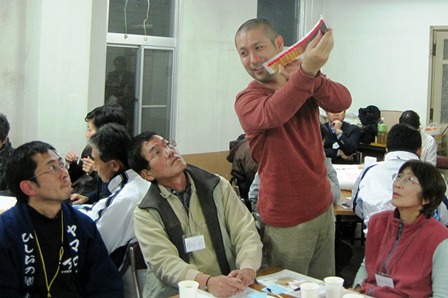
Part of the MUNITY ART
Studio-L, headed by Ryo Yamazaki, is the production team for this project,
About 30 residents of Shodoshima participate in each workshop.
The first workshop was held on October 29, 2012.
The theme was "How to surprise artists with islanders' handiworks" and participants discussed ideas for artworks.
The 2nd meeting on November 20, 2012.
Discussion about "what we want to do" and "what we can do" regarding the idea of artwork production.
Third meeting on December 13, 2012
The participants were divided into groups of the venue setup team (outdoor and indoor) and the planning and operation team (event and exhibition), and came up with concrete ideas.
Fourth meeting on January 29, 2013.
The actual process of packing soy sauce. The old soy sauce that was left over from Shodoshima was put into the remaining sauce bottles that did not meet the standards.
Source: sakahishiart.seesaa.net
Art (?) in the image above Contents
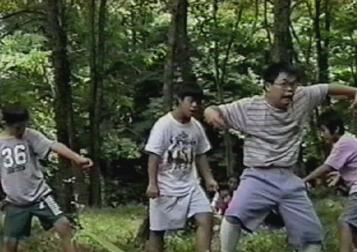
This is also part of the munity art, the text below explains the image
My first project was an improvisation dance workshop by Butoh dancer Natsu Nakajima with mentally handicapped children. communication skills of children with Down syndrome seemed to me to be cutting-edge art.
Source: www.nettam.jp
When we think of community, we may immediately think of local communities. But communities can also be racial, ethnic, and professional groups such as designers. In the broadest sense of the word, the origins of community art can be traced back to the religious rituals (shamanism) of prehistoric times.
Source: www.realiser.org
I don't think anyone thinks that hard about munity....
Part of the munity art.
This appears to be a work of art.
I don't get the impression from the video description that it doesn't feel right.
We call it "relational art" or "community art," but I think it should be a normal "communal activity" or "community activity" instead of being positioned as "art.
Picking up trash along the seashore could be considered "community art," and it could also be relational art.
