
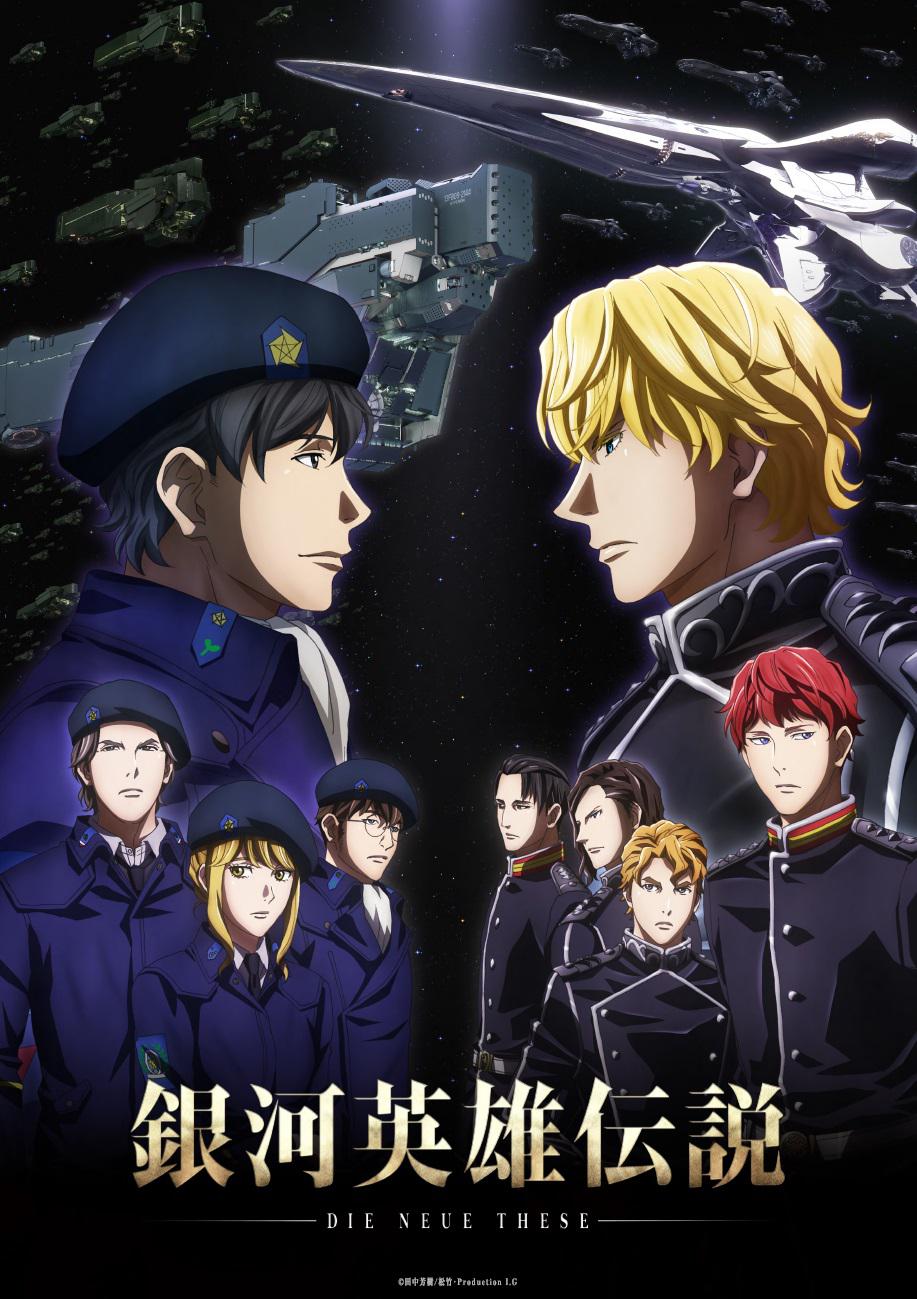
The Legend of the Galactic Heroes: Die Neue These" (Ginga Eiyu Densetsu: Die Neue These) is an anime work based on a science fiction novel by Yoshiki Tanaka. The original novel is known as one of the greatest works and masterpieces in Japanese SF history, and this is its second anime adaptation.
The Galactic Empire and the Alliance of Free Planets have been at war for over 150 years. Reinhard von Lohengram, the "ever-victorious genius" of the Empire, and Jan Wenley, the "undefeatable magician" of the Alliance, clash repeatedly on the battlefield over the fate of their respective camps.
The Legend of the Galactic Heroes: Die Neue These" Overview
Ginga Eiyu Densetsu Die Neue These" is an anime work based on the science fiction novel by Yoshiki Tanaka, which was renewed from the 1988 anime and broadcast in order from the original "Reimeihen". The series is composed by Noboru Takagi of "Durarara" and "Baccano! The director is Noboru Takagi of "Kuroko no Basket" and other works. The director is Shunsuke Tada, famous for "Kuroko no Basket" and other works. Production I.G, which produced the "Ghost in the Shell" series and "PSYCHO-PASS: Psycho-Pass" series, is producing the series.
The setting is a galaxy thousands of years in the future. The human race has expanded into space and is divided into two camps, the Galactic Empire and the Alliance of Free Planets, and they are fighting each other. This confrontation was stalemated for 150 years, but at the end of the 8th century, history was changed drastically by two figures. Reinhard von Lohengram, the "genius of war" and "ever-victorious hero" of the Galactic Empire, and Jan Wenley, the "undefeatable sorcerer" of the Free Planet Alliance. This is a space opera in which offense, defense, and intrigue unfold around the two opposing protagonists.
The Legend of the Galactic Heroes: Die Neue These
Astarte Conference (1922)
Centuries have passed since mankind entered the outer space. The Galactic Empire, a tyrannical state that at one time ruled the entire universe, and the Alliance of Free Planets, a republican state founded by people who escaped from the Empire, have been at war for 150 years.
Reinhard von Lohengram, a child of the Empire, plans to regain his sister, who was forcibly made a queen, and to achieve military glory.
After destroying the 4th and 6th fleets of the 2nd, 4th, and 6th fleets of the Alliance, Reinhardt, who had made his military prowess known to allies and enemies, attacked the remaining 2nd fleet. At this time, Alliance Brigadier General Jan Wenli, to whom full authority had been transferred after the death of his superior, used the momentum of Reinhardt's charge to create a situation in which he could bite the enemy fleet in the rear.
Like "two snakes chasing each other's tails," the two armies circled in an endless circle in pursuit of the other, and Reinhardt, judging that "it would only be a war of attrition," chose to retreat. Jan, who judged that he was "too exhausted to fight properly," also chose to retreat instead of pursuing, and the battle, later called the Battle of Astarte, came to an end.
As a result, the battle was a great victory for the Empire, and Reinhardt was appointed deputy commander of the Starfleet, effectively taking half of the Empire's regular fleet for himself, a major step toward his goal. On the other hand, he left a strong impression on Jan, the commander of the Second Fleet on the Alliance side, as he was "prevented from a complete victory.
Yang was unwillingly feted as a "hero of the Alliance" in order to cover up the heavy defeat in Astarte space. Fed up with this, Jan becomes wary of Reinhardt's military talent and closely watches his movements within the empire.
Seventh Iserlohn Offensive
The Imperial artificial celestial body Iserlohn, located in the corridor connecting the Empire and the Alliance, was a supply base for the fleet and a fortress that combined formidable offensive and defensive capabilities, and was one of the most important strategic bases for both sides. The allied side had tried to capture Fort Iserlohn many times, but each time their entire fleet was repeatedly obliterated before the main guns of Fort Iserlohn.
Jan was appointed commander of the Alliance's 13th Fleet for his achievements at the Battle of Astarte, and was given the mission to attack Fortress Iserlohn. Jan, who judged that "it is impossible to capture Fort Iserlohn by an external attack," plotted to seize the fortress by means of a scheme.
The whole plan was to gather a fleet outside the range of Fortress Iserlohn's main guns, lure out the Imperial garrison fleet, and then use the agents he sent to seize the fortress's functions. Thanks to Jan's skillful diversion and the efforts of Imperial soldiers who defected to the Alliance, the operation succeeded, and the Alliance took possession of Fortress Iserlohn unscathed.
The result is perceived by the Imperialists as a "historic defeat," and Reinhardt takes advantage of this confusion to further strengthen his military and political influence. Meanwhile, Jan, who was promoted to lieutenant general as a result of this great victory, hoped that "now that the Alliance had obtained Fortress Iserlohn, it would be possible to drag the Imperialists into a cease-fire agreement," but in reality, the war continued as politicians on the Alliance side planned for further war results and regime stability.
Alliance invasion of Imperial territory / Amritsa's folly
The Alliance, energized by the joys of Fortress Iserlohn, plans an expedition to "invade the Imperial system and liberate the people from tyranny. This was a reckless plan that was the result of a collusion between politicians who planned to "stabilize the regime through further war results" and a faction of the military that wanted to make achievements out of "jealousy toward Jan, who had made a name for himself as a hero of the Alliance. At the time, the majority of the Imperial Army had already been involved in the project.
Reinhardt, who already owned most of the Imperial Army at this time, saw this foolish military action, which included many of the Alliance's internal problems, as "easy prey," and drove the Alliance's large fleet, which had invaded, out of action through scorched-earth tactics. The allied fleet asked the headquarters for a decision to increase the supply force or withdraw, but this advice was squelched by politicians who could not stop the operation without any results and some soldiers who could not admit their mistake.
After weakening the allies sufficiently, Reinhardt cut off their retreat and launched a reverse offensive. The onslaught inflicts a heavy blow on the Alliance, which suffers a fatal loss of 40% of its total strength as a nation. The fact that the allied military forces, which were determined not to retreat, chose to fight a decisive battle rather than end the war as it was, further widened the wound.
Anticipating this outcome, Yang fought a solitary battle, minimizing the damage to his own 13th Fleet and succeeding in returning the Alliance's remaining forces to their own sphere of influence. With this defeat, the Alliance's forces were reduced to only the 13th Fleet, except for the 1st Fleet in the direct management of the capital, and were virtually destroyed.
Battle of Lippstadt / Civil War in the Reich
While the empire is reeling from the heavy blow dealt to the allied forces, Emperor Friedrich IV collapses. The dark struggle for the next emperor begins. Disappointed that he could no longer "get his sister back from the emperor," Reinhardt installed Erwin Joseph II, grandson of Friedrich IV, and effectively took control of the empire.
At this time, Reinhardt, in an attempt to further advance his war against the Alliance, conspired to stage a coup d'état within the Alliance, which was put down by Jan. This was suppressed by Jan, but as he had hoped, he succeeded in further reducing the remaining strength of the alliance.
Reinhardt, riding high on his own momentum, loses his childhood friend and trusted subordinate, Siegfried Kirchheiss, as he uses his powerful military force to crush the civil war. Reinhardt laments that he has lost a friend through his own mistake, but he is determined to fight a decisive battle against the Alliance in order to achieve the unification of the galaxy that he and Reinhardt had hoped to achieve together.
Meanwhile, some Imperial servicemen, defeated in a political dispute, defected to the Alliance side along with their own fleet. The Alliance, which had suffered fatal losses, regains some of its strength.
Eighth Iserlohn Offensive
In order for the Empire to settle its differences with the Alliance, it was necessary to capture Fortress Iserlohn. Therefore, Reinhardt carried out a daring maneuver to destroy Fortress Iserlohn by warping Fortress Gaisburg, an artificial celestial body of the same size as Fortress Iserlohn.
At this time, Jan was the spearhead of political dissonance on the Alliance side and was summoned to the Inquiry. Yang, who had never been interested in military glory, had even prepared a letter of resignation, saying, "I would rather resign from the army than be made a tool of trivial political disputes," but he was unable to submit it when reports of the attack on the Iserlohn Fortress were brought to the Inquiry's attention.
The confrontation between Fortress Iserlohn and Fortress Gaisburg alternated between various tactics, including exchanges of main gunfire and scheming. Although Fortress Iserlohn was forced into a tight corner on numerous occasions, the Imperial commander Karl Gustav Kemp, who was unaware of Jan's absence on the enemy side, took a cautious approach, and the fortress continued to narrowly avoid attack.
Kemp, thinking that there was no way out of this situation, tried to achieve his tactical goal by "hitting Fortress Gaisburg directly against Fortress Iserlohn," but Jan, anticipating that "the enemy would eventually do so," destroyed one of its mobile engines. This caused Fort Gaisburg, which had lost control, to deviate from its collision route to Fort Iserlohn while engulfing the Imperial Fleet, where it was hit by the main guns of Fort Iserlohn and exploded.
fall of the Fezzan
Judging that it would be difficult to invade the Alliance's territory using the corridor where the Iserlohn Fortress is located, Reinhardt decided to use the Feathern Autonomous Territory, which lies between the two countries. Although Fezzan maintained neutrality backed by its economic power, it repeatedly interfered in various ways with both the empire and the alliance for its own benefit, and from Reinhardt's perspective, it was an obstacle to his efforts to conquer the galaxy.
When Reinhardt learned that some nobles who had lost the race for the next emperor were planning to kidnap Joseph II, he dared to let them swim away and induced the criminal gang to escape through the Feathern to the Alliance territory. The plan succeeds, and Reinhardt launches an invasion of Fezzan under the guise of "recapturing the emperor.
Jan anticipates this, but being a "military man" he has few options, and fails to stop the invasion by Reinhardt, who wields almost all the power of the empire as his own. Fezzan fell into the hands of the Empire, and Reinhardt secured a way to invade the Alliance territory without passing through the Iserlohn Fortress.
At this point, Reinhardt launches Operation Twilight of the Gods (Operation Ragnarok) to settle the score with the Alliance in order to take the entire galaxy for himself and fulfill his promise to Kirchheiss. Jan, entrusted with the fate of the alliance, senses that the time for a decisive battle with Reinhardt is near.
Characters in "The Legend of the Galactic Heroes: Die Neue These
protagonist
Reinhard von Lohengram.
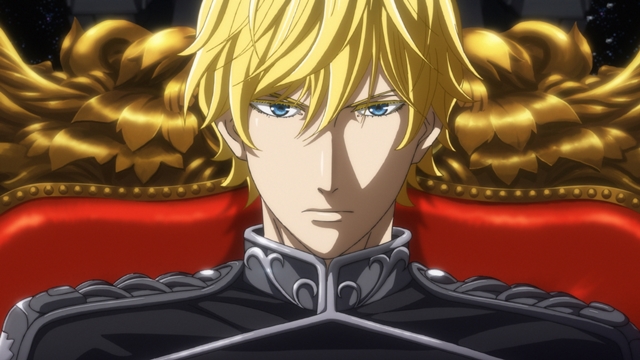
CV: Mamoru Miyano
One of the main characters. He is a young senior general of the Galactic Empire. Despite his young age, he has achieved many feats of valor and risen to the upper echelons of the Imperial Army. He hates the emperor who took his sister away from him, and has doubts about the current system of the empire, where the tyranny of the aristocrats is still prevalent, and secretly vows to overthrow the dynasty and change the current system of the empire.
Jan Wenli
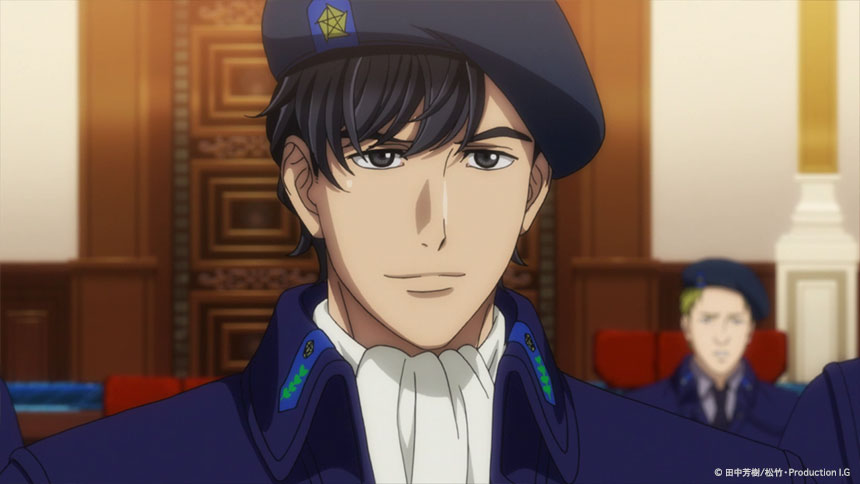
CV: Kenichi Suzumura
Brigadier General of the Free Planet Alliance. He has no desire to be a soldier and has an aversion to power, war, and the military. He is an elusive character, but he is known as an "undefeatable magician" with an outstanding strategic and tactical mind.
galactic empire

Contents
- The Legend of the Galactic Heroes: Die Neue These" Overview
- The Legend of the Galactic Heroes: Die Neue These
- Astarte Conference (1922)
- Seventh Iserlohn Offensive
- Alliance invasion of Imperial territory / Amritsa's folly
- Battle of Lippstadt / Civil War in the Reich
- Eighth Iserlohn Offensive
- fall of the Fezzan
- Characters in "The Legend of the Galactic Heroes: Die Neue These
- protagonist
- Reinhard von Lohengram.
- Jan Wenli
- galactic empire
- Siegfried Kirchheiss.
- Paul von Oberstein
- Wolfgang Mittermeier
- Oscar von Leuenthal
- Anne Rose von Grunewald
- Free Planet Alliance
- Julian Mintz
- Alex Caserne
- Frederica Greenhill.
- Walter von Schoenkopf
- Terms for The Legend of the Galactic Heroes: Die Neue These
- Golden Baum Dynasty Galactic Empire
- Free Planet Alliance
- FL
- Brünhild
- Theme and insert songs for "The Legend of the Galactic Heroes: Die Neue These
- OP (Opening): SawanoHiroyuki[nZk]:Uru "Binary Star
- ED (Ending): ELISA "WISH