
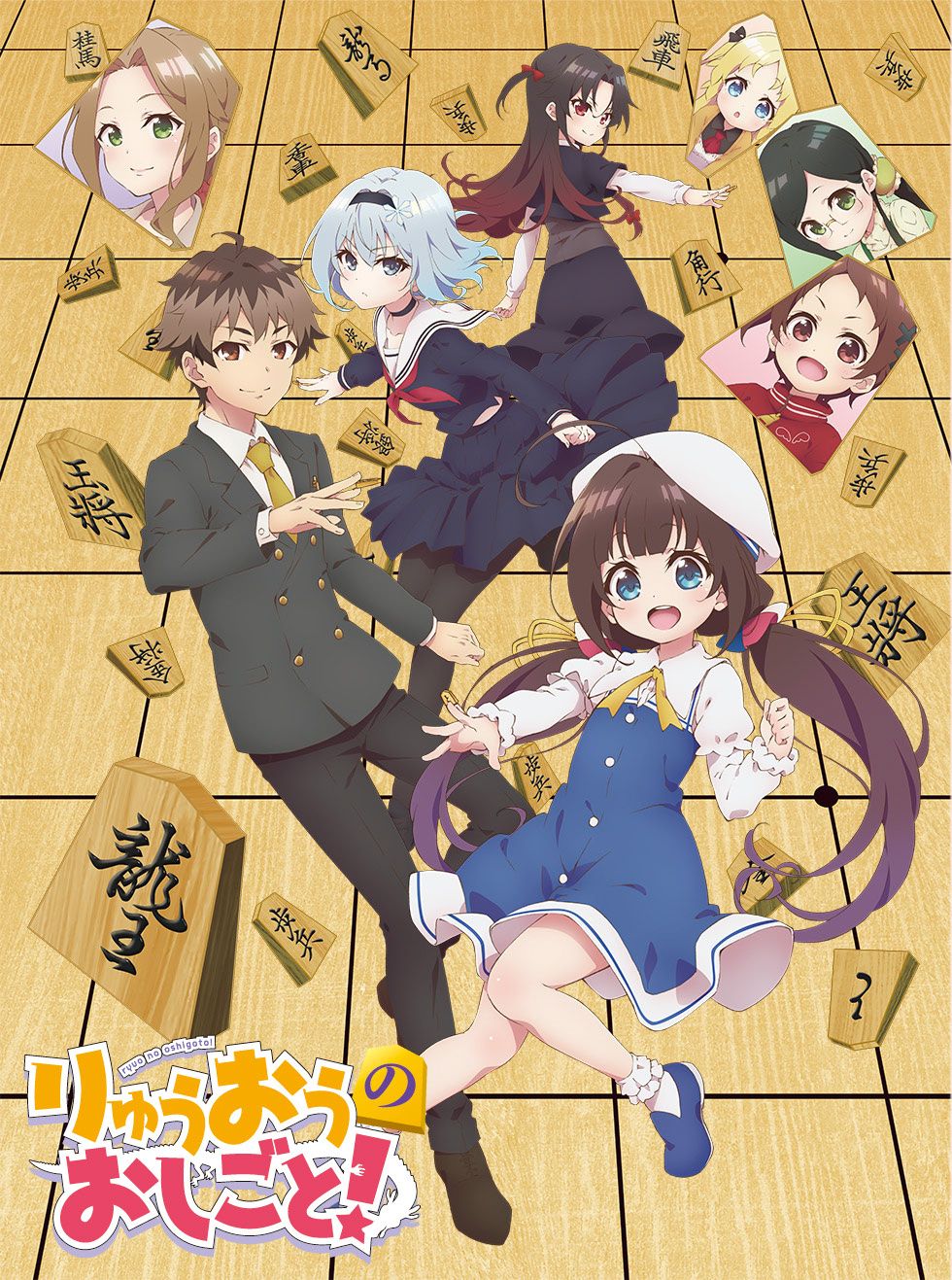
The "Central City! is a light novel by Shiro Shiratori. It is about young professionals living in the world of Shogi, and was adapted into an anime in 2018. The animation was produced by project No.9 and directed by Shinsuke Yanagi.
Ai Hinazuru Ai, a third grader, suddenly arrives at the door of 16-year-old Yaichi Kutouryu, who holds one of the titles in the world of Shogi. Ai insists that she has promised to be his apprentice, and she becomes Yaichi's on-the-go apprentice. Hachikazu, who had been suffering from burnout syndrome, learns of Ai's extraordinary talent as a professional chess player through training her, and he himself begins to face shogi once again.
Miu Takeuchi

CV: Aya Harada
Ai's classmate in Osaka.
She is a prudish character who tells Ai about her mature views on love.
Terms used in "Central City! Terminology
if it were only ...
An Ishikawa dialect often used by Ai.
It means "fool".
speckled edge
It has a stronger meaning than "slack."
sudden death
A word often used by Ginko.
It means to die suddenly. Sudden death.
In Shogi, to be choked by failing to see the tsume of one's own Osho.
It is a mystery which meaning Ginko uses.
Tsume-shogi (Japanese chess game)
Shogi puzzle using Shogi rules.
This puzzle is based on the rules of Shogi, a Japanese chess game in which the pieces are arranged in a Shogi position.
Ai is good at this, and according to Yaichi, Ai is the "God of Stuffed Shogi".
intertwining two or more people's lives together (e.g. a husband and wife)
A strategy in which Yaichi or Ai is good at.
It is one of the Shogi strategies. It has existed since the Edo period.
Ibisha Furibisha
Shogi strategies can be broadly divided into two categories.
One is classification by offense and the other is classification by defense (enclosure).
Most professionals use only one of these two as their strong points.
It is rare for professionals to use both of them.
Yaichi was originally an iaibisha player, but learned furibisha in the game against Santo伐.
Judging
The offensive pieces should work well.
Mitsuru Ikushi Tamasho is known as a master of handling, and Yaichi learns from him how to handle furi-hisha while he teaches her how to handle it.
encouragement association
The Japan Shogi Association is a public interest incorporated association established by the Japan Shogi Federation for the purpose of promoting and developing Shogi as a traditional culture, improving techniques, and promoting friendship and exchange through Shogi.
It is a professional Shogi training organization.
(To be precise, the organization is called "Shinkin Kishi Shorei Kyokai.
Basically, the age limit for joining the association is 19 years old or younger, and the minimum age requirement is 3 or 4-dan amateur level or higher.
workshop
Equivalent to a subordinate organization of Shorei Association.
An organization operated by the Japan Shogi Federation for the purpose of fostering healthy boys and girls through Shogi.
The organization does not aim to train professional players.
professional woman go player
A woman who plays Shogi as a profession and participates in the Women's Ki Tournament.
Originally, there was no gender discrimination in Shogi, and a woman could become a professional Go player by joining the Shogi-Shogi-Kai and achieving the required results to become a 4-dan player.
However, there are currently no women who have become professional shogi players.
The Women's Professional Shogi Association was created for the purpose of promoting Shogi to women, in addition to the professional Shogi players.
Women who are under 27 years old and meet certain conditions are qualified for Women's 2nd level.
Conditions
The applicant must be promoted to B2 class at a training session, or join B2 or above from the beginning and play 48 games or more after joining.
The applicant must have achieved the required number of games in official tournaments in which amateurs are allowed to participate.

Contents
- Overview of "Central City! Outline of "Rio no Oshigoto!
- The story of "Central City! Storyline
- New apprentices are elementary school students
- Rivalry
- The Battle of the Women Goers
- Game with a Meijin
- The characters and characters of "Central City! Characters and Characters of "Rio no Oshigoto!
- Yaichi Kuzuryu
- Ai Hinatsuru
- Sora Ginko
- Yashajin Ai
- Keika Kiyotaki
- Kosuke Kiyotaki
- Mio Mizukoshi
- Ayano Sadato
- Charlotte Izoard
- Ayumu Kannabe
- Seiichi Tsukimitsu
- Oga Sasari
- Yoshitsune Kuruno
- Mitsuru Oishi
- Natagiri Jin
- Akira Ikeda
- Tsukuyomizaka aburi
- Kugui Machi
- Only a bull's-eye.
- Rina Shakado
- Sainokami Ika (The god of thunder)
- Tamayo Rokuroba
- Kazumi Horaku
- master
- Asuka Oishi
- Akina Hinatsuru
- Takashi Hinatsuru
- Yashajin Koten
- Miu Takeuchi
- Terms used in "Central City! Terminology
- if it were only ...
- speckled edge
- sudden death
- Tsume-shogi (Japanese chess game)
- intertwining two or more people's lives together (e.g. a husband and wife)
- Ibisha Furibisha
- Judging
- encouragement association
- workshop
- professional woman go player
- Words of wisdom, famous lines, famous scenes, and famous scenes from "Central City! Famous quotes and lines / Famous scenes / Famous scenes from "Rio no Oshigoto!
- Ai "like this...like this..."
- Ginko: "Next time, we'll take them down in the shortest amount of time."
- Kiyotaki: "Not every disciple of a Meijin can become the next Meijin."
- Ginko: "Tonkatsu!"
- Yaichi said, "Reversal is almost impossible. But we cannot give up here. There is only one way to make the impossible possible, and that is... to challenge the impossible."
- Katsuraka: "No effort goes unrewarded. I fought to prove it."
- Yaichi: "Totally school kids are the best!"
- Ai: "Please teach me chess!"
- The story behind the "Central City! Backstory, trivia, small stories/episodes, and anecdotes of
- The process of creating "Central City! is in the works.
- Reality and Fiction in the Shogi World
- The title the author wanted to give
- Yaichi's name
- The theme song of "Central City! theme song
- OP (Opening): Machico "Korekara
- ED (Ending): Miki Ito "For what you want to protect
- ED (Ending): Miki Ito "Ano Hi no Yume