
Although the image of soccer players as upper-class, luxury-car-driving men is deeply rooted in the minds of many, many of the players selected for the Japanese men's national team are surprisingly hard-working. They are not born elites, but have earned their place in the national team through hard, blood-soaked efforts. Here is a list of such non-elite players.
Keisuke Honda
Source: blog-imgs-44.fc2.com
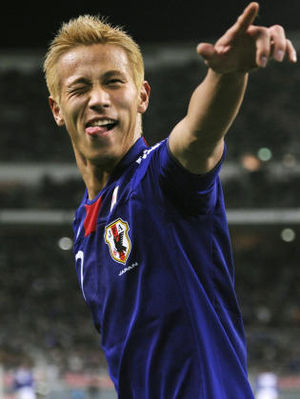
Keisuke Honda
CSKA Muscovite, who lost his position in the South African World Cup partly due to Shunsuke Nakamura's poor performance, has been Japan's absolute ace ever since.
He was born in Settsu-shi, Settsu-shi. His parents were divorced in the spring of the second year of elementary school. When he was a child, he went to Torikai Satsuki-en. When he was in the second year of Torikai Kita Elementary School, he joined the local Settu Football Club and started playing soccer. He entered Settsu-shi Dainichi Junior High School. During his junior high school days, he was nicknamed "Gori" (for his heavy arm wrestling with a red tank top and jeans). Later, he joined Gamba Osaka Junior Youth and played with Akihiro Ienaga, Michihiro Yasuda, and Masaaki Higashiguchi, but was not promoted to the youth team, so he went on to Seiryo High School in Ishikawa.
Source: ja.wikipedia.org
She herself often says in interviews that "the starting point was that she was not promoted to Gamba Osaka Junior Youth."
Shinji Kagawa
Source: 2chfootball.net
Shinji Kagawa
He joined Manchester United from the 2012 / 2013 season as Dortmund's ace in the 2011 / 2012 season, leading the team to two consecutive wins.
After failing the junior youth selection by Vissel Kobe, he was recommended by the coach of Kobe NK, who had a connection with the first coach of FC Miyagi Barcelona (Sendai City, Miyagi Prefecture), to study soccer in Sendai from junior high school.
Source: ja.wikipedia.org
Since I was active in Cerezo since I was young, I thought it was on the Elite Road, but it was not selected by Vissel. In the case of Kagawa, the defeat in South Africa World Cup must be one of the setbacks.
Yuto Nagatomo
Source: www.goal.com
Yuto Nagatomo
In 2010, he moved to Cesena of Italy's Serie A. During the season, he moved to the prestigious Intel and became a regular player with his dedicated movement. He is also known for being trusted by his teammates.
He started playing soccer when he was in the first year of elementary school and was selected for Ehime F.C. Junior Youth in the sixth year, but failed. He met his former teacher, Hiroshi Inoue, when he was in Saijo City Kita Junior High School. His running during this period made the base of his current abundant amount of exercise. He was selected as a regular at the second year of Higashifukuoka High School, a strong soccer team, under Jun'ya Morishige, but he was not selected for the regional selection and was unknown nationwide, so he was not recommended for sports. He entered the Faculty of Political Science and Economics of Meiji University, where he was going to, with a designated school recommendation.
Source: ja.wikipedia.org
In 2005, immediately after joining the Meiji University Soccer Club, he developed a herniated disc and was unable to play in the game, so he spent days cheering at the stands. During this period, he was stressed out from not being able to play soccer and spent days playing pachinko and other games, but thanks to the encouragement of his older sister and university alumni, he was able to overcome this. In 2006, when he was in his second year at university, he was converted from a side half to a right side back. Coach Akihiko Kamikawa, who was affiliated with Meiji University, said that the reason he converted Nagatomo to a right side back was to make use of his physical strength, running ability, and ability to complete attacks.
Source: ja.wikipedia.org
A few years ago, Intel's steady left side back didn't join the team as a starting member at the university, so they cheered by playing the drum at the stand.
Shunsuke Nakamura
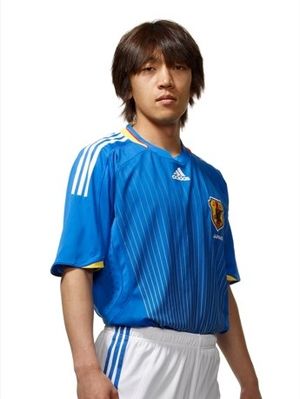
Source: images.keizai.biz
Shunsuke Nakamura
Yokohama Marinos → Regina → Celtic → Espanyol → Yokohama F. Marinos. Led the team as No. 10 of the Japanese national team for a long time. During the Celtic period, he scored a free kick against Manchester United at Old Trafford, which is still talked about.
In 1985, he joined 深園 FC and started playing soccer. From 1991 to 1994, he belonged to the Yokohama F. Marinos Junior Youth League and won the national championship twice, but he could not be promoted to a youth player. In 1994, he entered Kirimitsu Gakuen High School and joined the soccer club. He participated in the National High School Soccer Championship in his second year of high school and won the second place in the third year of high school.
Source: ja.wikipedia.org
It was shocking when he was excluded by Tourssier in the 2002 World Cup. After that, Shunsuke moved to a foreign country, but when his teammates asked him, "Why didn't you participate in the World Cup?", he answered honestly, "It's because you don't have enough real strength." He has reached the level of a veteran player, but I want him to play hard forever.
Yuji Nakazawa
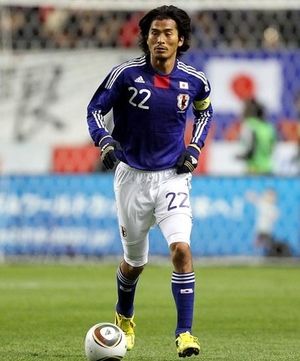
Source: football-uniform.up.seesaa.net
Yuji Nakazawa
At the World Cup in 2006 and 2010, he worked hard as a center back. His characteristic hairstyle was devised in his own way so that it would catch the attention of the upper management of the team even a little when he was a Verdi trainee.
From childhood to studying in Brazil
He started playing soccer in the sixth grade of elementary school, which was later than other professional players. Since the Misato Technical High School in Saitama Prefecture was not a prestigious school of soccer, he planned to go to Brasil to study soccer to increase the value of selling to the J. League after graduation. He joined the Brazilian soccer club FC America and was gradually used for practice matches. His teammates included ジウベウト and Silva. A year later, when he returned to Japan to renew his visa, he gave up playing in Brazil because he did not receive the necessary documents from the club.
Source: ja.wikipedia.org
When I was a student trainee
He tried to sell it to J. League clubs, but was not invited by any of them. He continued to practice with the students in his alma mater's soccer club. In 1998, he scored a goal in a practice match with the youth team of Verdi Kawasaki, which led to his joining the team under a trainee contract. Under the trainee contract, he is not paid a salary, but pays the necessary expenses to the club to participate in the practice. If he is approved, he can practice with a professional, but the club does not provide financial support such as transportation expenses, so he joined the practice at his own expense. He took two hours of one way training from Yoshikawa City, Saitama-ken, to Inagi City, Tokyo-to, where Verdi's practice range is located (the transportation fee is about 1800 yen for a round trip). The treatment and memories of this time seemed to be a humiliation for him, and he spent all his time with the monotonous repetition of basic physical strength training while watching the training of the professional, and he sighed with the trainer who accompanied him in the training.
Source: ja.wikipedia.org
Performance in the J. League
He became a professional player in 1999. In the same season, he took the regular position, won the J-League Rookie of the Year award, and was invited to the Sydney Olympics by Tourssier's team to participate in the Sydney Olympics.
Source: ja.wikipedia.org
It is well known that when I was a Verdi trainee, I didn't hesitate to tackle Kazu, who was a superstar at that time, and Kazu got angry. However, when I think about Nakazawa at that time, he was desperate. A player like Nakazawa who is full of guts will be important in Japan in the future too.
