
A massively multiplayer online game distributed by Wargaming.net, in which players deal with tanks and other vehicles that have appeared in historical reality. The online TPS game features more than 350 types of tanks from the United States, the Soviet Union, Germany, and other countries involved in World War II, which were developed and designed mainly between 1920 and 1960, and the goal is to destroy enemy tanks in tank battles.
The service was launched in 2011. The game is also available in Japanese and has been expanded to PS4 and iOS applications.
caliber
The size of the muzzle diameter as seen from the front of the main gun. The caliber determines the approximate power of the main gun.
Although all the units are in millimeters (mm), they are often expressed in pounds (pdr), perhaps because only the United Kingdom has adopted the pound system.
rate of fire
Approximate maximum number of times a shot can be fired in one minute. It may vary depending on the skill and proficiency of the crew.
The larger the caliber, the slower the rate of fire (speed of loading) tends to be.
Average penetrating power
The difference in penetrating power depending on the type of ammunition that can be fired by that main gun.
These are average values, and in rare cases the penetration may be greater or less than the values.
(ammunition) cartridge
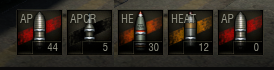
AP (armor-piercing bullet), APCR (hard-core armor-piercing bullet), HE (grenade), HEAT (armor-piercing grenade), AP (enhanced AP bullet) *Icons are identical
In all, there are five different types of ammunition that can be fired by the main gun. Tanks are equipped with up to three types of ammunition.
AP (armor-piercing round): the most basic round, the standard round used to penetrate enemy armor.
HE (howitzer): ammunition that explodes when it lands to attack enemy infantry. It has low penetrating power but does a lot of damage, and a blast is present.
APCR (hard-core armor-piercing round): Commonly referred to as a gold bullet, it has a higher credit price than AP and HE rounds. ammunition with significantly higher penetration than AP rounds.
HEAT (armor-piercing grenade): A grenade that has the penetrating power of AP rounds and is treated as a gold bullet like the APCR.
Reinforced AP (reinforced armor-piercing ammunition): This ammunition is installed in some tanks in place of the APCR, and is in fact a backward-compatible ammunition of the APCR. Like the APCR, it is a gold bullet.
Average Damage
The average damage of each of the three types of ammunition in the tank. Like penetration, it can go up or down.
In the case of this main gun, it is AP/APCR/HE.
Distribution of impact at 100m
It is a guideline for the accuracy of the main gun, the lower the better.
In the case of 0.45, it means that if you aim at a target from a distance of 100 meters, you may miss by up to 4.5 meters from where you are aiming.
The greater the distance, the greater the difference.
aiming time
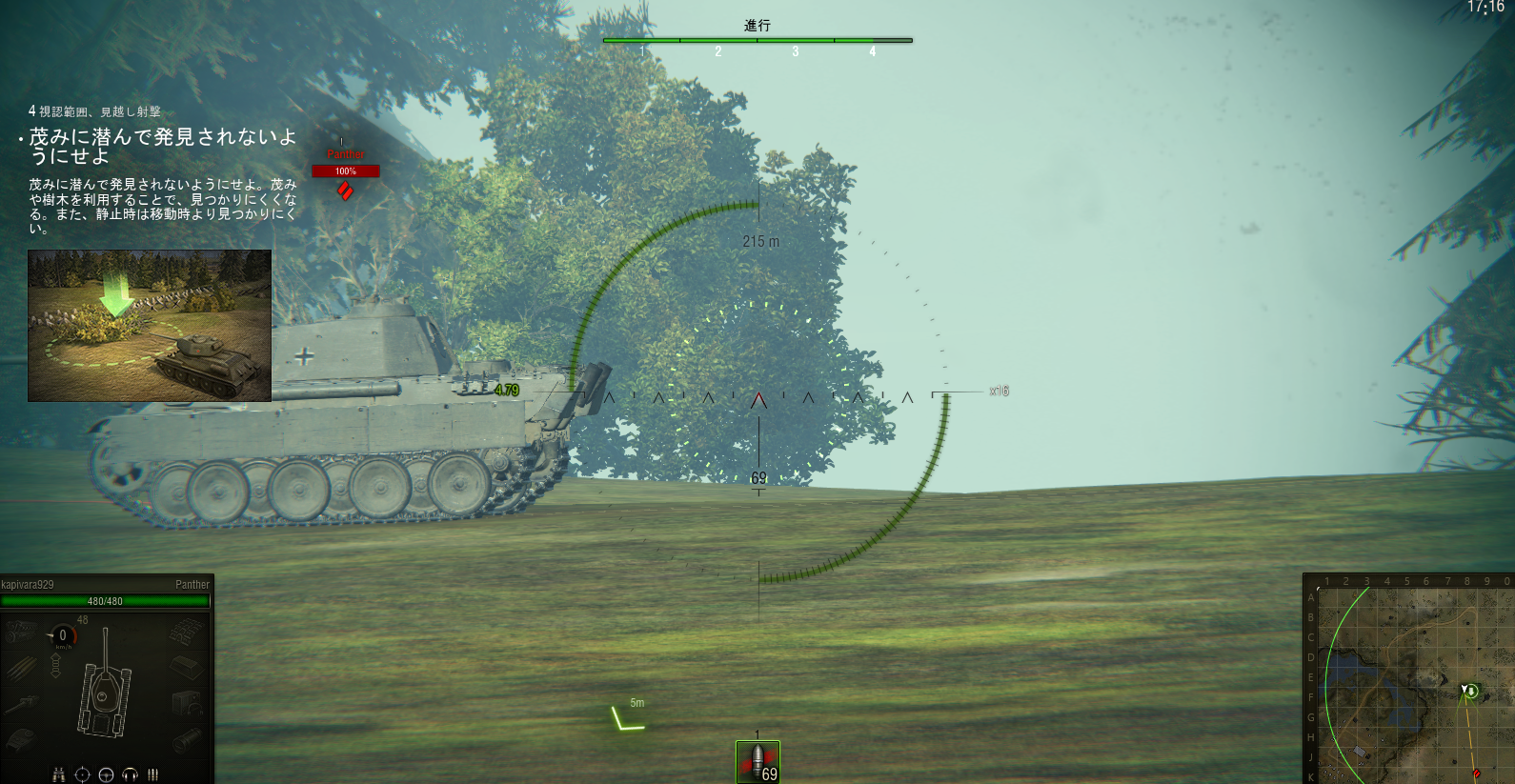
The green dotted circle in the center is the convergence circle.
The aiming method in this game is based on a "aiming circle" that follows the reticle displayed in the center of the screen.
The time it takes for the circle to fully converge after it has diffused to its maximum is called the "aiming time.
The aiming circle will spread out immediately after firing, when moving, or when moving the sights, and will automatically converge if the sights are not moved.
If the gunner does not move the circle, it will automatically converge. Accuracy also seems to vary greatly depending on the gunner's proficiency.
weight
The maximum load capacity of a tank's crawler is set, making it impossible to carry equipment beyond that limit.
All parts of the tank except the crawler have a set weight, and the payload can be increased by developing the crawler or purchasing additional equipment. In some cases, enhanced payload may not be necessary.
armored

Each tank is armored to nullify all bullets with penetrations below its armor thickness.
From left to right: front/side/rear armor arrangement.
The set armor thickness is the actual armor thickness when the tank is hit by bullets from directly in front, and bullets may be repelled depending on the "angle of incidence" of the bullet *see below.
Bullets are repelled by armor.
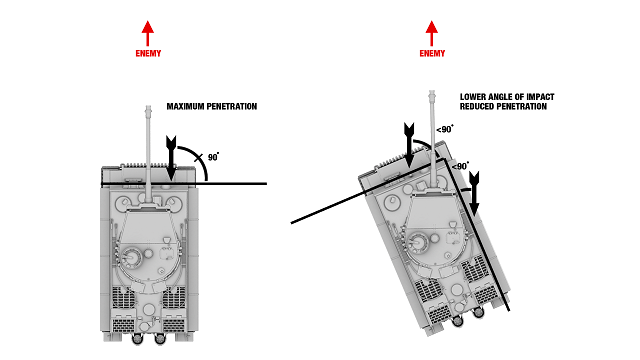
This is a system unique to tanks, and it is no exaggeration to say that it is an important element.
The tank is armored in various parts, which refers to the thickness of the steel plate. The thickness of armor varies from tank to tank, but most heavy tanks are heavily armored.
The tank used in the image is a square tank when viewed from above.
For example, the frontal armor thickness of this tank is 100mm. In this case, it would be penetrated by a bullet with a penetrating power of 100 mm or more at an almost right-angle angle.
However, by tilting the tank toward the front as shown in the image on the right, the "angle of incidence" of the fired projectile can be changed, and armor thickness of 100 mm or more can be secured in effect.
This method was actually used in Germany during the war, and is called the "lunch angle" in the game, since the angle of the tank is turned toward the 12 o'clock direction.


Contents
- Overview of "World of Tanks
- game mode
- random game
- conventional warfare
- battle
- assault
- grand battle
- The "World of Tanks" game system
- About Tanks
- About the Main Cannon
- caliber
- rate of fire
- Average penetrating power
- (ammunition) cartridge
- Average Damage
- Distribution of impact at 100m
- aiming time
- weight
- armored
- Bullets are repelled by armor.
- Spot (found)
- Concealment rate
- Tier
- Types of Vehicles Appearing
- Tank Classification
- Light Tank
- Medium Tank
- Heavy Tank
- Tank Destroyer
- Self Propelled Artillery
- Countries in which they appear
- America
- United Kingdom
- Russia (former Soviet Union)
- Germany
- France
- China
- Japan
- Czechoslovakia
- Sweden
- Poland
- Items from "World of Tanks
- Items for manual use (some are used automatically during combat)
- Repair Kit
- first-aid kit
- Fire extinguishers, automatic fire extinguishing systems
- Deactivation of speed limiting devices
- Items used automatically at the start of combat
- 100 octane gasoline, 105 octane gasoline
- Lend Lease Oil, premium oil
- Crew Capacity Improvement (Food and Beverage)
- crew member
- Chief of the train
- Pilot
- Radio operator (radio operator)
- Gunner
- Loader
- Terms for World of Tanks
- WG
- World War II
- LT
- MT
- http
- TD
- SPG, Arty
- module
- elite tank
- price tank
- (Christmas) tree
- crew member
- Experience, free experience
- credit
- mini-map
- (Internet) chat
- disparity platoon
- Backstories, trivia, and small stories/episodes and anecdotes from "World of Tanks".
- April Fool's Day Events
- Officials distribute mods