
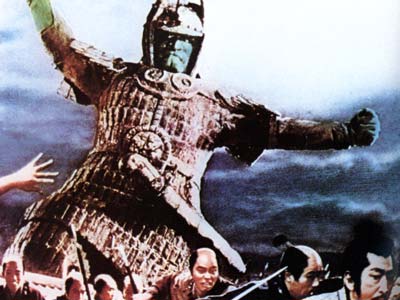
Daimajin" is the name of a guardian god who appears in the film. Daimajin" is the name of the guardian god appearing in the films, who usually has a mild expression on his face, but once he becomes angry, his expression changes to one of rage. Each work has its own independent episode.
Outline of "Daimajin
The "Daimajin" film series, consisting of "Daimajin," "Daimajin Angry," and "Daimajin Strikes Back," is a Japanese special effects period drama, all three of which were produced and released by Daiei (now KADOKAWA) in 1966.
Riding on the momentum of "Daikaiju Gamera," Daiei's highly successful film beyond the Toho monster films, "Daimajin" was shown simultaneously with "Gamera vs. Barugon," the second in the Gamera series, as a GW program in 1966. This double release of a tokusatsu monster movie, which even Toho, the original home of tokusatsu monster movies, had not been able to achieve, created a huge sensation. The second film, "Daimajin Angry," was released in July of the same year, followed by the third film, "Daimajin Strikes Back," in December of the same year.
Each film has its own episode and different characters, but they all take place in Japan's Warring States Period. When evil people conspire against the people and the people are oppressed, the Daimajin, a stone statue with a peaceful expression, begins to move, and at the climax of the film, he displays his destructive power and defeats the evil people.
Produced at Daiei's Kyoto Studios, the home of period dramas, each film was directed by one of Daiei's leading veteran directors of the time, Kimiyoshi Yasuda, Kenji Misumi, and Issei Mori. The screenplays for all three films were written by Tetsuro Yoshida, Daiei's exclusive screenwriter of the "Zatoichi" and "Akamodo Suzunosuke" series, and they have a profound reality as period dramas.
The film and special effects cinematographer, Tomijiro Morita, and special effects director, Yoshiyuki Kuroda, were classmates in elementary school, making them a great duo. The superb special effects technology that became their masterpiece was said to have led to an invitation from Tsuburaya Productions shortly afterward.
The music was composed by Akira Ifukube, a leading Japanese composer who has composed music for many films, including Toho's "Godzilla" series. At first, Ifukube said, "I had a godly image of Godzilla, but when I saw the movie, I was surprised to see a blue-black face with bloodshot eyeballs staring at me, which was a big surprise. He gave this demi-god a very impressive theme tune consisting of three scales, which builds a profound depth to the world of the work.
The original proposal for "Daimajin" was submitted at a planning meeting held at Daiei's headquarters in 1965. The title of the proposal was "Daimajin ga Ngeru" ("Daimajin Appears"). It was proposed as a unique special effects period drama adapted from the legend of the Golem depicted in the Czechoslovakian fantasy spectacle film "Golem the Giant" (1936, dir. Julien Duvivier). Around that time, Daiei Kyoto Studio produced the Japan-U.S. co-production of an aerial special effects film "Flight from Ashiya" (directed by Michael Anderson), and it is said that this film perfected the special effects technology using blue-back compositing, which led to the proposal of the project.
Synopsis and story of "Daimajin
The first film "Daimajin
During the Sengoku period (1467-1568), on the night of the Hanabusa fief in the Land of Tamba, when the local people were holding a festival to seal off the evil gods, the lord Hanabusa Tadakiyo was killed along with his wife, and his children, the young Tadafumi and Kosasa, were also targeted. However, they are rescued by their loyal retainer, Sarumaru Kogenta, and escape to the mountain of the devil god, a sacred place from which no pursuers can come.
Ten years passed, and Tadafumi and Kozasa grew up to be a strong young man and a beautiful young woman, respectively. They are living in hiding, sheltered by Shinobu, a priestess who is Kogenta's aunt, near the statue of the god of war, which has sealed the demonic god.
Meanwhile, in his territory, Samanosuke was committing tyranny by forcing his people to do hard labor to build a fortress. Tadafumi wants to avenge his hated Samanosuke as soon as possible, but first, Kogenta goes down to the village to check on the situation in the territory. Kogenta blunders into the territory, but his true identity is discovered and he is captured. Takebo, a child of the villagers, sees this and escapes from the territory and comes to Oyama to ask for help. Tadafumi, who had learned about Kogenta, secretly descends the mountain to help him without telling Shinobu and Ozasa, but is caught in a trap by Inukami Gunjuro, a member of the Samanosuke faction, and is captured himself.
This time, even the priestess Shinobu goes to the fiefdom herself, and tells Samanosuke that if he continues to torment the people, there will be divine punishment by a demon god. Furthermore, Gunjuro, who had received an order from Samanosuke to destroy the statue of the god of war, comes up to the mountain of the devil, and unluckily, Kosasa and Takebo are found by him. There, Kosasa learns that Tadafumi and Kogenta are to be executed in the Ming Dynasty. When a stake was driven deeply into the forehead of the statue of the god of war, blood flowed from the forehead of the statue, a divine wind blew and thunder roared. Then, Gunjuro and other members of Samanosuke's crew were swallowed one by one by the cracks in the earth. When Kozasa eventually came to, the area was calm as if nothing had happened. He prayed desperately to the statue of the god of war to save his brother and Kogenta, and finally tried to offer himself from the top of the cliff where the waterfall cascaded down. At that moment, the statue of the god of war began to walk. It changed its calm face into a terrifying demi-god.
In the territory, the crucifixion of Tadafumi and Kogenta was about to be carried out. Kozasa and Takebo rushed to the scene, the villagers prayed to the gods, and Samanosuke looked proud of his victory. At that moment, however, a dark cloud suddenly appeared, the wind blew, a ray of light fell to the ground, and suddenly it took the form of a gigantic demon god. The demonic god broke through the fortress and invaded the castle. The castle soldiers, desperately trying to stop it, are crushed one by one and disappear under the destroyed buildings. Tadafumi and Kogenta are rescued by the Hanabusa family. The demons kick the soldiers away and chase after Samanosuke. No amount of twisting iron chains or smashing rocks will stop its progress. Even when surrounded by flames, he extinguishes them with a swing of his arm. Finally, Sanosuke, unable to escape, was captured by the demigod. The demon god pinned him to the crucifixion stand and pulled out a chisel that had been driven into the demon god's forehead and thrust it deeply into his chest.
However, the demon god's anger remained unquenched, and he tried to advance further while the local people fled. Tadafumi tried to stop him, but was pushed away, and when Takebo tried to stop him as well, the demigod tried to crush him with his foot. Takebo tried to stop him, but the demigod tried to crush him with his foot. Then the demon god stopped moving.
With a desperate heart, Kosasa asks the demon god to calm his anger. When the tears of purity from his eyes fell on his feet, he turned his face into a gentle warrior god, then collapsed and disappeared into the wind.
The second film "Daimajin Angry
During the Warring States Period, the Mikoshiba territory was a place where people suffered from oppression. There, people were constantly trying to flee to the neighboring Chigusa territory.
In Yakumo no Kuni, there was a beautiful Yakumo lake between Chigusa territory and its branch Nagoshi territory, where a statue of a warrior god was worshipped as a guardian deity.
Mikoshiba Danjo, a warlord of the Mikoshiba domain, was determined to obtain the beautiful lake.
One night, Danjo unexpectedly attacked the Chigusa domain. The Chigusa fief collapsed. Juro, the lord of Chigusa, barely escaped with the help of his retainer Hayato, and was never seen again. Danjo, believing that Juro had escaped to Nagoshi, attacked the Nagoshi territory, killed the lord, and captured his eldest son, Katsushige, as a hostage. Hayuri, Katsushige's younger sister and Juro's fiancee, escapes Danjo's clutches and goes with his servant Tadaira to a statue of the god of war on the island of Kami in the lake to pray for the restoration of his family and peace.
Meanwhile, the Genshikan, under Danjo's command, arrives at the lake and attempts to blow up the statue of Takejin by setting a large quantity of gunpowder on it. When Hayuri and Taira rushed to the statue to stop him, a huge explosion occurred. The statue is reduced to rubble and crumbles into the lake. The Genkan clan pulls up, somewhat dismayed that no haunting or other event has occurred. Hayayuri and Tadaira, strangely enough, did not suffer even a scratch. Then a small boat came swinging by. Juro and Hayato were lying there, injured. Juro, who had been treated by Hayuri, immediately set sail with Hayato to go to Chigusa to save Katsushige. However, a ship carrying the Gemban's men approached them looking for Juro. Just as they encountered each other, there was a sudden surge of high waves on the lake, and the Genkan boat disappeared to the bottom of the lake.
Juro, saved by the gods, returns to Chigusa and once captures Danjo, but he is caught in the gap and escapes, and Juro decides to flee for the safety of his people. Danjo, thinking Juro would flee to Nagoshi, told the men of Nagoshi that he would slay Katsumo, a hostage, if Juro did not hand him over. On the morning of Katsushige's execution, a battered boat washes up on the shore of the lake. There, he found a man of the Genshikan's hand poked in the chest with a stone statue stake. Amidst the commotion, Katsushige is rescued by a courageous local boy and escapes in a small boat to the island of Kami. At the same time, Danjo's forces were at work on Kami no Shima, and Hayuri was captured. The boat with Katsushige on board meets Juro's boat, which happens to be returning near Kami no Shima, but at that moment, it is surrounded by Danjo's men. All were then captured and executed.
In Chigusa, Juro and the other captives were crucified while the local people looked on. As Danjo's high pitched laugh echoes around the area, Hayuri is burned at the stake. Shedding tears, Hayuri prays to God to protect everyone by giving her life.
At that moment, a statue of the god of war appears from the bottom of the lake and transforms into a demon god in the shape of an angry man. The lake then splits in two and becomes a path, along which the demi-god moves with ease.
A gust of wind blows over the place of execution and the fire is extinguished. The sound of heavy footsteps echoed around the panicked Danjo and the others, and the stone wall collapsed, revealing the demigod.
The demigod first breaks off the Hayayuri crucifix and gently places it on the ground, then glares at Danjo with a snap. Danjo tries to holed up in the castle. The desperate counterattack from the castle is of no use in front of the demigod, who turns the area into a pile of rubble. He tries to blow it up along with a large amount of gunpowder, but the demigod cannot even get a scratch on him.
Danjo then tries to escape to the lake alone in a boat, but when he is cornered by the demigod, the flames of the demigod's anger run over the lake and burn the boat. Danjo tries to escape to the top of the mast, but he is engulfed in flames as he is burned at the stake on the boat, which eventually burns to the ground.
The area cleared up as if nothing had happened, and as Hayayuri's tears of gratitude fell into the lake, the demi-god disappeared back into his original peaceful warrior god face.
Third film "Daimajin Gyakushuu" (The Great Demon Strikes Back)
During the Warring States Period, when it was believed that all disasters such as heavy snowfalls and floods were the divine work of the Arakami, who lived in the Devil's Mountain, the men in the village of Uryu-no-sato were preparing to welcome the New Year when one of them named Sanpei came running out of breath as he was returning from his work in the mountains to welcome them.
According to Sanpei, Arakawa Hidamori, a warlord from Uryu no Sato who is aiming to conquer neighboring countries in war, has captured villagers who were working in the mountains and forced them to work in order to build a factory to produce gunpowder in Jigokudani. He wants to escape from Hell Valley somehow, but it is very impossible because the eyes of enemies are shining everywhere, so he has no choice but to cross the mountain of the demon god who is said to be possessed and no one will go near him. I escaped by going over there. So he wants to go to Hell Valley again to tell his captors about it. But when Sanpei finishes telling the villagers everything, he dies. With only women, children, and old people left in the village, there is no one who can cross the soon-to-be snow-covered mountain. However, three children, Tsurukichi, who is waiting for his father, Daisaku, who is alone with his brother, and Kinta, the younger brother of the dead Sanpei, set out for the mountain of the evil god without the villagers' knowledge.
Just as they are about to enter the mountain of the evil god, Tsurukichi's young brother Sugimatsu stops them from behind. He had been following him all the way. Tsurumatsu had no choice but to join them, and the four of them finally entered the mountain of the evil god. As they climbed the steep rocky mountain, a rock collapsed over their heads and the four fell to the bottom of the cliff, fainting. When they looked up in the sky, they saw a large hawk watching over them. They managed to safely arrive at the top of the Demon God's mountain. The four of them prayed, "Please allow us to cross this mountain from now on. Then the hawk circled in the air. This hawk was the messenger of the demon god. After walking for a while, they were eating nigiri-meshi (rice balls) they had brought with them when they were discovered by three samurai pursuers used by Hida Mamoru to capture the fleeing Sanpei. The four men, all of whom were armed with firearms, joined forces to fend off their pursuers and finally crossed the mountain of the demon god.
Meanwhile, in Hell Valley, Tsurukichi's father, Kibei, and Daisaku's brother, Shohachi, were annoyed that Sanpei had not returned to them by the time they arrived.
Tsurukichi and the other four children, who had no way of knowing this, continued onward until they came to a riverbank, but there was no way out. They make a raft to go down the river, but the current becomes swift and the raft breaks when it hits a rock, and all four are thrown into the river. Tsurukichi and Daisaku were unhurt, but Kinta, who had injured his leg, saved Sugimatsu and was swept away by the rapids. As night fell, they made a campfire and decided to leave early in the morning because they smelled sulfur and thought that Jigokudani was close by.
Construction had been completed in the snowy Jigokudani. Hida Mamoru, in order to attack the neighboring country, presses the villagers to show him the way out of the country, but they refuse, saying that it is impossible with this snow, and he threatens to take them to the sulfur spring if they do not tell him.
Tsurukichi and the other three were dizzy from the snow and fatigue. Daisaku and Sugimatsu collapse halfway up the snowy mountain. Tsurukichi shook Daisaku and Sugimatsu to wake them up, as they would die if they fell asleep. Just as the samurai were setting up their firearms, a hawk flew in and attacked the samurai one after another, but the hawk was shot. Tsurukichi buried the dead hawk with snow and put his own amulet on it. He stood on the cliff and threw himself into the valley, hoping that if Kinta's death and the heavy snowfall had angered the demon god, he would appease his wrath and vowing to give his life in exchange. Then, the giant statue of the demon god's mountain suddenly moves and is enveloped in light as it transforms into an angry face. Daisaku and Sugimatsu woke up and saw the place where Tsurukichi had thrown himself into the light, and the great demon god appeared from there, holding Tsurukichi in his hand.
In Jigokudani, the villagers who would not talk were about to be dropped into a sulfur spring. At that moment, a hawk, the messenger of the gods, cried out and a furious snowstorm swept through the valley, causing the earth to shake and the Great Satan appeared. The Daimajin kicked the soldiers out of the way and pushed forward. The Hida Guard fled to the newly completed fortress to intercept the Daimajin. He attacks with log drops and cannons, but is unable to stop their advance. The fort collapses one by one and Hidamori has no choice but to flee. When Daimajin pulls out his sword and thrusts it into the ground, the earth cracks and a cliff collapses, wiping out all of his soldiers. Hidamori, cornered, is finally grabbed by the Daimajin and plunged into the sulfur spring with a single thrust of his sword.
The storm had passed. Tsurukichi and Sugimatsu were safely reunited with their father, and everyone prayed to Daimajin. Then the Daimajin returned to his gentle form as a statue of the god of war, and as the sky cleared, the statue scattered like snow.
Major characters in "Daimajin
The first film "Daimajin
Hanabusa Kozasa (played by Miwa Takada)
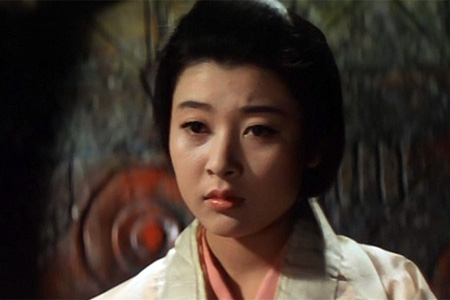
Daughter of Hanabusa Tadakiyo, lord of Hanabusa in the Land of Tamba.
Her parents were killed when she was young, and she escaped with her brother Tadafumi to the mountain of the demon god, where she eventually grew up to become a beautiful maiden.
She is the heroine of the first work, moving the hearts of the demi-gods with her strong prayers and pure tears, without regard for her own life.
Tadafumi Hanabusa (played by Yoshihiko Aoyama)
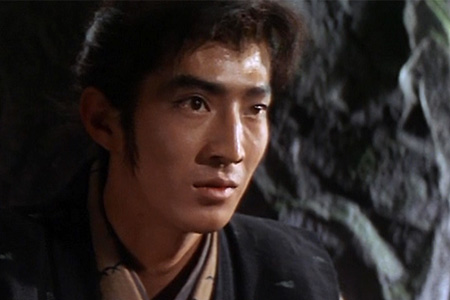
He is the elder brother of Ozasa and the young lord of the Hanabusa family.
He escapes with Ozasa to the Devil's Mountain and eventually grows up to be a fine young man.
He secretly descends the mountain to avenge the murder of his parents, but is caught in a trap by the Samanosuke faction and captured.
Sarumaru Kogenta (played by Fujimaki Jun)
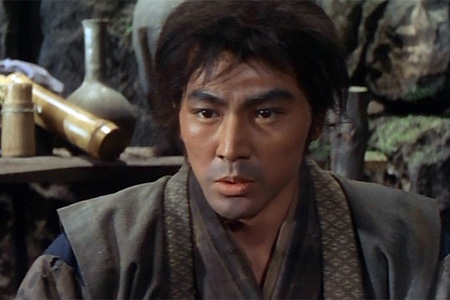
A loyal retainer of Tadakiyo Hanabusa.
He escaped to the Devil's Mountain with his young siblings Tadafumi and Kosasa and watched over them as they grew up.
He descends the mountain to investigate the situation in his territory and blends in with the local people, but is discovered by the Samanosuke faction and captured.
The second film "Daimajin Angry
Chigusa Juro Tokisada (performed by Hongo Koujiro)
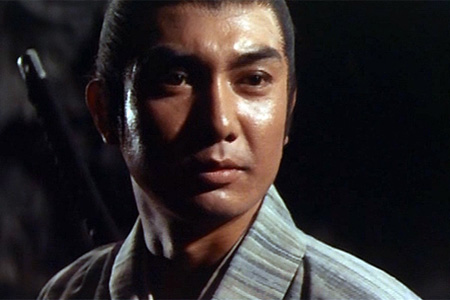
He is a young lord of the Chigusa domain in the Land of Yakumo.
He is married to Hayuri, the daughter of the lord of Nagoshi, a branch of the Chigusa domain, and they are sworn to be man and wife.
When the Chigusa domain is attacked by Mikoshiba Danjo, a warlord of the neighboring Mikoshiba domain, he attempts to escape.
He later fights back against Danjo several times, but is finally captured.

Contents
- Outline of "Daimajin
- Synopsis and story of "Daimajin
- The first film "Daimajin
- The second film "Daimajin Angry
- Third film "Daimajin Gyakushuu" (The Great Demon Strikes Back)
- Major characters in "Daimajin
- The first film "Daimajin
- Hanabusa Kozasa (played by Miwa Takada)
- Tadafumi Hanabusa (played by Yoshihiko Aoyama)
- Sarumaru Kogenta (played by Fujimaki Jun)
- The second film "Daimajin Angry
- Chigusa Juro Tokisada (performed by Hongo Koujiro)
- Hayuri (played by Shiho Fujimura)
- Third film "Daimajin Gyakushuu" (The Great Demon Strikes Back)
- Tsurukichi (played by Hideki Ninomiya)
- Daisaku (played by Shinji Horii)
- Kinta (played by Mahide Iizuka)
- Sugimatsu (played by Muneyuki Nagatomo)
- Daimajin Data
- Famous Scenes & Highlights from "Daimajin
- Scene in which Samanosuke incurs the wrath of Daimajin.
- A scene of a great demon walking across a lake that has been split in half.
- The scene where the Daimajin appears in "Daimajin Strikes Back."
- Backstory, Trivia, and Small Stories/Episodes/Anecdotes from "Daimajin
- TV version of "Daimajin" was planned.
- Appeared in TV commercials as a celebrity