
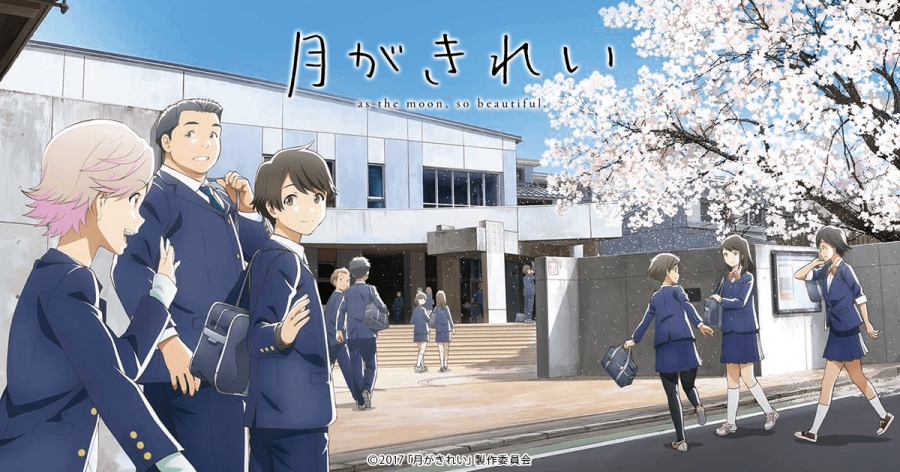
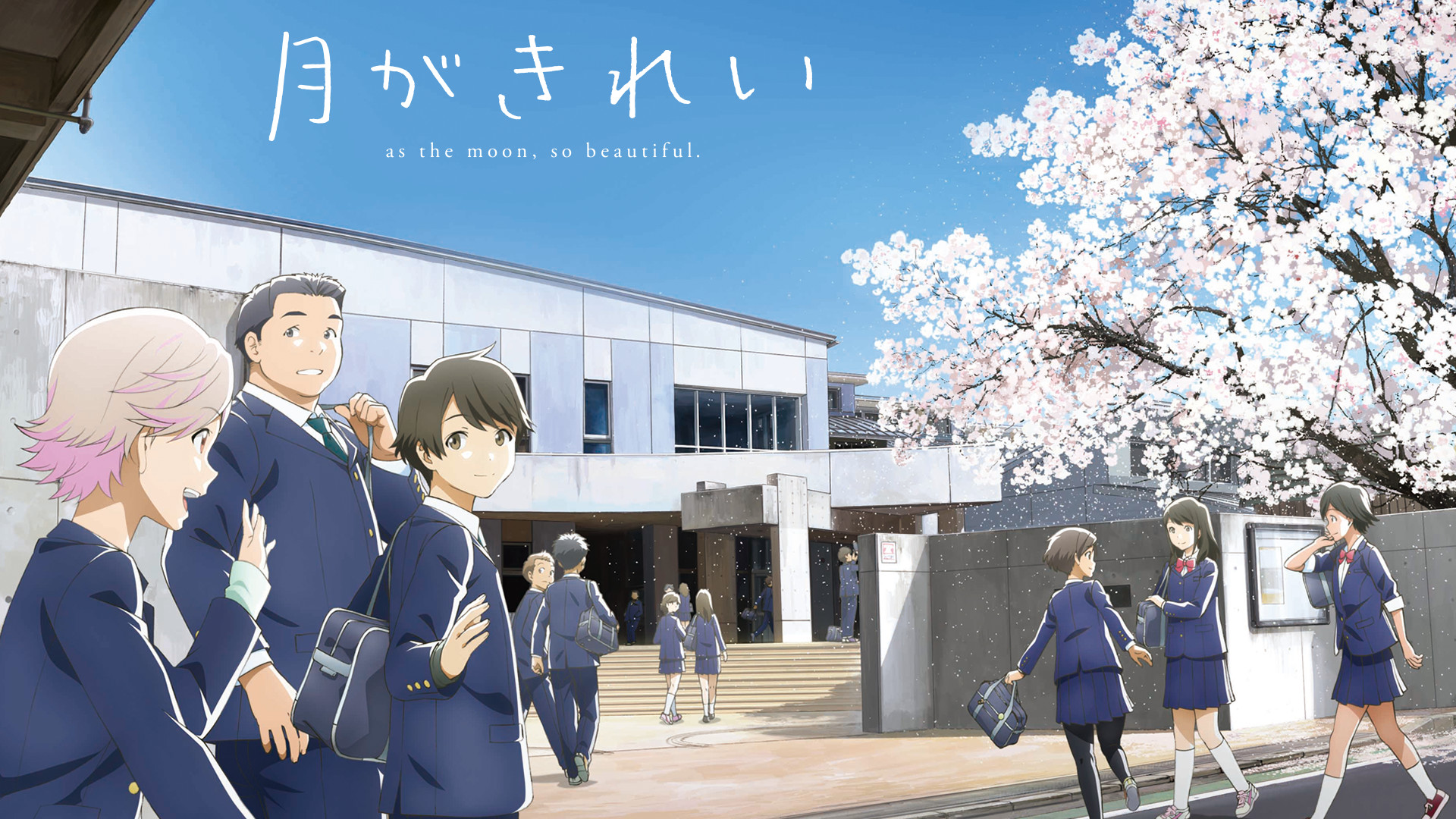
Tsuki ga Kirei" is an original anime work that aired from April to July 2017 with a total of 12 episodes (a recap of the first half was aired between episodes 6 and 7 as episode 6.5). It was produced by feel. Set in Kawagoe City, Saitama Prefecture, it depicts a realistic human drama centering on the love story of the main character, Kotaro Azumi, a junior high school student, and his classmate, Akane Mizuno.
Realistic adolescent feelings
Another highlight of this work is the careful and sensitive depiction of the adolescent mind.
For example, at the beginning of the story.
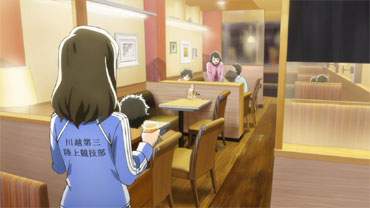
For example, at the beginning of the story, when Kotaro and Akane go out to eat at a family restaurant with their families and happen to see each other, their expressions and attitudes are depicted as very shy and awkward.
Being close to one's family should be a wonderful thing, but somehow, it is embarrassing to let it be known. The feeling of being embarrassed to let people know what kind of person one's family is is a feeling that is unique to adolescence.
Source: image.hackadoll.com
At the family restaurant, Akane's mother greets Kotaro's family.
From an adult's point of view, she may mean to say hello to her classmate's parents, but this, too, is something embarrassing from a child's point of view.
Also in the latter half of the story, Kotaro is in an awkward situation with his mother over his future career. When Kotaro and his mother get into an awkward relationship over his career path, he stubbornly refuses to eat the onigiri she offers him.
However, when his stomach rumbles with hunger, he reaches out his hand and takes a bite of the onigiri, and later eats it enthusiastically. This scene depicts the rebelliousness of an adolescent against his parents and his mental infancy, which cannot be sustained for long.
These subtleties of the adolescent's mind are also depicted for those who are now the same age as Kotaro and Akane, as well as for those who were once the same age as Kotaro and Akane. It is a feeling that makes you want to say, "Oh, I know that feeling!
It is precisely because this film depicts not only a pure love story, but also emotions that everyone has experienced at least once or twice, that it has gained the support of many people.
Akane and Shinzaki's friendship with other girls
While a pure love story is depicted, the friendship scenes among the girls surrounding Akane are also very realistically depicted and were highly supported by the viewers.
Akane is accompanied by Shinzaki, Setsuko, and Miu in class.
For example, when one of them says she has to go to the restroom, the others all go with her. They go to the restroom as a group even though they have no need to go.
They never break their stance that they go everywhere together, not just to the restroom.
Or, they try to get some kind of personal information from you by saying, "We're friends, aren't we?
And while saying "We're friends, aren't we?" and "We're friends, aren't we?" they laugh at their friend's mistakes when he or she is not around to see them.
Amidst the sweet and sour pure love between Kotaro and Akane. The sometimes sharp and piercing depiction of these raw female friendships is also a highlight of this work.
Incidentally, Akane is working with Shinsaki, Setsuko, and Miu on the day the class announcement was made.
When Akane nervously stepped into the class, she was approached by Shinsaki, Setsuko, and Miu, who were already in the group.
It seems that Shinsaki and Akane had a known relationship, which led to Akane joining Shinsaki and her group.
Akane is sensitive to the atmosphere around her and sometimes swallows her own feelings so as not to disturb it.
On the other hand, Shinzaki, Setsuko, and Miu are strong-willed and often say things like, "We are friends, aren't we?
In the story, Akane is so concerned about the way Shinzaki and the others look at her and their words (e.g., when Akane tries to leave the place, they constantly ask her why) that she is unable to see Kotaro and is restricted in her activities, making the viewer wonder if she and Shinzaki are really "friends" or not. The way the story is portrayed makes the viewer wonder if Akane and Shinzaki are really "friends".
During adolescence, being alone in class is unbearable.
Akane may have felt a sense of relief that she did not have to be alone because of the presence of Shinzaki and the others who called out to her. Perhaps it was because she did not want to be alone that she continued to stay with them.
In this light, the relationship between Akane and Shinzaki and her friends seems to depict a complicated friendship pattern that is peculiar to adolescence and is common among girls, and it is very impressive.
Famous quotes and lines from the work
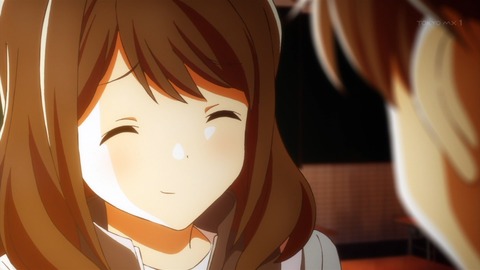
I've learned that it's a big lie that people aren't influenced by others."
Source: livedoor.blogimg.jp
An experimental report. One can neither influence nor be influenced by others."
These words appear in Osamu Dazai's essay, "Mono o Kangaeru Ashi" ("A Reed That Thinks").
Believing in these words, Kotaro did not allow others to read his novels, perhaps because he was ashamed to show his novels to others.
However, Kotaro's thoughts were completely changed by Akane's presence.
The sight of Akane gallantly running across the field.
The image of Akane smiling shyly, saying that she was nervous and did not like to be seen by others, and that is why she made mistakes so easily.
Even so, the image of Akane saying that she loves to run, and her words.
Akane who shyly but firmly talked about her weaknesses (being nervous, not good at being seen, and failing easily).
Kotaro's heart was strongly shaken by this, and some feelings must have developed in his heart.
As a result, Kotaro spoke these lines.
After this, Kotaro decided to submit his novel to a publishing company and asked Daisuke to read his novel for advice.
This line makes us realize that people can be influenced by others and take a new step forward from there.
Can I confess? I want to give it up.
Episode 6. Chinatsu's line to Akane.
At this point, Chinatsu is told by Akane that Kotaro, whom she has feelings for, is dating Akane.
Nevertheless, the fact that she says such a line to Akane shows Chinatsu's character of not being timid, in both good and bad ways, and of being too straightforward about her own feelings.
On the other hand, from Chinatsu's point of view, she cannot give up completely without telling him how she feels. Kotaro and Akane are dating. However, we can assume that she has a straw-like feeling in her heart that maybe, just maybe, there is still a little hope left, and that is why she does not know until she confesses her feelings.
Given this, we can understand Chinatsu's sadness as she uttered these words.
May we be together forever."

Source: renote.net
In episode 8, Kotaro and Akane go to a wind-bell festival and write their wishes on strips of paper to hang on the wind-bells.
However, they did not know what kind of wishes they wrote on the tanzaku, because they were embarrassed to tell each other.
However, Kotaro and Akane's wishes were revealed to the viewers by showing the strips of paper.
The wish was "May we be together forever.
The purity of the wish inevitably made viewers wince, but the fact that Kotaro and Akane had both written the exact same wish, but neither of them knew about it, was also very heartbreakingly well-directed.
'I thought it was a miracle that someone I love would like me.'
Akane received Kotaro's love in the form of a novel on the train.
Kotaro then shouted all his heart out to Akane, who was on her way to a distant city.
After that, he told Kotaro how he was troubled and hurt by his first love and how he still wanted to be with her. Kotaro and Akane's words tell the story of how they still wanted to be together.
This line is the last line before the ending of the story.
This line, spoken by Kotaro in the first half and by Akane in the second half, is also the last line of the film.
The two meet, are bewildered by their first romance, suffer, and get hurt a lot, and yet create glorious memories together.
In the end, they fulfill their wish "May we always be together," which they wrote on a strip of paper at the Fu-ring Festival.
Backstory, trivia, and small stories/episodes and anecdotes about "The Moon is Beautiful".
Episodes and anecdotes related to the phrase "the moon is beautiful
There is an anecdote about the title of this film, "Tsuki ga kirei" (The moon is beautiful).
When Natsume Soseki, one of Japan's greatest writers, was an English teacher, one of his students translated "I Love You" as "I love you.
Soseki told him that Japanese people do not say such words and that he should translate it as "The moon is beautiful.
However, since the only sources that can be found to prove this are postwar sources, there is a theory that this is an anecdote invented by a later generation.
However, based on this anecdote, the phrase "The moon is beautiful" has often appeared in novels and other creative works as a substitute for lines expressing love.
The title "Tsuki ga kirei" (The moon is beautiful) may have been chosen for this work as well, based on this anecdote.
Incidentally, there is a website "Tsuki ga Kirei desu" Verification that continues to independently verify this, so those who want to know more details may access that site.
The moon is beautiful." Verification.
niguruta.web.fc2.com
Theme song for "Tsuki ga Kirei" (The Moon is Beautiful)
Opening: "Imakoko" / Nao Higashiyama

Contents
- Outline of "The Moon is Beautiful
- Characters and characters in "The Moon is Beautiful
- Kotaro Azumi (CV: Shoya Chiba)
- Akane Mizuno (CV: Yoshimi Obara)
- Chinatsu Nishio (CV: Rie Murakawa)
- Takumi Hira (CV: Atsushi Tamaru)
- Yamashina Romain (CV: Eishin Fushimura)
- Daichi Ogasawara (CV: Makoto Kaneko)
- Takizawa Aoi (CV: Haruka Shiraishi)
- Aira Miyamoto (CV: Mainaka Ishimi)
- Setsuko Sato (Setsuko Sato/CV: Misono Suzuki)
- Miu Imazu (CV: Haruka Chisuge)
- Ryoko Sonoda (CV: Nao Higashiyama)
- Daisuke Tachibana / CV: Mutsuki Iwanaka
- Synopsis and story of "The Moon is Beautiful
- Highlights of the film
- A love story between Kotaro and Akane that is too pure
- Unfulfilled love - Chika and Takumi's existence
- Realistic adolescent feelings
- Akane and Shinzaki's friendship with other girls
- Famous quotes and lines from the work
- I've learned that it's a big lie that people aren't influenced by others."
- Can I confess? I want to give it up.
- May we be together forever."
- 'I thought it was a miracle that someone I love would like me.'
- Backstory, trivia, and small stories/episodes and anecdotes about "The Moon is Beautiful".
- Episodes and anecdotes related to the phrase "the moon is beautiful
- Theme song for "Tsuki ga Kirei" (The Moon is Beautiful)
- Opening: "Imakoko" / Nao Higashiyama
- Ending: "Tsuki ga kirei" / Nao Higashiyama
- About the song inserted in the play