
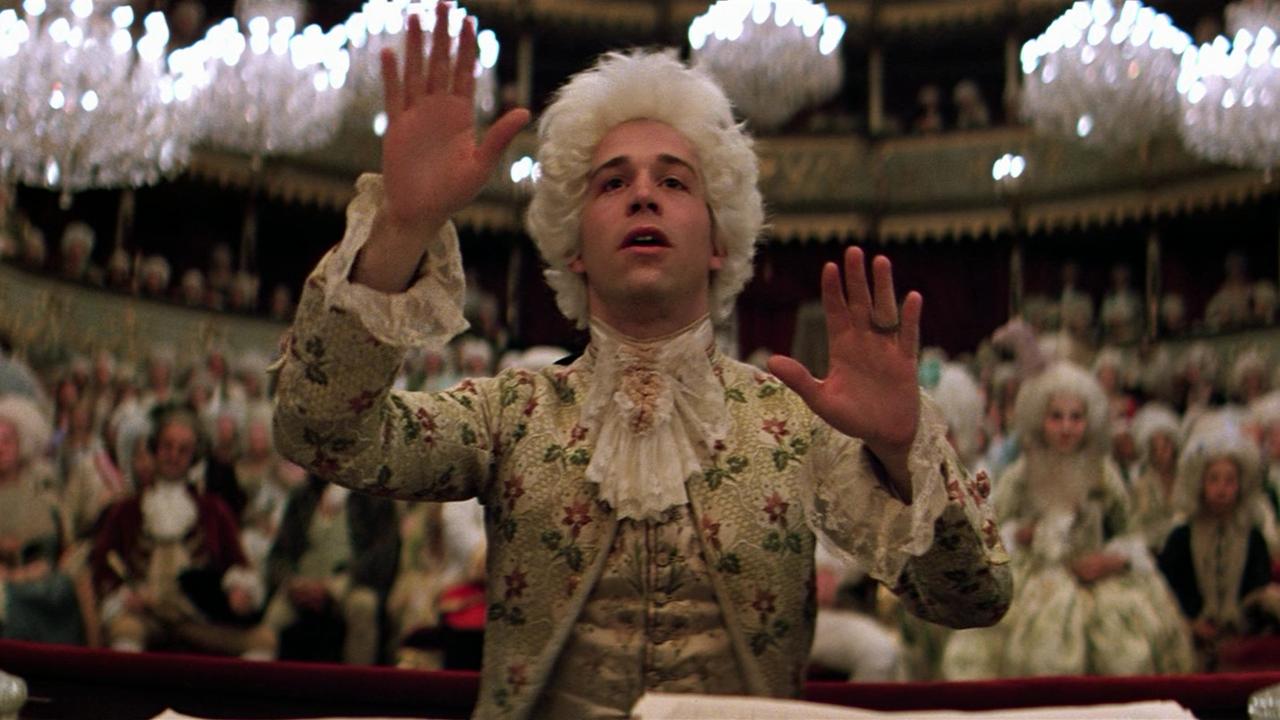
The film "Amadeus" is an adaptation of Peter Schaeffer's play of the same name, produced in the U.S. in 1984 by director Milos Forman. This topical film depicts the life of Mozart, a musical genius who died young, through his confrontation with the court composer Salieri. The film won eight Academy Awards.
An elderly man attempts suicide and is taken to a mental hospital, where he soon begins to tell the story of the life of a genius who changed everything in his life.
Overview of "Amadeus
The film "Amadeus" is a 1984 American film depicting the life of Wolfgang Amadeus Mozart through his confrontation with Antonio Salieri.
Peter Schaeffer adapted his play of the same name into a screenplay, and the film was made by the duo behind "On the Cuckoo's Nest," produced by Saul Zainz and directed by Milos Forman.
The film won eight Academy Awards, including Best Picture, Best Director, Best Actor, Best Adapted Screenplay, Best Art Direction, Best Costume Design, Best Makeup, and Best Sound. Tom Hulce, who played Mozart, was nominated for an Academy Award for Best Actor, and F. Murry Abraham, who played Salieri, won an Academy Award for Best Actor.
The film features many highlights not found in the Broadway stage version, such as the insertion of highlight scenes from the operas "Abduction from the Hind Palace," "The Marriage of Figaro," "Don Giovanni," and "The Magic Flute. In the film, the operas "Abduction from the Hermitage" and "The Magic Flute," originally written in German, were sung with English lyrics translated by Peter Schaeffer, who also wrote the script.
The opera scenes were filmed at the "Stavovsky Theater" in Prague, the Czech capital, where Mozart himself conducted the first performance of "Don Giovanni". Most of the outdoor locations were shot in Prague, where the old townscape from the Middle Ages still exists, and many of Prague's historical buildings were also used for indoor filming.
The film was released in Japan in February 1985, and in 2002, a "director's cut" version was released with a 20-minute cut scene restored and digital sound.
Synopsis and story of "Amadeus"
Mozart! Forgive me for killing you!"
One winter night, an old man was brought to a mental hospital after killing himself by cutting his throat with a razor.
The old man's name was Antonio Salieri, a former court musician. Later, when his condition stabilized, Salieri began to tell the priest who came to talk to him about his past with the musical genius Mozart.
Salieri was jealous of his own circumstances that prevented him from pursuing a career in music due to his father's opposition, and envied Mozart, who had played the piano in front of the emperor and the pope since he was a child. Then came a turning point for Salieri. When his father passed away, he was able to go to Vienna, the capital of music. Within a few years, he was recognized by the music-loving Emperor Joseph II of Austria and appointed court composer.
One day, Salieri attended a concert given by Mozart at the residence of the Archbishop of Salzburg. At the time, he did not even know what Mozart looked like, but there he saw a young man chasing a woman around with a strange laugh. When Salieri discovers that it is Mozart, he is disappointed by the sheer vulgarity of the situation. However, when he later saw his performance and the score and was exposed to the splendor of his music, the gap between the two was so drastic that he was in disbelief.
Mozart was invited to the court of Vienna by Joseph II. Mozart was delighted to be asked to compose an opera in German to be performed at the National Theater. However, Mozart's pride was hurt when he improvised a march that Salieri had written to welcome him in front of the emperor. Although Salieri's pride is hurt, he shows his dignity as an adult in the moment. However, he is jealous of God, who has given Mozart a unique talent, not to him, and decides to take revenge on God.
Mozart's opera is a great success. There the emperor is introduced to his fiancée Konstanze by Mozart, who tells him to marry her quickly and move to Vienna. Soon after, Mozart and Konstanze were married and went to live in Vienna without asking for permission from Mozart's father, Leopold, who wanted to bring them back to Salzburg.
After their marriage, Mozart continues to spend money wildly, and Konstanze begins to have trouble making ends meet. Mozart did not want to be judged by an Italian who was not as talented as he was. Konstanze took the score to Salieri without her husband's knowledge and asked him to review it. When Salieri saw the score, which was all original, he was astonished to see that there was no rewrite at all and the music was completed in his mind before he wrote it, and at the same time, he hated God more and more and determined to destroy Mozart.
One day, Leopold suddenly arrives at Mozart's house in Vienna. He is surprised to find the house in disarray, and when he learns that Constanze, whom he has never met before, is pregnant, Mozart, who has become ill at ease, forcefully invites Leopold to a bar.
Then, a young woman comes to Mozart's house. The woman says she has been hired by someone to be a maid in the house. Leopold refuses to let a stranger into his house, and Constanze is happy to be saved by not needing to be paid.
Salieri finds out from Laure when they will be away and, with her help, enters Mozart's house, where he finds a piece of music in his workroom that he is writing. It was an opera of the French play "The Marriage of Figaro," which the emperor had banned.
When the emperor learns from Salieri about "The Marriage of Figaro," he summons Mozart to the court and asks him to explain why he is writing an opera that is banned by the emperor.
Mozart then begins rehearsals. However, Salieri ordered the theater director to rewrite the score, saying, "The Emperor's wishes forbid the performance of operas with ballets. Mozart, unaware of Salieri's order, asked Salieri for help. Salieri told him that he would discuss the matter with the emperor, but he had no intention of doing so. But a few moments later, the emperor suddenly showed up at a rehearsal he had never been to. When he saw the soundless dance, he was furious. he said angrily. Mozart was overjoyed, and he thought that Salieri had spoken for him, and he began to respect him.
The Marriage of Figaro" was cancelled after nine performances. Mozart was not satisfied and asked Salieri why. Salieri replied that the Emperor could not endure a four-hour opera and that the audience would not be pleased if the ending was not exciting. But Salieri felt that his opera was wonderful. And now he tells Mozart that he wants him to see his new opera.
Salieri's new opera was praised by the emperor as "the best opera ever written" and the audience was also very impressed. Mozart, who had come to see the opera, also praised him.
One day, Mozart received the news that his father, Leopold, had died. Mozart put his sorrow and repentance for his father into an opera, "Don Giovanni", and performed it. However, it was not well received by the audience, and the production was cancelled after five performances. However, only Salieri, who also felt his immeasurable talent in this opera, was able to further his desire for vengeance.
From then on, Mozart lived a life of worklessness and drinking. One night, there was a knock at the door of Mozart's house and a mysterious man came to visit. The man was wearing a mask and cloak that Leopold had once worn. The man asked Mozart to compose a requiem for a large sum of money, but Mozart thought that his dead father's anger appeared in his appearance as the "Grim Reaper". The man was actually Salieri, who wanted to play the requiem at Mozart's own funeral.
At the same time, Mozart was asked by a friend to work on a popular opera, but Konstanze was uncomfortable with the low income from a popular opera and was not keen on it. She encouraged Mozart to compose a requiem, but he gave priority to composing a popular opera. Konstanze is fed up with Mozart and takes her child to a spa.
Mozart was completely sick from drinking, but he completed a popular opera, "The Magic Flute". However, he collapsed during the performance. Salieri, who had come to see the performance, carried Mozart to his room and took care of him. Then there is a knock at the door. Mozart thought it was the Grim Reaper and asked Salieri to send him away with more money. But Salieri claims the money as an additional reward for the Grim Reaper and says, "A messenger in black has just arrived, and I must complete the requiem by the next morning. If you complete the requiem by the next morning, he will pay you more money.
Unable to get up, Mozart asked Salieri to dictate the requiem. Salieri frantically transcribes Mozart's requiem. He is unable to keep up with the speed and suddenness of the musical ideas, even though he has the talent of a common man. But Mozart's inspiration eventually reaches Salieri, and Salieri, as if possessed, transcribes the Requiem.
At dawn, Mozart tells Salieri, "Let's take some rest. I'm still all right," Salieri says, "I can help. I can help you," Salieri tells Mozart. I thought you hated me. Please forgive me. Soon after, Constanze, who had been to the spa, came home. When he saw his master's face lying on the bed, looking dead, he tried to get him to stop composing the requiem and to send Salieri out of the room. However, Salieri tries to respect Mozart's wishes. Constanze tearfully apologizes to Mozart for being a bad wife, but Mozart has already run out of steam.
In the rain of sorrow, the funeral is held with only a few people, including Konstanze, Salieri, and Laure, seeing him off. When the carriage carrying Mozart's body arrives at a suburban cemetery, the body is thrown into the grave as if it were garbage.
After his long confession, Salieri tells the priest, "You are like me. You are like me. You are just like me, an ordinary man.
As he is carried down the corridors of the asylum, Salieri's monologue continues. I am the king of the mediocre. I forgive you, all the mediocre people of the world.
Salieri's figure was accompanied by the strange, high-pitched laughter of Mozart.
Main characters
Antonio Salieri (played by F. Marley Abraham)


Growing up in a country town, he admired Mozart, who played the piano in front of the emperor and the pope from an early age.
He envied his father, who did not understand music and did not allow him to pursue a career in music, even though he had a dream of becoming a musician.
After his father died, he was recognized by Emperor Joseph II of Austria in Vienna, the capital of music, and appointed court composer.
A Christian since childhood, he respected God, but after meeting Mozart, he became jealous that God had not given him any talent, but had given the peerless talent to Mozart, who was extremely vulgar. He swore revenge against God and at the same time, he drove Mozart into a mental corner and eventually drove him to death.
Wolfgang Amadeus Mozart (performed by Tom Hals)

He lived in Salzburg, Austria, where his father Leopold took him to play the piano in front of the emperor and the pope from an early age, and he was highly regarded for his talent as a child prodigy.
As he grew up, his musical talent remained intact, but he became playful, selfish, a drinker and a womanizer, and had a strange, vulgar, high-pitched laugh.
However, he had absolute confidence in his work, and when his superiors asked him to make corrections, he would question them until he was satisfied.
His enthusiasm won him the favor of the Austrian emperor, and he went on to write a series of operas in Vienna.
In Vienna, he married Constanze, the daughter of the landlady of a boarding house, and became the father of a child.
After his father's death, he is haunted by the ghost of his father, and eventually falls ill with alcohol and drugs, and dies at the young age of 35.
Konstanze Mozart (Played by Elizabeth Berridge)

Daughter of the landlady of the boarding house where Mozart lives in Vienna.
She married Mozart and became a mother of one child.
Her husband's extravagant spending habits make her life increasingly difficult, and she goes to Salieri without her husband's permission to ask for a review of her music scores, which he refuses to accept due to his court duties.
Unlike her childlike appearance, she has a fierce temperament, including a head-on confrontation with Mozart's father over a maid.
She is proud of her husband's works and resents the humiliating treatment of them.
Emperor Joseph II (played by Geoffrey Jones)

Emperor of Austria and Holy Roman Emperor.
He was the elder brother of Marie Antoinette, who later became Queen of France.
He was also active in cultural development, especially in the field of music, and hired Mozart as a court musician with an awareness of German music.
He was an influential figure in the subsequent reform movement in Austria as "Josephist thought.
Leopold Mozart (Played by Roy Dotrice)

Mozart's biological father.
Although born in Germany, he became a chamber composer at the court of Salzburg, Austria. He was also a music theorist.
He discovered and nurtured his son Mozart's talent, gave him the best musical education the world could conceive at the time, and developed him into a composer unparalleled in history.
He died in Salzburg, Austria.
Rolle (played by Cynthia Nixon)

Contents
- Overview of "Amadeus
- Synopsis and story of "Amadeus"
- Main characters
- Antonio Salieri (played by F. Marley Abraham)
- Wolfgang Amadeus Mozart (performed by Tom Hals)
- Konstanze Mozart (Played by Elizabeth Berridge)
- Emperor Joseph II (played by Geoffrey Jones)
- Leopold Mozart (Played by Roy Dotrice)
- Rolle (played by Cynthia Nixon)
- Famous Scenes & Highlights from "Amadeus"
- The emperor's chief advisors are Mozart's enemies.
- Mozart's acrobatic piano playing
- Opera "Don Giovanni" with penance for his father
- Backstories, trivia, and small stories/episodes and anecdotes from "Amadeus"
- Tom Hulce as Mozart
- F. Marley Abraham was not originally cast as Salieri.
- The hit song "Rock Me Amadeus" was born from this film.
- Music used at the beginning
- Mozart: Symphony No. 25 in G minor, K.183, 1stmovt.