
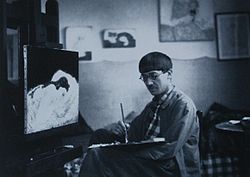
The movie "FOUJITA" starring Odagiri Joe is scheduled for release in November 2015. The "FOUJITA" depicted in the film is a Japanese painter whose real name was Tsuguharu Fujita, who later changed his name to Leonard Fujita. The film follows the life and works of FOUJITA, whose distinctive appearance and unique style of painting created a sensation in Paris.
Do you know the painter "Fujita Tsuguharu"?
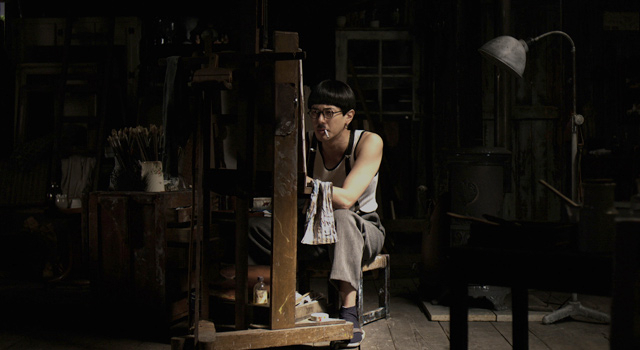
This image is a scene from "FOUJITA," which will be screened in the fall of 2015.
This man with the "big head," played by Odagiri Joe, is Tsuguharu Fujita.
He moved to Paris in 1913 and became the darling of the Paris art world in the 1920s when his paintings of nude women were highly acclaimed.
Tsuguharu Fujita (November 27, 1886 - January 29, 1968) was a Japanese-born painter and sculptor. Active in Paris before World War II, he was a representative painter of the Ecole de Paris, where his paintings of cats and women were his specialty, and his unique "milky skin" nudes, while incorporating Japanese painting techniques into his oil paintings, were highly acclaimed by the Western art world. After becoming a naturalized French citizen, his baptismal name was Léonard Foujita.
Source: ja.wikipedia.org
Ecole de Paris" is the collective name for a group of painters who gathered in Montmartre and Montparnasse in Paris in the first half of the 20th century from all over the world to lead a bohemian lifestyle.
Among them were Henri Rousseau, Maurice Utrillo, Modigliani, Marie Laurencin, Marc Chagall, and many others.
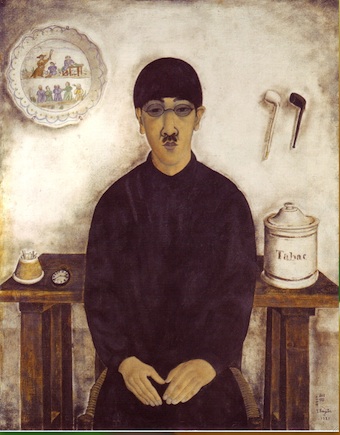
With his distinctive appearance and eccentricities, often referred to by his fellow painters as "fufu," Fujita tends to be highlighted as eccentric, but in fact, it is known that he was working hard to create new painting techniques in hidden places.
Milky white skin" expression that no other painter can imitate.
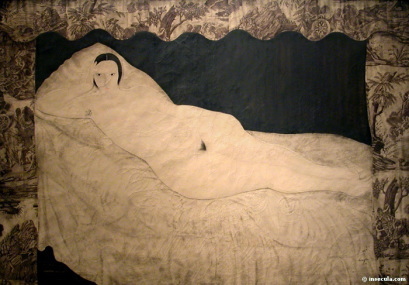
This painting with Fujita's unique expression of translucent, milky white skin is "Kiki the Nude in the Bedroom," painted in 1922.
The model is Kiki, the mistress of Man Ray, also known as the "Queen of Montparnasse," and the composition of this painting is similar to Manet's nude "Olympia.
It seems to me that Kiki's work represents her spirit of challenge as an Oriental to the Western masterpieces.
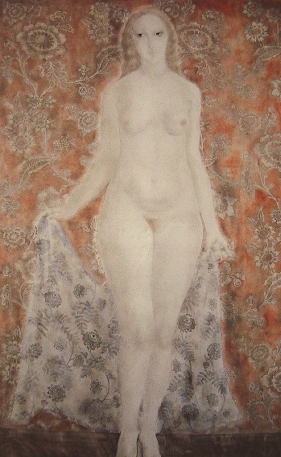
Likewise, the beautiful skin tones of the "Nude" from 1923 attract the viewer's eye.
It is a graceful work in a style that seems to have been created using Japanese painting techniques.
It is thought to have been an astonishing technique in the Paris art world of the time.
In 1925, he was awarded the Legion of Honor by France and the Order of Leopold by Belgium.
Source: ja.wikipedia.org
In his personal life, divorced four times, married for the fifth time and finally found a lifelong companion.
Shortly before moving to Paris, Fujita married a Japanese woman for the first time.
However, it fell apart after only a little over a year, and in 1917, he married a second time to Fernand, a French model.
His third marriage was to a French woman, Lucie, who eventually became Fujita's official mistress.
After the breakup of that marriage, Fujita traveled to the United States to hold a solo exhibition and was accompanied by his new mistress, Madeleine.
After returning to Japan in 1935, Fujita met a Japanese woman named Kimiyo and married her for the fifth time.
This marriage was to be his last, and Kimiyo remained with him until his death at the age of 81.
Work as a military painter
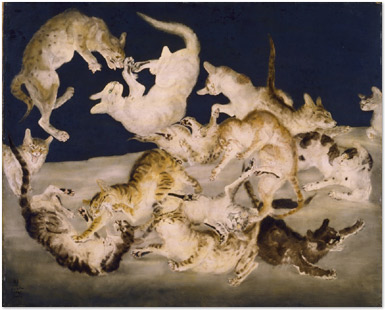
From 1938, Fujita went to China as a military painter. He returned to Paris, but World War II broke out soon after.
Upon his return to Japan, Fujita became president of the Army Art Association and painted "war paintings.
This is his 1940 work, "Cat (Conflict).
It has a dynamism and dynamism that is completely different from his previous style of painting. While borrowing the figure of a cat, the work expresses the anxiety and various emotions about the looming war within it.
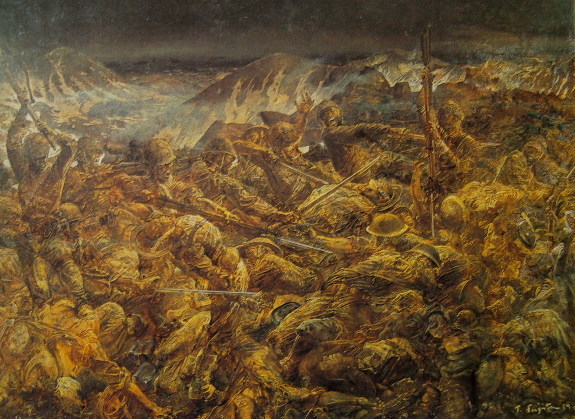
And this is the masterpiece of war painting, "The Crushing of Atz Island" (1943).
The painting was criticized after the war for "glorifying war" and "inspiring war," but in fact, the painting conveys no such "glorification of war" image at all.
It is said that many people shed tears, clasped hands, and prayed in front of this painting.
Fujita himself described this work, in which he painstakingly depicted the many nameless young men and women who died in battle, as "a work of the greatest conversion.
From his return to Paris after the war to his death
In 1949, after the defeat in the war, he left Japan because he was fed up with criticism of his cooperation in the war. He was also chased out of Japan by GHQ at one point after the war, and was sheltered by a miso brewer in Chiba Prefecture.
When a heartbroken Fujita returned to France, many of his close friends had already left the world or gone into exile, and he was called a "ghost" by the mass media. It was against this backdrop that he reunited with Picasso, with whom he remained friends until his later years.
In 1955, he became a French citizen (later he lost his Japanese citizenship), and in 1957, the French government awarded him the Chevalier de la Legion d'Honneur, and in 1959, he was baptized as a Catholic and became Leonard Fujita.
He died of cancer in Zurich, Switzerland, on January 29, 1968. His body was buried in Villiers-le-Bacle (French version), a suburb of Paris. The Japanese government conferred the Order of the Sacred Treasure, 1st class, on him after his death.
Source: ja.wikipedia.org
Finally.
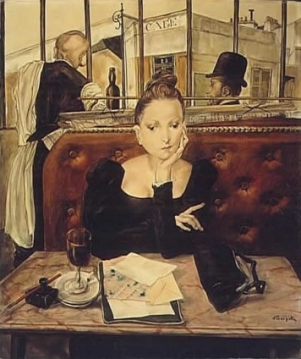
There is a work of art that I personally like very much.
It is this painting titled "At a Cafe.
It is a scene of a café where a white-skinned woman in a black dress is kissing her cheeks.
The colors are very European and make me want to keep looking at it.
Tsuguharu Fujita led a checkered life, and with the release of the movie, I expect that his work will be further appreciated in the future.

Contents
- Do you know the painter "Fujita Tsuguharu"?
- Milky white skin" expression that no other painter can imitate.
- In his personal life, divorced four times, married for the fifth time and finally found a lifelong companion.
- Work as a military painter
- From his return to Paris after the war to his death
- Finally.